A loud grind today can mean a costly failure tomorrow, but not every issue warrants a new door. You’ll weigh age, visible wear, and safety faults like broken springs or frayed cables. Compare repair bids to replacement ranges, and test auto‑reverse and balance. Consider insulation, seals, and opener upgrades to improve efficiency. If repairs approach half the price of a new door, or structural damage exists, you may pivot. The quick checks below can tilt the decision.
Key Takeaways
- Identify failure modes and safety risks; stop use if springs are broken, cables frayed, or sensors misaligned.
- Compare repair cost and downtime versus door age, duty cycle, and remaining service life.
- Verify parts availability, UL-compliant components, correct load ratings, and technician credentials and warranties.
- Assess visible wear, balance test results, and whether structural panels or tracks are damaged or obsolete.
- Consider energy, noise, and smart upgrades; if benefits and reliability gains exceed costs, repair or replace accordingly.
Is Garage Door Repair Worth It? Quick Decision Guide
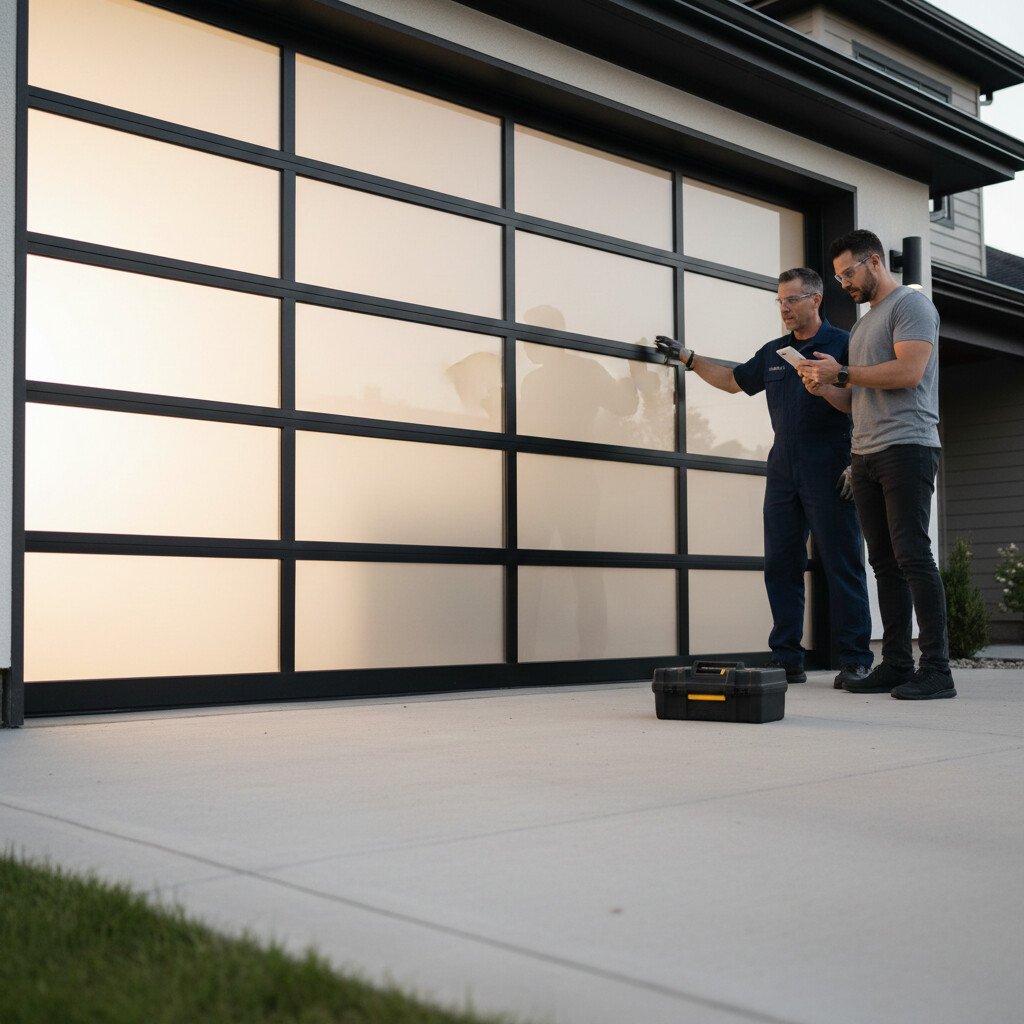
How quickly can you decide if a repair is worth it? Start by identifying the failure mode, door age, and duty cycle.
Prioritize life-safety: broken torsion springs, frayed cables, and misaligned sensors demand immediate professional service.
Compare repair types—spring replacement, roller swap, hinge reinforcement, opener logic board—by expected service life, parts availability, and downtime.
Verify UL-compliant components and load ratings match door weight.
Review technician credentials and repair warranties; prefer written parts-and-labor coverage with clear exclusions.
Check cycle counts, noise, balance, and track plumb.
If repeated failures indicate systemic wear or structural damage, pause and reassess the scope before authorizing work.
Garage Door Repair vs. Replacement Costs: Realistic Ranges
Once you’ve sized the repair scope and safety risks, price becomes the next filter. Expect common repairs to land in defined bands: rollers $60–$150, cables $90–$200, torsion springs $150–$350, openers (motor/board) $150–$400, track realignment $125–$250, panel swap $200–$700. Full door panel sets escalate quickly.
Your repair cost factors include part grade (standard vs. high-cycle), door size/weight, labor rates, emergency service, hardware compatibility, and code-compliant safety sensors.
Compare that to a replacement investment: steel single door installed $900–$1,800; insulated carriage/wood $1,800–$4,500; double doors add 40–80%. New opener installed $400–$900.
Prioritize reliability, warranty, and safe operation.
Tracks are a great example of where “repair” isn’t always the smart long-term move—especially if the rail is warped, cracked, or pulling out of framing. This guide on making the repair-or-replace decision for bent garage door tracks helps you judge safety, longevity, and total cost.
Check Age, Wear, and Safety Risks Before You Repair
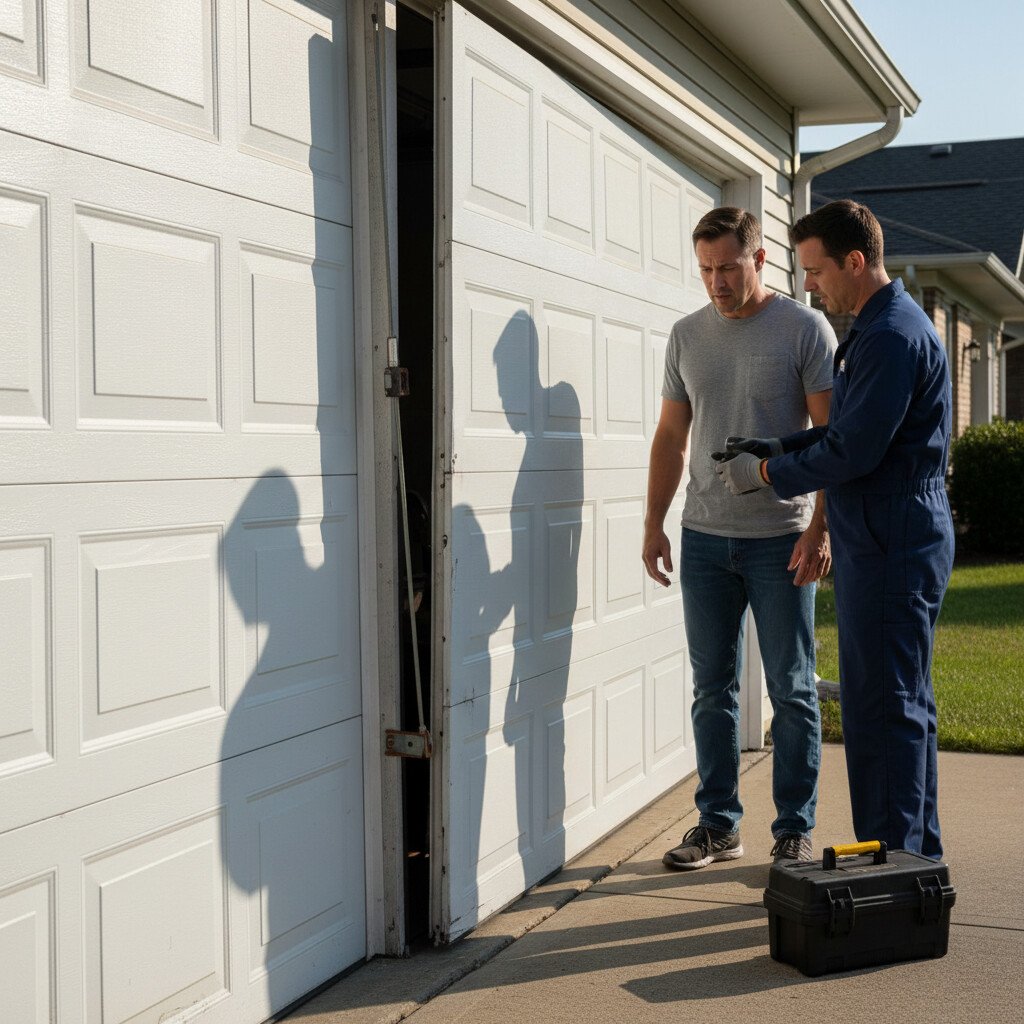
Before you touch a wrench, assess the door’s age, duty cycle, and visible wear to determine if repair is prudent or hazardous. Compare estimated door lifespan to actual years of service; frequent cycling accelerates fatigue.
Inspect panels, tracks, rollers, hinges, and fasteners for cracks, elongation, rust, or deformation. Check the spring balance and cable fray; if the balance fails, don’t operate.
Test safety features: photo-eyes align and stop-reverse reliably, force settings aren’t excessive, and manual release functions smoothly. Listen for grinding or binding, indicating misalignment.
If structural damage, obsolete parts, or compromised safety systems exist, prioritize professional evaluation over DIY repair.
Before you decide repair vs replace, it’s critical to judge how widespread the wear is—one worn hinge is simple, but multiple worn components can signal the system is deteriorating fast. Use this garage door wear assessment guide for smarter repair decisions to evaluate what’s fixable and what’s becoming a recurring problem.
Energy Efficiency and Smart Upgrades: When Garage Door Repairs Pay Off
When a repair decision hinges on efficiency, target upgrades that cut heat loss and add control without compromising safety.
Replace worn bottom seals, side weatherstripping, and threshold to stop infiltration. Specify insulated panels with higher R-values and sandwich construction to reduce thermal bridging and improve energy savings.
Tune or replace misaligned tracks and rollers to reduce motor load. Install DC openers with soft start/stop, battery backup, and automatic reversal tests.
Add smart technology carefully: secure Wi‑Fi openers, encrypted remotes, and activity logs. Use geofencing and scheduling to minimize open time.
Confirm photo-eyes, force settings, and manual release function after any upgrade
Garage Door Repair and Resale: Value Boosts and Replacement Triggers
Although curb appeal drives first impressions, buyers and appraisers value garage doors for condition, operation, and safety.
You boost resale value by correcting noisy rollers, misaligned tracks, frayed cables, and weak springs. Replace hinges, weather seals, and sensors to pass inspections and reduce liability.
If the panel is cracked, the opener lacks photo-eyes, or the door fails balance tests, replacement is smarter than repair.
- Fresh, quiet door cycling smoothly at sunrise
- Clean lines, new seals, rain beading off panels
- Safety sensors blinking steadily, door reversing crisply
- Insulated steel reflecting porch light, no rust
When evaluating long-term value, scheduling a thorough inspection with trusted door repair services helps determine the best financial choice.
Conclusion
Bottom line: weigh age, condition, and failure mode first. Fix safety hazards (springs, cables, opener sensors) immediately. Price the repair against a replacement, if it’s over 50% of a new door, pivot to replacement. Inspect panels, tracks, rollers, and test auto‑reverse. Consider insulation (R‑value), sealing, and smart controls; these can cut noise, energy loss, and boost resale. When the door’s near the end of its life, don’t pour water into a leaky bucket; upgrade and restore safety, reliability, and efficiency.