You weigh door type, you weigh materials, you weigh installation complexity—because each pushes price up or down. Most standard installs run about $900–$3,000, while custom or oversized setups can top $6,000. Labor, opener integration, and old door haul-away add more. Regional rates and access constraints shift totals further. Insulation and upkeep affect lifetime cost, not just day one. Want a clearer number for your garage and not a national average?
Key Takeaways
- Typical installed costs range from $900–$1,800 for single doors and $1,400–$3,000 for double doors; custom setups run $2,500–$6,000+.
- Material affects price: steel $600–$2,000, aluminum $700–$2,500, composite $1,200–$3,500, wood $1,200–$4,000+ (custom $3,500–$8,000).
- Insulation adds $150–$1,200: polystyrene (R-6 to R-9) and polyurethane (R-12 to R-18+) improve efficiency and comfort.
- Labor, permits, and complexity add $200–$1,200 for installation, plus $0–$250 permits and $75–$200 old door removal.
- Opener and hardware extras: openers $150–$800, smart features $50–$200, hardware/safety components $200–$600 total.
If you want a deeper breakdown beyond averages, review garage door installation cost factors that change the final price.
Average Price Ranges by Door Type
Typical prices: single-layer steel $400–$900, insulated steel $700–$1,800, aluminium $800–$2,000, composite/faux wood $1,200–$3,500, real wood $1,500–$4,500, glass/frameless $2,000–$5,500, custom carriage-style $2,500–$7,500+.
Prices vary by style, size, and installation. Insulated steel offers quiet, efficient value. Aluminium suits coastal areas but dents easily. Composite mimics wood without high upkeep. Glass/frameless boosts curb appeal but raises hardware costs. Carriage-style doors increase labour for heavier panels and upgraded tracks.
Since price ranges depend heavily on style and build, comparing the best garage door options for your home can explain why costs differ by door type.
Key Factors That Influence Cost
While the door model sets the baseline, several variables swing your final bill. You’ll see costs rise or fall based on labor hours, parts, and site conditions. Focus on what installers measure and price.
- Installation complexity: Framing repairs, reframing a crooked opening, or low headroom tracks can add 2–6 labor hours, often $150–$600 more.
- Opener integration: Adding or upgrading a smart opener, new rail, and safety sensors typically adds $250–$600, plus wiring if none exists.
- Removal costs: Hauling away an old door, tracks, and spring system runs $75–$200; disposal fees vary by market.
- Spring and hardware: Torsion springs, high‑cycle upgrades, and reinforced struts add $120–$400.
- Site access and location: Tight driveways, stairs, or urban permits add time and fees; expect 10%–20% premium in high-cost metros.
Door Sizes and Configuration Options
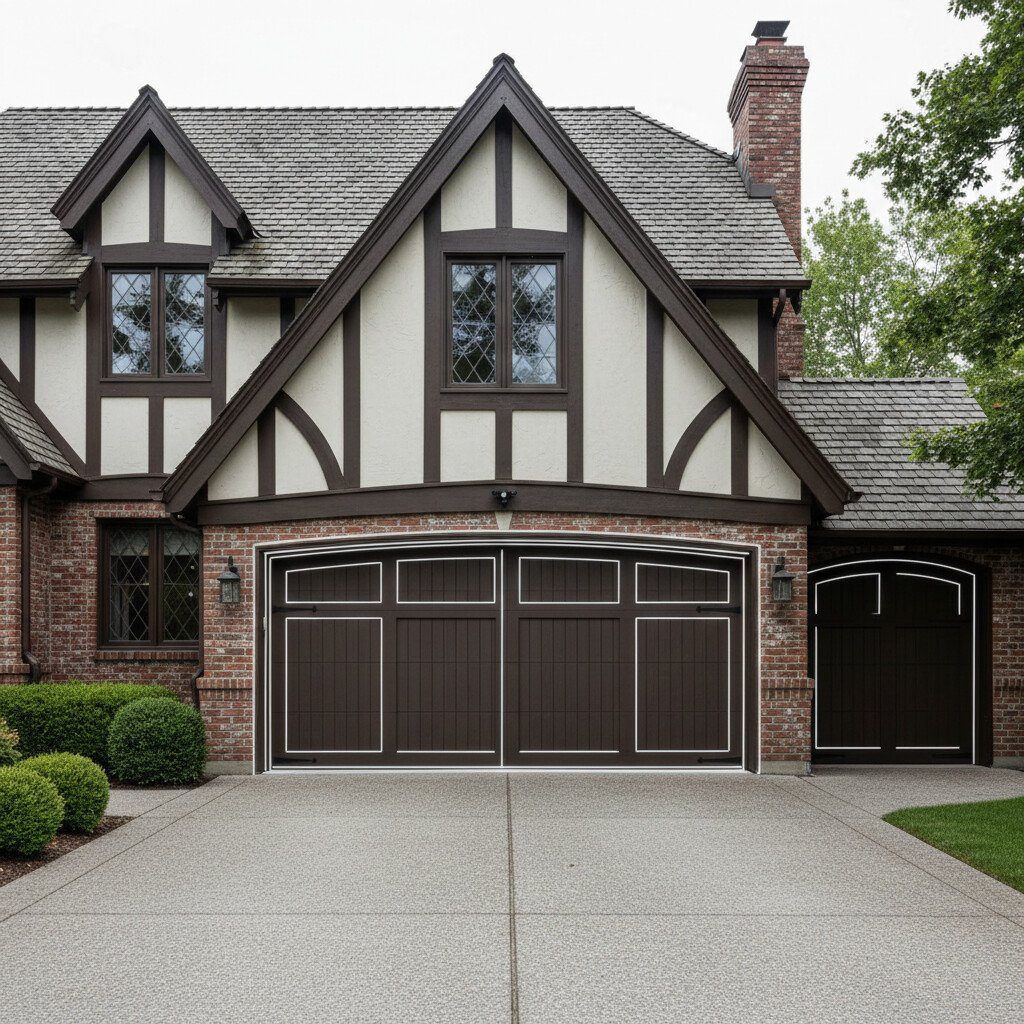
Those variables matter even more once you pick a door size and layout. You’ll choose between standard door sizes and custom configurations that change labor, hardware, and opener specs. Typical single doors run 8–9 ft wide by 7 ft high; doubles run 16×7 ft. Wider or taller doors need heavier tracks, stronger springs, and larger openers, increasing cost 10–25%. Multi-bay or tandem layouts add framing and sealing work.
| Choice | Feeling | Budget Signal |
|---|---|---|
| 8×7 single | Relief | Lowest |
| 16×7 double | Confidence | Mid |
| Oversize/custom | Pride | Highest |
Expect rough installed ranges:
- Single, standard door sizes: $900–$1,800
- Double, standard: $1,400–$3,000
- Custom configurations (arch tops, high-lift, odd widths): $2,500–$6,000+
Plan for extra labor in tight ceilings, offset openings, or wind-rated setups.
Larger doors and custom configurations often increase labor time, and garage door installation duration is a big driver of total cost.
Material Choices and Their Price Impact
You’ll weigh steel vs. aluminum on price (steel typically cheaper, sturdier) and factor in wood’s premium for aesthetics.
You’ll also budget for upkeep—wood needs regular sealing/painting, while steel and aluminum have lower maintenance costs.
Finally, consider insulation and R‑value: higher ratings raise upfront cost but can cut energy bills and noise.
Steel vs. Aluminum
Two popular garage door materials—steel and aluminum—differ noticeably in cost, durability, and upkeep. You’ll see price gaps driven by raw material, fabrication, and long-term performance. Steel typically runs $600–$2,000 installed; aluminum averages $700–$2,500, with wider glass options pushing higher. Consider the tradeoffs before you buy.
- Steel durability lowers lifetime cost; it resists dents better and accepts thicker gauges (24–27), which reduce repairs.
- Aluminum weight is lighter, easing strain on openers and springs, potentially cutting hardware wear and labor time.
- Insulated steel doors (R-9 to R-18) cost more upfront but reduce energy loss, improving payback in colder climates.
- Aluminum resists rust, valuable in coastal zones, but dents more easily.
- Maintenance: steel needs repainting; aluminum needs dent management and occasional clear-coat checks.
Wood Aesthetics, Upkeep
While steel and aluminum prioritize durability and weight, wood sells on curb appeal—and the price reflects it. Expect $1,200–$4,000 for a factory wood door, $3,500–$8,000 for custom carriage style, and $10,000+ for premium hardwoods. You’re paying for species (cedar, mahogany, hemlock), panel complexity, and hand-applied wood finishes.
Upkeep drives lifetime cost. Budget $150–$400 every 1–3 years for sanding and resealing; neglect can void warranties and lead to warping or delamination.
Plan $200–$600 for periodic repainting, more for high-exposure coastal zones. Hardware upgrades (heavier springs, tracks) add $150–$350 due to weight.
Follow maintenance tips: keep bottom seals fresh, clean and dry panels, touch up finish at hairline cracks, and inspect annually. Done right, wood maintains value—and your curb appeal ROI.
Insulation and R‑value
Garage door insulation (R-value) affects cost and energy savings. Higher R-values mean thicker, heavier panels and possible hardware upgrades, but better comfort and efficiency.
- Non-insulated: $0, R‑0; suitable for detached garages in mild climates.
- Polystyrene: +$150–$350, R‑6 to R‑9; budget-friendly, easy install.
- Polyurethane: +$300–$700, R‑12 to R‑18; strongest, quietest, best efficiency.
- High-R premium: +$700–$1,200, R‑18+; ideal for conditioned spaces, cold/hot climates.
- Thermal breaks/seals: +$60–$150; reduce edge losses.
Expect 5–15% energy savings in attached garages; higher in extreme climates.
Insulation Levels and Energy Efficiency
Upgrading garage door insulation ($150–$600) improves temperature control, reduces drafts, and lowers energy loss. In extreme climates, savings reach 8–20% ($60–$200/year).
Polyurethane panels provide higher R-value and better air sealing than polystyrene. Heated or cooled garages shorten payback to 2–5 years; unconditioned garages still reduce heat transfer.
Use continuous panels and proper weatherstripping to maximise efficiency and ROI.
Hardware, Tracks, and Spring Systems
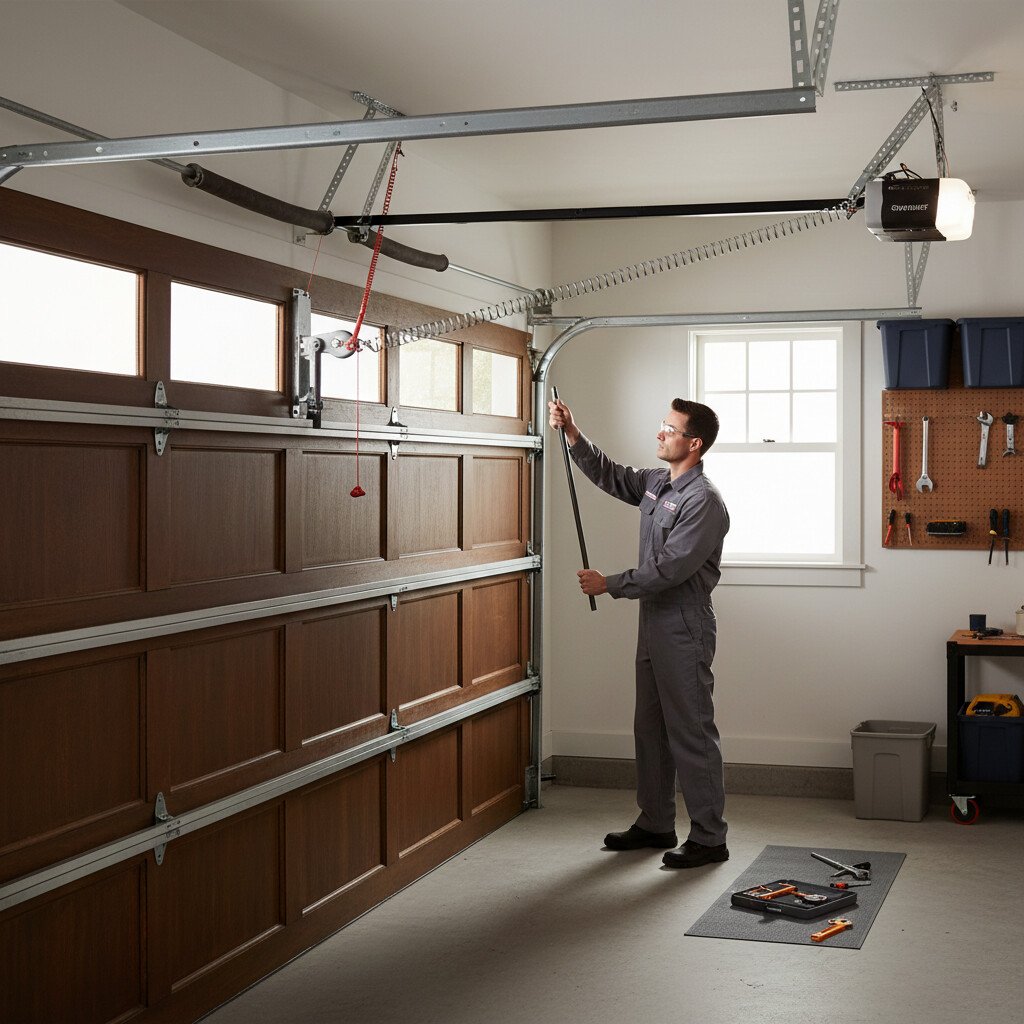
You’ll choose between torsion and extension springs, with typical parts ranging from about $120–$350 for torsion and $40–$120 for extension, plus $150–$300 labor.
Tracks, rollers, hinges, and fasteners usually add $75–250 in parts, with premium quiet or heavy-duty hardware pushing totals higher.
Balancing spring type with hardware grade helps control lifetime costs by reducing service calls and noise.
Types of Spring Systems
While the door’s panels and opener get attention, the spring system quietly determines safety, balance, and total installed cost. You’ll typically choose between torsion springs and extension springs, and the right match depends on door weight, cycle rating, and headroom.
Expect higher upfront cost for torsion but better longevity and smoother operation; extension is cheaper but needs more maintenance and safety add-ons.
- Torsion springs: $200–$600 installed; 10,000–20,000 cycles; best for heavy doors.
- Extension springs: $150–$350 installed; 10,000 cycles; budget pick for lighter doors.
- High-cycle upgrades: +$75–$200; worthwhile if you open/close >8–10 times daily.
- Dual-spring setups: +$100–$250; reduces strain, lowers failure risk, improves balance.
- Safety components (containment cables, shaft drums): +$40–$150; essential for code compliance and injury prevention.
Choose based on duty cycle, door size, and noise tolerance to minimise lifetime cost.
Track and Hardware Costs
Tracks and hardware typically add $120–$450 to a garage door install.
- Tracks: $60–$200 (galvanised/powder-coated)
- Brackets/fasteners: $40–$120
- Spring hardware: $80–$250 (excluding springs)
- Rollers: $40–$90 for ball-bearing (quieter, longer-lasting)
Heavier or insulated doors may need reinforced tracks and higher-grade hinges. Alignment and track maintenance cost $75–$200. Upgrades—wide-radius tracks, high-cycle, or corrosion-resistant hardware add $50–$300 but extend service life and reduce repairs.
Opener Types, Smart Features, and Add‑Ons
Although the door itself sets the baseline, opener choice, smart controls, and add‑ons can shift your total install by $150–$1,200+.
You’ll see cost swings based on opener types, smart features, and add ons options, plus measurable installation benefits.
- Chain-drive openers: $150–$300; loud but budget-friendly and durable for heavy doors.
- Belt-drive openers: $250–$450; quieter operation, ideal near living spaces.
- Direct/Jackshaft: $450–$800; wall-mounted, frees ceiling space, great for high-lift tracks.
- Smart features: $50–$200 extra for Wi‑Fi hubs, app control, camera, geofencing; adds monitoring and remote access.
- Add‑ons: battery backup ($75–$150), keypad ($40–$80), LED lighting ($30–$100), soft-start motors ($50–$100), auto‑lock ($80–$150).
Expect $75–$200 for basic opener installation, more for jackshaft setups.
Choose features that match door weight, noise tolerance, and convenience to optimize value.
Labour, Permits, and Regional Price Differences
Labour typically costs $200–$600 for a standard install, $500–$1,200 with framing or torsion spring work. Two techs usually finish in 3–6 hours; complex jobs add $75–$150/hour per worker.
Permits: $0–$250; inspections: $50–$150. Check if your city classifies the door as structural.
Coastal and cold-climate areas may be 10–35% higher due to wages and codes. Get itemised regional quotes for labour, permits, and timelines.
Ways to Save and Budget Planning Tips
Set a realistic budget by ranking must-haves (size, R‑value, wind rating) versus nice-to-haves (windows, hardware). Get three quotes with the same specs and compare line items.
Steel sandwich doors often offer the best cost-to-R‑value. Schedule installs in slow seasons, bundle upgrades, and compare R‑value per dollar (R‑9 to R‑12 is optimal).
Save 10–20% by skipping custom colours or designer glass, reusing compatible tracks/openers ($150–$400), or choosing discontinued models (25–40% off). Include energy, maintenance, and warranty in the total cost.
You can avoid surprise add-ons by using garage door installation planning tips to prepare the opening, timeline, and hardware choices in advance.
Conclusion
In this marketplace, you’re the captain charting a course: door type, size, and material are your winds, pushing costs from $900–$3,000, with custom builds sailing past $6,000. Insulation is your ballast—pay a bit more now to trim energy spend later. Factor labor, opener integration, old door removal, and local rates as tides that shift totals. Choose smart features like stars, not fireworks. Get three quotes, bundle work, and time purchases off‑season to land the best harbor.