Think of your garage door as armor against weather, wear, and intrusion. You’ll weigh climate exposure, corrosion risk, and UV load; compare steel, aluminum, wood, composites, fiberglass, and glass by durability, maintenance, and impact ratings; and check R-values, wind ratings, and hardware compatibility. Match finishes to your home and HOA rules, and factor warranties and lifecycle costs. Choose wrong, and you’ll pay twice—choose right, and you’ll gain efficiency, security, and…
Key Takeaways
- Match materials to climate: prioritize corrosion resistance in coastal areas, UV-stable finishes in sunny regions, and insulated, gasketed panels in cold or windy zones.
- Balance durability and maintenance: steel and fiberglass last 20–30 years; aluminum dents easily; wood needs annual sealing; vinyl is low-maintenance.
- Evaluate performance: check R-value, wind-load rating, impact resistance, and hardware reinforcement (hinges, fastener pull-out, opener torque compatibility).
- Consider long-term costs: factor energy efficiency, maintenance frequency, repairability, and warranty coverage for panels, springs, hardware, and finishes.
- Align aesthetics and compliance: coordinate panel profiles, colors, and window lites with HOA rules; prefer factory coatings and tempered or laminated glass.
Before comparing materials, it helps to understand how garage door installation works so you can choose what fits your needs long-term.
Evaluate Your Climate and Weather Exposure
Map climate demands—temperature, humidity, wind, sun, and corrosives—and use them as design inputs.
Coastal: prioritise corrosion resistance and sealed hardware.
High-UV: specify UV-stable, colourfast finishes.
Cold: address thermal bridging and low-temp gasket elasticity.
High wind: verify wind-load ratings, reinforced struts, and track anchorage.
Humid/freeze-thaw: ensure moisture barriers, edge sealing, and drainage.
Assess site exposure (orientation, overhangs, nearby structures) to anticipate rain and heat, then match materials and coatings to those loads.
If you’re choosing based on heat, humidity, or storms, explore the best garage door options for your home to match material performance to your environment.
Compare Durability and Maintenance Demands
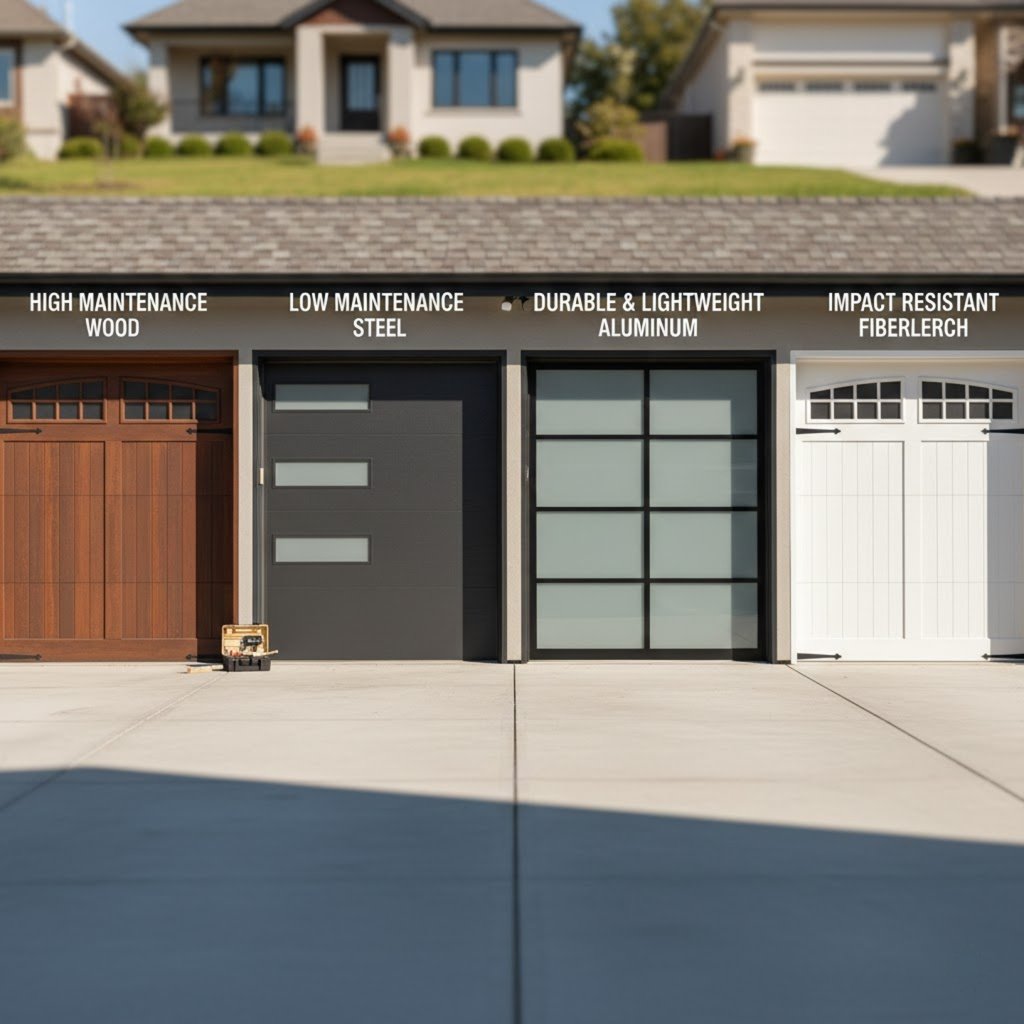
You should compare each material’s expected lifespan, not just its appearance, to match service life with your usage.
Assess how steel, aluminum, wood, fiberglass, and composites resist weathering and corrosion, especially at panel edges, tracks, and fasteners.
Then plan upkeep and repairs—finishes, lubrication, seal replacements, and hardware checks—so the door stays safe, quiet, and within warranty.
Material choice affects wear over time, so review garage door lifespan after installation to pick what lasts longest for your usage.
Lifespan by Material
Material choice determines a garage door’s lifespan, maintenance needs, and safety.
- Steel: 20–30 years with proper coating and hardware maintenance.
- Aluminum: 25+ years; lightweight but thinner panels dent easily.
- Fiberglass: 20–30 years; resists warping and needs less refinishing.
- Wood: 15–25 years with regular sealing and alignment; neglect reduces life.
- Vinyl (PVC): 20+ years with low maintenance, though repairs are difficult after impact.
- Insulated sandwich doors: Extend skin and hardware life.
Use certified components and schedule annual inspections to reduce failures and environmental impact.
Weathering and Corrosion
Even in mild climates, weathering and corrosion drive most garage door failures, so material chemistry and coatings are just as important as panel style.
You’ll see the biggest differences in salt, UV, and freeze-thaw exposure. Galvanized steel with a G90 or higher zinc layer offers solid corrosion resistance; pair it with baked-on polyester or PVDF weatherproof coatings to slow red rust.
Aluminium won’t rust, but it pits in coastal chlorides unless you specify marine-grade alloy and anodizing.
Fiberglass skins shrug off salt and UV but can microcrack under impact, allowing moisture ingress.
Vinyl resists rot yet expands thermally, stressing fasteners.
Engineered wood requires sealed edges and factory primer to avoid swelling.
For hardware, choose stainless or zinc-nickel plated components and isolated fastener interfaces to minimize galvanic attack.
Upkeep and Repairs
Material choice sets the maintenance calendar and repair profile as much as it sets corrosion resistance. You’ll balance durability, inspection intervals, and repair costs against weight and hardware stress. Steel needs seasonal lubrication and rust checks; aluminum reduces corrosion but dents easily; wood demands sealing; fiberglass resists moisture but can fade. Set maintenance schedules by cycle counts, humidity, and salt exposure, and always de-energize openers before work.
| Material | Upkeep and Repair Notes |
|---|---|
| Galvanized Steel | Inspect edges for rust creep; tighten fasteners; moderate dent repair costs. |
| Aluminum | Light load on springs; frequent denting; low corrosion; panel swaps are common. |
| Wood | Annual sealing; swelling risks; heavier loads accelerate spring wear. |
| Fiberglass/Composite | Minimal corrosion; UV checking; adhesives and specialty resins raise repair costs. |
Lubricate rollers, hinges, and torsion bearings quarterly; replace frayed cables immediately.
Understand Insulation, R-Values, and Energy Efficiency
Insulation stabilises temperature, reduces noise, and protects equipment. Polystyrene provides moderate R-values at a lighter weight; polyurethane foam bonds to the door skin, delivering higher R-values, rigidity, and vibration control. Higher R-values cut heat loss and improve energy efficiency.
Choose polyurethane for the best R-value-to-thickness ratio and stiffness.
Ensure continuous thermal breaks at stiles and rails to prevent heat bridging. Use tight perimeter seals and bottom astragals to limit air leakage.
Select R-values by climate: cold regions need R-12 to R-18, mild zones R-6 to R-9.
Check U-factor for whole-door performance, and confirm panels meet fire, emissions, and wind-load standards.
Insulation benefits only show up when the setup is done right—energy efficiency starts with proper garage door installation.
Weigh Security, Strength, and Impact Resistance
You should compare material strength ratings (yield strength, tensile strength, gauge/thickness) to ensure the door resists prying and deformation under load.
Evaluate impact-resistant options such as dual-skin steel with foam cores, wind-rated assemblies, and laminated or polycarbonate glazing that meet ASTM/UL impact standards.
Match these specs to your risk profile—forced entry, storms, or high-traffic impacts—to balance security with service life.
Material Strength Ratings
Start by comparing published strength metrics so you can match a door’s build to real-world threats. Use manufacturer material ratings, third-party certifications, and lab-tested data to guide strength comparisons.
Check tensile strength, yield strength, panel gauge, and section modulus to understand how the door resists deformation under load. Verify fastener pull-out values, hinge reinforcement specs, and track steel thickness to ensure the assembly holds under forced entry.
- Review ASTM/EN standards, UL listings, and DASMA data sheets for apples-to-apples material ratings.
- Compare steel gauges (lower number = thicker), aluminum tempers (e.g., 6061-T6), and composite fiber volume fractions.
- Confirm corrosion protection: galvanization class, powder-coat thickness, and anodizing grade.
Prioritize frames and struts with documented load ratings, not marketing claims. Demand test reports and warranties that cite exact thresholds.
Impact-Resistant Options
With strength metrics in hand, focus on assemblies engineered to absorb blows without catastrophic deformation.
Prioritize multi-layer skins bonded to resilient cores; steel or aluminum faces over high-density polyurethane or mineral wool yield superior impact resistance without excessive weight.
Specify thicker-gauge stiles, reinforced end caps, and through-bolted hardware to maintain panel integrity under point loads.
Assess rating protocols (ASTM/EN) and verify tested drop, pendulum, or missile results.
For hurricanes, choose impact-rated glazing with laminated interlayers and captive retainers.
If corrosion’s a risk, use galvanized or powder-coated steel; in coastal zones, upgrade to marine-grade aluminum and stainless fasteners.
Balance material selection with lifecycle safety: add continuous struts, wind-lock rollers, and heavy-duty tracks.
Ensure opener torque, spring indexing, and hinge spacing match the reinforced assembly.
Balance Aesthetics, Curb Appeal, and HOA Considerations
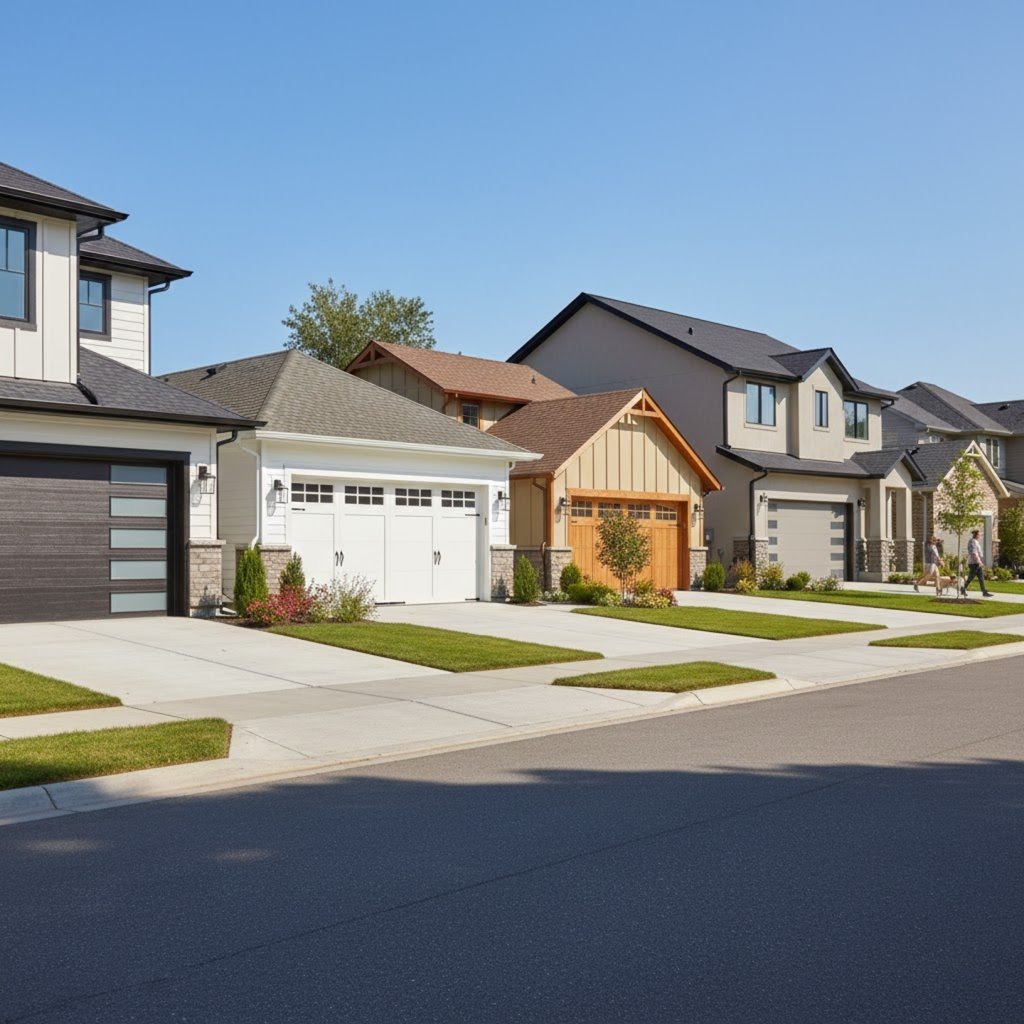
Even as performance specs drive material selection, align the door’s appearance with your home’s architecture, neighborhood context, and any HOA constraints.
Balance performance with aesthetics that respect your home’s style, neighborhood context, and HOA requirements.
Match panel profiles, sightlines, and color values to existing façades. Confirm finishes and window lites comply with neighborhood guidelines and safety glazing standards. Use materials that accept factory-applied coatings for uniform colorfastness and low-maintenance curb appeal.
Track design trends, but filter them through local codes and community covenants to avoid violations.
- Choose material/finish pairs: galvanized steel with baked-on polyester, aluminum with anodized clear, or fiberglass with UV-stable gelcoat for consistent hue and corrosion resistance.
- Coordinate hardware: powder-coated tracks, tamper-resistant hinges, and low-visibility fasteners preserve aesthetics and safety.
- Validate window options: tempered or laminated lites, obscurity levels, and muntin patterns that echo architectural rhythm.
Assess Long-Term Costs, Warranties, and Lifespan
While curb appeal and HOA fit set the look, your budget over 10–20 years hinges on how the door performs, ages, and stays covered. Do a cost analysis that includes energy losses, finish maintenance, hardware wear, and opener strain. Rate R-value, wind-load compliance, and corrosion resistance; they drive service intervals and safety risk. Pair that with a warranty evaluation—years covered, parts vs. finish, transferability, exclusions, and required maintenance.
| Factor | What to verify |
|---|---|
| Coverage scope | Panels, springs, rollers, tracks, finish, labor |
| Term limits | Separate years for structure, hardware, finish |
| Conditions | Proof of tune-ups, proper balancing, approved cleaners |
| Exclusions | Coastal corrosion, UV chalking, impact damage |
| Remedies | Repair vs. prorated replacement, response time |
Project total cost of ownership and prioritize durability that reduces emergency calls and injury exposure.
Match Material Options to Use Cases: Steel, Aluminium, Wood, Composite, Fibreglass, and Glass
Six primary garage door materials meet most residential and light-commercial needs, each suited to specific performance, climate, and maintenance requirements.
- Align climate with corrosion protection
- Match R-value to garage use
- Confirm wind, impact, and glazing codes
Steel: offers high durability and impact resistance with multi-gauge skins, insulated cores, and strong wind ratings; specify galvanized steel with baked-on finishes.
Aluminum: suits coastal areas due to corrosion resistance and reduced opener strain; include thermal breaks.
Wood: provides classic curb appeal and repairability; verify species, moisture levels, and balanced construction to prevent warping.
Composite: doors feature rot-resistant skins over insulated cores with minimal maintenance.
Fiberglass: resists dents and salt exposure but requires UV-stable gelcoats.
Glass: doors maximize daylight; use tempered or laminated panels with thermal spacers for safety and efficiency.
Conclusion
You’ve got the specs to choose wisely. Start with climate, then zero in on durability, maintenance, and R-value to keep energy costs in check. Prioritize impact ratings, robust hardware, and tamper-resistant locks for safety. Balance curb appeal with HOA rules—measure twice, cut once. Compare steel, aluminum, wood, composite, fiberglass, and glass against warranties and lifecycle costs. In the end, you’ll match material to environment and use case, ensuring a secure, efficient, and resilient garage door that lasts.