
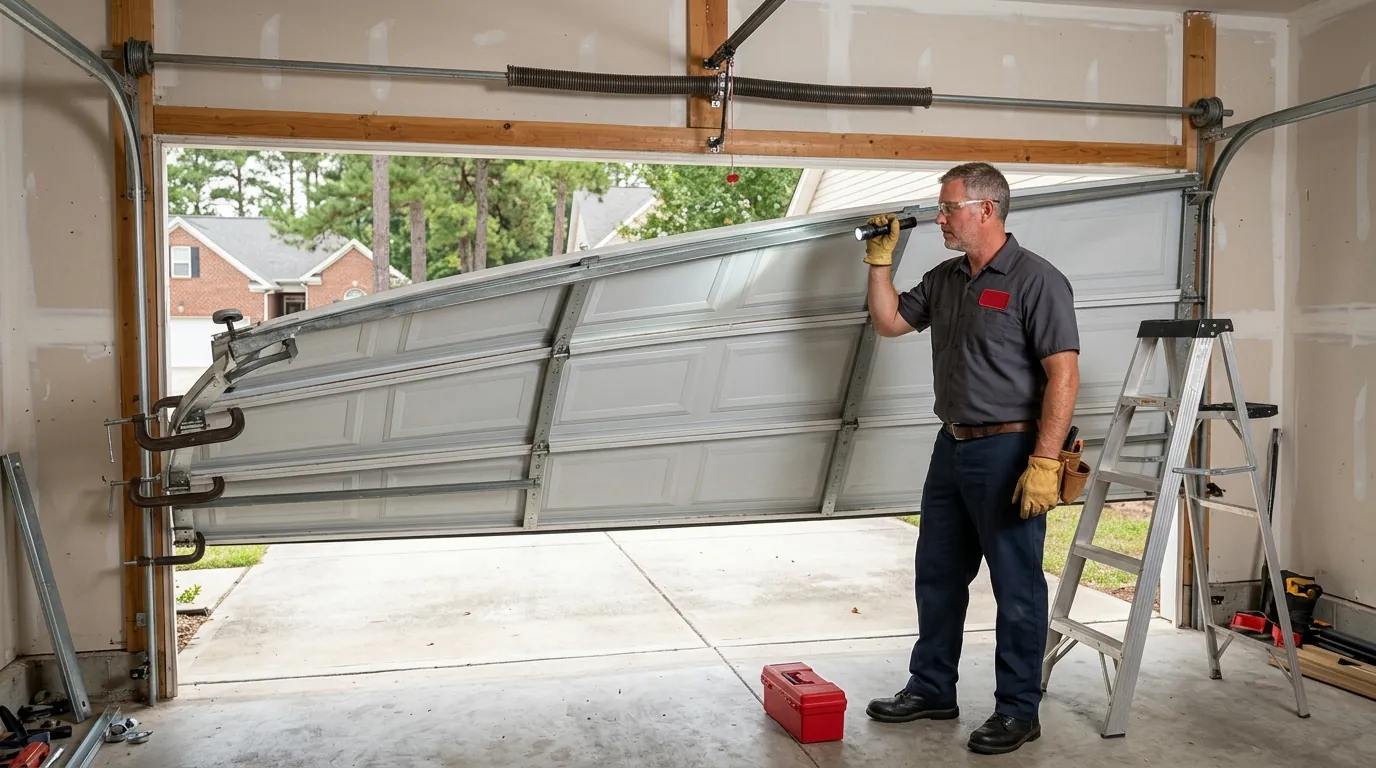
What should you do if your garage door comes off track?
Stop using the door: unplug the opener, keep people, pets and cars away, and leave the rollers, cables and brackets alone. An off-track door hangs on springs and cables under tension, and forcing it bends the track and the door sections further.
Unplug the opener
The opener keeps driving the door against an empty or bent track, and every cycle bends the sections, the rollers and the opener arm.
Keep people, pets and cars clear
A door hanging out of its track drops without warning. Park outside and keep children out of the garage until the door is re-hung.
Leave rollers, cables and brackets alone
Pushing a roller back in by hand shifts the load on the cables and springs. A mallet or pry bar turns a re-hang into a new track section and a new door section.
Lock the door to the house
A garage door stuck open leaves the house reachable from the garage, so lock the connecting door.
Call and describe both tracks
Say which side left the track, whether a cable hangs loose and how far the door is open. That tells the technician what the job involves before arriving.
Door crooked, jammed or hanging open? Call (716) 328-9097. Calls booked by 12 pm, Monday to Saturday, get a same-day visit, with no trip fee anywhere in our North Carolina service area.
How does a garage door come off its track?
A garage door comes off its track when a vehicle bumps it, a lift cable goes slack or snaps, track brackets work loose, the track bends, or worn rollers wobble out of the channel. An object in the door’s path during travel also pushes rollers out.
- Vehicle impact
- A bumper or mirror hits the bottom section, bends the vertical track and pushes the lowest rollers out of the channel.
- Slack or broken cable
- A lift cable that snaps or unspools from its drum drops one side of the door. The door tilts, and the tilt levers the rollers on the other side out of the track.
- Loose track brackets
- Jamb brackets hold the vertical track to the wall framing. Loose bolts let the track spread away from the door until the rollers slip past its edge.
- Bent track
- A dent narrows the channel and jams the roller, or opens the channel and lets the roller escape.
- Worn rollers
- Cracked wheels, worn bearings and bent stems wobble inside the track and ride over its lip.
- Obstruction
- A bin, bike or ladder stops one side of the door while the opener keeps driving, which twists the door out of line.
Causes chain together. A slack cable tilts the door, the tilt pushes rollers out, and an opener left running then bends the track. That chain is why a technician checks the cables and springs on every off-track call, not only the track.
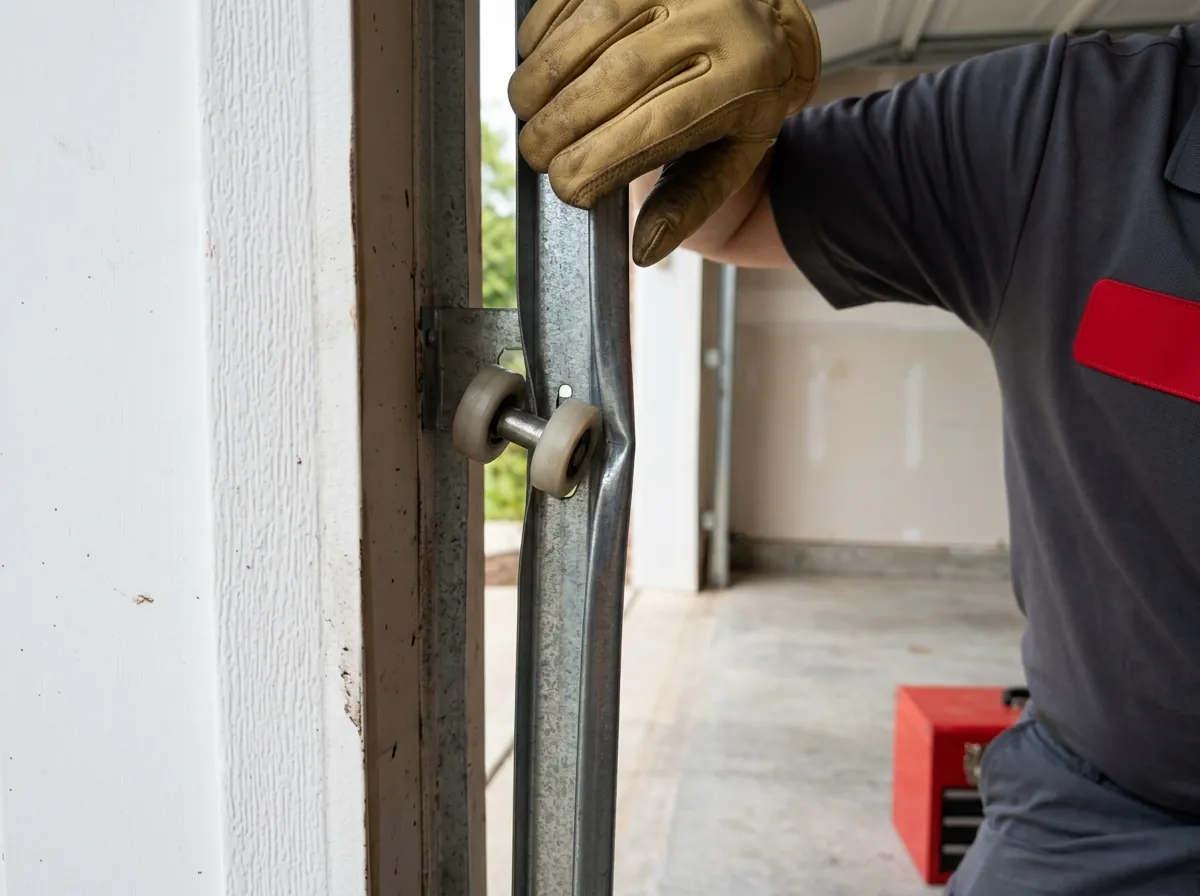
Which parts are involved when a door leaves its track?
An off-track repair involves the vertical and horizontal tracks, the rollers in each hinge, the jamb and flag brackets that hold the track, and the lift cables that keep the door level. A bent door section or a broken spring is checked on the same visit.
A residential garage door track is a steel channel, commonly 2 in wide. It guides the rollers straight up the door jamb, around a 12 in or 15 in radius curve, and back along the ceiling. The radius sets how much headroom the door needs above the opening.
| Part | What it does | What goes wrong |
|---|---|---|
| Vertical track | Guides the rollers up the jamb, tilted slightly back so the door clears the stop | Bent by a vehicle, or pulled out of line by loose jamb brackets |
| Horizontal track | Carries the open door under the ceiling on back-hang angles, braced against sway | Sags or twists when a back hang loosens |
| Track radius | The 12 in or 15 in curve that turns the door from vertical to horizontal | Kinked at the curve when a tilted door is forced up |
| Flag bracket | Joins the vertical and horizontal track at the top of the jamb and carries the end bearing plate | Loose bolts let the two tracks separate at the joint |
| Jamb brackets | Fasten the vertical track to the jamb framing | Work loose and let the track spread away from the door |
| Rollers | Wheels on stems, mounted in the hinges and the top and bottom fixtures, riding inside the track | Crack, seize or bend, then climb out of the channel |
| Lift cables | Run from the bottom brackets to the drums and hold the door level | Snap or unspool, so one side drops and the door tilts |
Wind-rated doors add one rule. The type, number and spacing of the jamb brackets are set by the manufacturer’s wind-load drawing (DASMA TDS 181), so a re-hang on a wind-rated door puts the brackets back to that pattern.
How do technicians re-hang an off-track garage door?
A technician secures the door, relieves the load on the cables, guides the rollers back into the track, and straightens or replaces bent track. The tracks are then set plumb and parallel, the cables re-wound evenly, and the balance and auto-reverse re-tested.
Secure
Clamps hold the hanging door first, so it cannot drop or roll while anyone works near it. This safety step is part of the free diagnosis visit.
Inspect
The technician checks both tracks, the rollers, the cables and the springs to find why the door left the track.
Price
You get the price before any work starts, and the work starts only when you say yes.
Relieve
The load comes off the cables before anything moves. This step is technician work, because the springs and cables hold the door’s full weight.
Guide
The rollers go back into both tracks, section by section.
Straighten
A small bend is straightened; a kinked or split track section is replaced, and loose brackets are tightened or replaced.
Align
The vertical tracks are set plumb and parallel, with an even gap between each track and the door.
Test
The door runs level, stays put 3 to 4 ft off the floor on its own (the sign of a balanced door), and reverses on contact with an object.
Plumb, parallel tracks keep every roller the same distance into the channel. A track out of plumb rubs one side of the door and walks the rollers out again, which is why the alignment check comes before the test. The re-hang carries a 1-year labor warranty; parts carry the manufacturer’s warranty, which we register for you.
What affects the cost of off-track garage door repair?
Off-track repair cost depends on whether the track straightens or needs a new section, how many rollers and cables are damaged, whether a door section bent, and the door’s size and weight. The technician states the full price before any work starts.
Track damage
A bend straightened on site, or a section replaced.
Rollers
Cracked or bent rollers replaced.
Cables
Slack cables re-wound on the drums, snapped cables replaced.
Door sections
A bent or cracked section found during the re-hang.
Door size
Double-width and heavier doors take more labor.
There is no trip fee anywhere in our North Carolina service area, so the visit, the diagnosis and the price cost nothing when you decide not to go ahead. Call (716) 328-9097 or request an off-track door repair quote.
The track is where the fault shows, not always where it starts.
When is an off-track door a cable or emergency repair?
An off-track door is a cable repair when a lift cable snapped or unspooled, and an emergency when the door hangs open, blocks a car in or cannot be secured. The technician checks for both on the re-hang visit and prices any cable work with the re-hang.
A cable lying on the floor or hanging slack beside the track means the door dropped on that side. The door goes back on its track only after the cable problem is fixed, and technicians who replace a snapped garage door cable fit both sides as a pair.
A door stuck open overnight, or hanging where a car or a person passes under it, is an emergency garage door repair. Phones are answered 24 hours a day, 7 days a week, and emergency service is available 24/7 in every city we serve.
Doors that stay on their tracks but still stick, grind or refuse to move go to our garage door repair technicians.