
How do you know a garage door spring is broken?
A broken garage door spring shows as a visible gap in the coil above the door, a loud bang from the garage, a door far heavier than usual, or an opener that hums and lifts the door only a few inches. A two-spring door with one break rises crooked.
Gap in the coil
The torsion spring on the shaft above the door has split into two coils with a space of a few inches between them.
Bang from the garage
A single sharp bang from the spring above the door, often with nobody near the door. That is the spring letting go.
Heavy door
A door that lifted easily by hand now feels like dead weight, because nothing counterbalances it any more.
Stop after a few inches
The opener raises the door a short way, then reverses or stops as it strains against the full door weight.
Hum or strain from the opener
The motor runs and the door stays shut. Chamberlain lists a broken spring among the causes of an opener that hums without moving the door.
Crooked rise
One side of the door climbs ahead of the other, or a lift cable hangs slack beside the track.
Seeing any of these? Leave the door where it is, keep the opener switched off and keep people and cars out from under it. Call (716) 328-9097 for a same-day visit when you book by 12 pm, Monday to Saturday. No trip fee, and you hear the price before any work starts.
Why do garage door springs break?
Garage door springs break from metal fatigue: each opening and closing is one cycle, and a standard spring is rated for about 10,000 cycles. Rust pits from humid or salt air speed up the fatigue cracks, and an unlubricated coil wears faster than a maintained one.
- Standard rating
- 10,000 cycles, one cycle being one opening plus one closing.
- High-cycle rating
- 25,000 to 100,000 or more cycles, from heavier, longer wire.
- Salt air
- Rust pits on the coil start fatigue cracks early. DASMA advises keeping doors in coastal locations closed where possible.
- Lubrication
- A lightly oiled coil runs closer to its full cycle rating than a dry, rusting one.
A 10,000-cycle spring lasts about 13.7 years at 2 cycles a day and 4.6 years at 6. The calendar life depends on how often the door runs, not on the age of the house.
| Door use | Cycles a year | Years to 10,000 cycles |
|---|---|---|
| 2 cycles a day | 730 | about 13.7 |
| 4 cycles a day | 1,460 | about 6.8 |
| 6 cycles a day | 2,190 | about 4.6 |
Which garage door spring do I have: torsion or extension?
A torsion spring is coiled on a steel shaft above the door opening, while extension springs run alongside each horizontal track and stretch as the door closes. Most sectional doors use 1 or 2 torsion springs; extension springs carry a safety cable threaded through each coil.
The springs, cables and drums together form the counterbalance system: they offset the door’s weight so the opener only has to move a balanced door. A torsion spring stores energy by twisting and turns the cable drums as it unwinds; each drum winds a lift cable tied to a bottom corner of the door. An extension spring pulls its lift cable over pulleys instead.
| Spring type | Where it sits | How it lifts | Containment | Quantity |
|---|---|---|---|---|
| Open torsion | On a 1 in steel shaft above the opening | Twists, turns the drums, drums wind the cables | The shaft holds a broken coil in place | 1 or 2 |
| Extension | Beside each horizontal track | Stretches as the door closes, pulls the cables over pulleys | A safety cable through each spring | 2 |
| Enclosed torsion | Sealed inside the shaft tube | Wound by a gear at the end of the tube | The tube | 1 on a single door, 2 on a double |
The full comparison of layouts, lifespans and noise lives in the guide to torsion vs extension garage door springs.
Four measurements identify a torsion spring: wire size, inside diameter, length and wind direction. Common residential wire sizes are .234, .250 and .262 in, and DASMA’s color chart runs from .1200 to .6250 in. Inside diameters are usually 1-3/4, 2, 2-1/4 or 2-5/8 in. The right-wound spring sits left of center, often with a red cone; the left-wound spring sits right of center, often black. Extension springs are painted by the door weight they carry per pair, from 50 to 300 lb in 10 lb steps (DASMA TDS 171).
Torsion spring replacement
The broken spring and its partner come off the shaft; new springs matched in wire size, inside diameter and length go on, with new winding cones where the old ones are cracked.
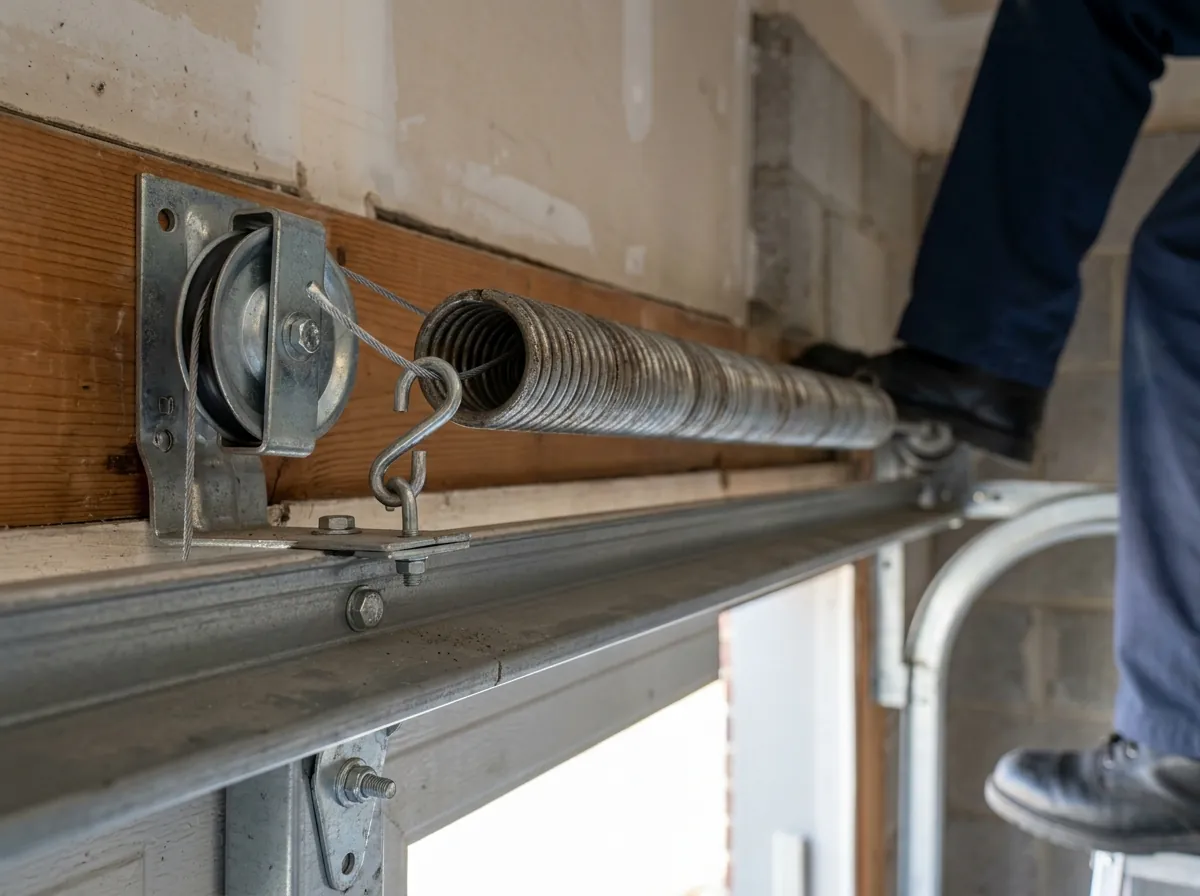
Extension spring replacement
Both side springs are replaced with springs of the door-weight color, on new safety cables, with the pulleys and lift cables checked for wear.
Enclosed torsion springs
TorqueMaster-style systems keep the spring inside the shaft tube and tension it by gear. The tube is opened and the spring replaced to the manufacturer’s method.
High-cycle spring upgrades
Heavier, longer wire rated for 25,000 to 100,000 or more cycles. It suits a door that runs many times a day and lowers the cost per year of use.
Do you need to replace both garage door springs?
Yes, both springs on a two-spring door are replaced together. They have run the same number of cycles, so the surviving spring is near the end of its own rating. Matching wire size, inside diameter and length on both sides keeps the drums turning evenly.
A new spring paired with a worn one pulls harder on one side. The door rises unevenly, one cable carries more load, and the older spring is already close to its own break. Replacing the pair at once saves a second visit for the same door.
How does a technician replace a garage door spring?
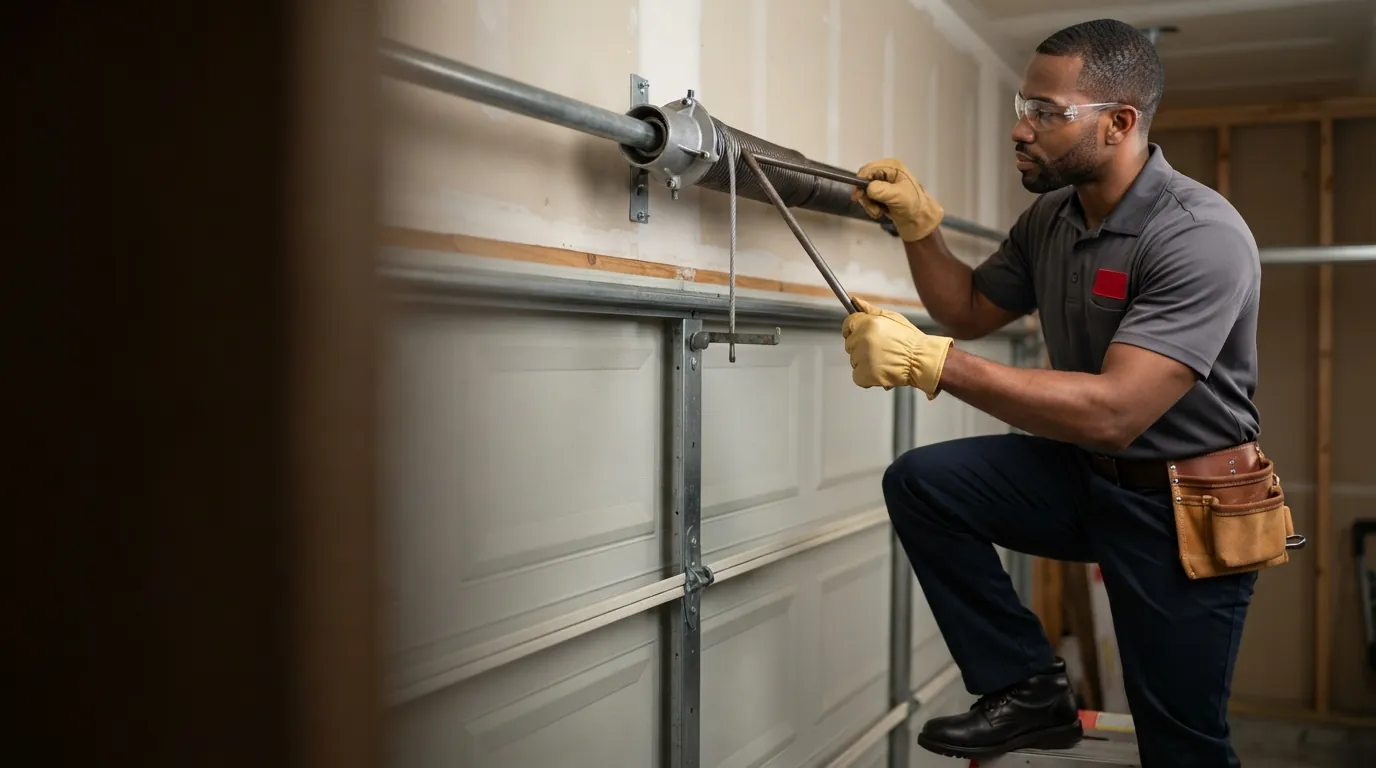
A technician replaces a garage door spring in 6 stages: secure the door closed, measure the old spring, release its remaining tension, fit a matched pair, tension them to the manufacturer’s chart, and test the balance and auto-reverse. A balanced door then holds still 3 to 4 ft up.
Secure the door
The door stays closed and clamped so it cannot move while the spring is out.
Measure the old spring
Wire size, inside diameter, length and wind direction identify the replacement.
Release the remaining tension
The technician unloads the broken assembly with the correct tools. This is the step that injures untrained people.
Fit a matched pair
New springs, cones and, where worn, bearings go on the shaft or, on extension doors, on new safety cables.
Tension to the chart
The turn count comes from the manufacturer’s chart for the door’s height, drum and track radius.
Test balance and reversal
The released door holds 3 to 4 ft above the floor, and the opener reverses on a 1-1/2 in object.
Before any of this starts, the technician tells you which springs the door needs and what the job costs. You decide; nothing is touched until you say yes.
No trip fee
No trip fee anywhere in our North Carolina service area.
Price first
The technician gives you the price before any work starts, and the work starts only when you say yes.
Same-day visits
Same-day visits for calls booked by 12 pm, Monday to Saturday.
Warranty
1-year labor warranty on every repair; the springs carry the manufacturer’s warranty, which we register for you.
Can you replace garage door springs yourself?
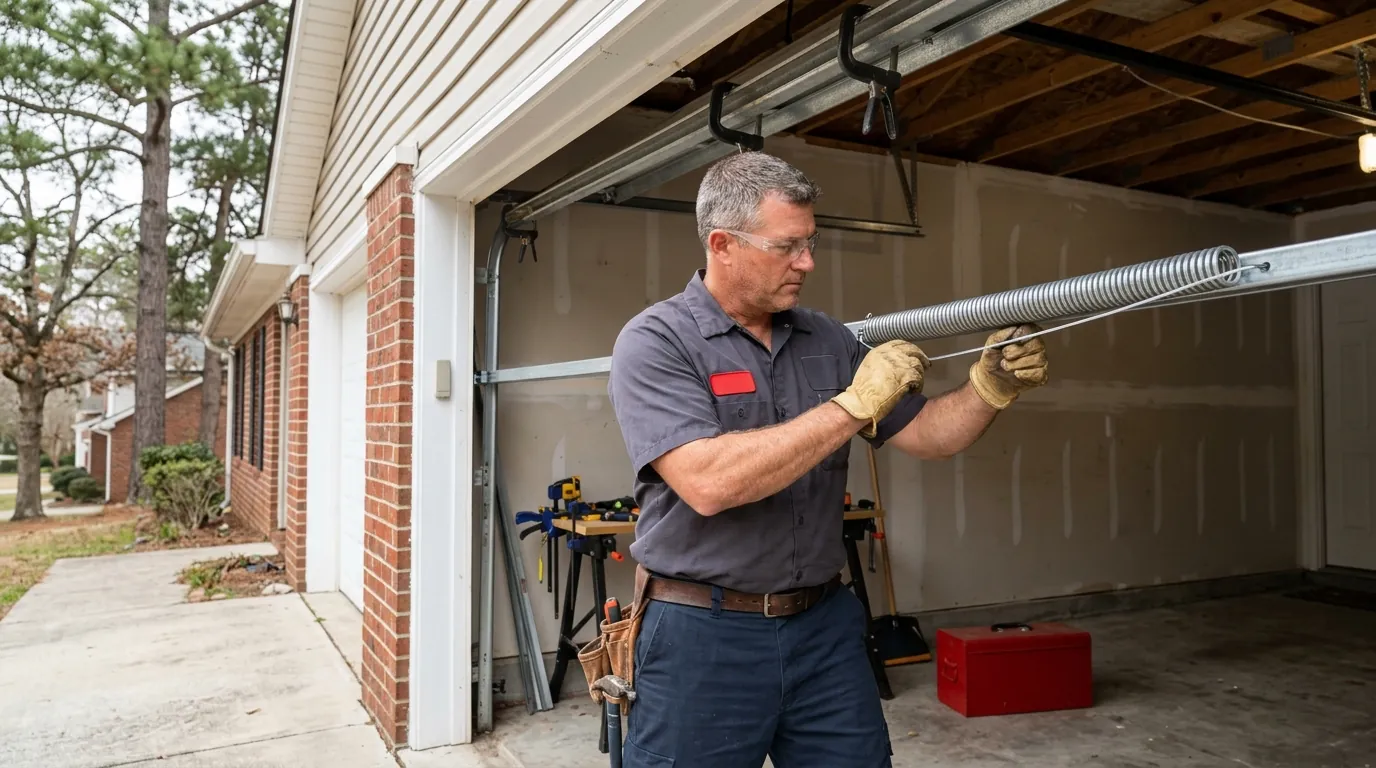
No. DASMA, the door and access systems manufacturers’ association, directs that only a trained door systems technician adjusts or replaces springs. A wound torsion spring stores enough energy to cause severe injury or death, and the cables and bottom brackets it tensions carry the same risk.
A broken spring does not make the door safe to work on. On a two-spring door the other spring is still wound, and the winding cone, set screws, drums and bottom brackets all sit under its load. The released energy spins winding tools and throws loose parts at the person holding them.
Springs, lift cables and bottom brackets hold stored spring energy. They are technician work on every door.
What affects the cost of garage door spring replacement?
Spring replacement cost depends on the spring type, how many springs the door uses, the wire size the door’s weight demands, and the choice between standard 10,000-cycle and high-cycle springs. Worn cables, drums or bearings replaced during the same visit add to the total.
Spring type
Open torsion, extension or enclosed torsion.
Spring count
1 or 2 torsion springs, always 2 extension springs.
Wire size
A heavier door needs thicker, longer wire.
Cycle grade
Standard 10,000-cycle or high-cycle springs.
Related parts
Frayed cables, cracked cones, worn drums or bearings found at the visit.
Third-party price ranges for each spring type are collected on the page about what a spring replacement costs. For your own door, the technician quotes the full job at the visit, with no trip fee, before any work starts. Request a spring replacement quote or Call (716) 328-9097.
What else fails when a garage door spring breaks?
A spring break rarely stays a spring problem. A broken spring leaves the lift cables slack, and a slack cable unspools from its drum and pulls the door crooked or out of its track. A door stuck open after a spring break is too heavy to lower safely by hand, so the garage stays unsecured until a technician arrives.
The technician checks both cables and drums during every spring job. A cable that has jumped its drum or frayed against the track is replaced in the same visit; that is lift cable replacement, and it goes on with the new springs rather than after them.
A spring that breaks with the door up leaves a garage open to the street. Leave the door where it is and call: phones are answered 24 hours a day, 7 days a week, and emergency service is available 24/7 in every city we serve. The page on a garage door stuck open covers what to do until the visit.