
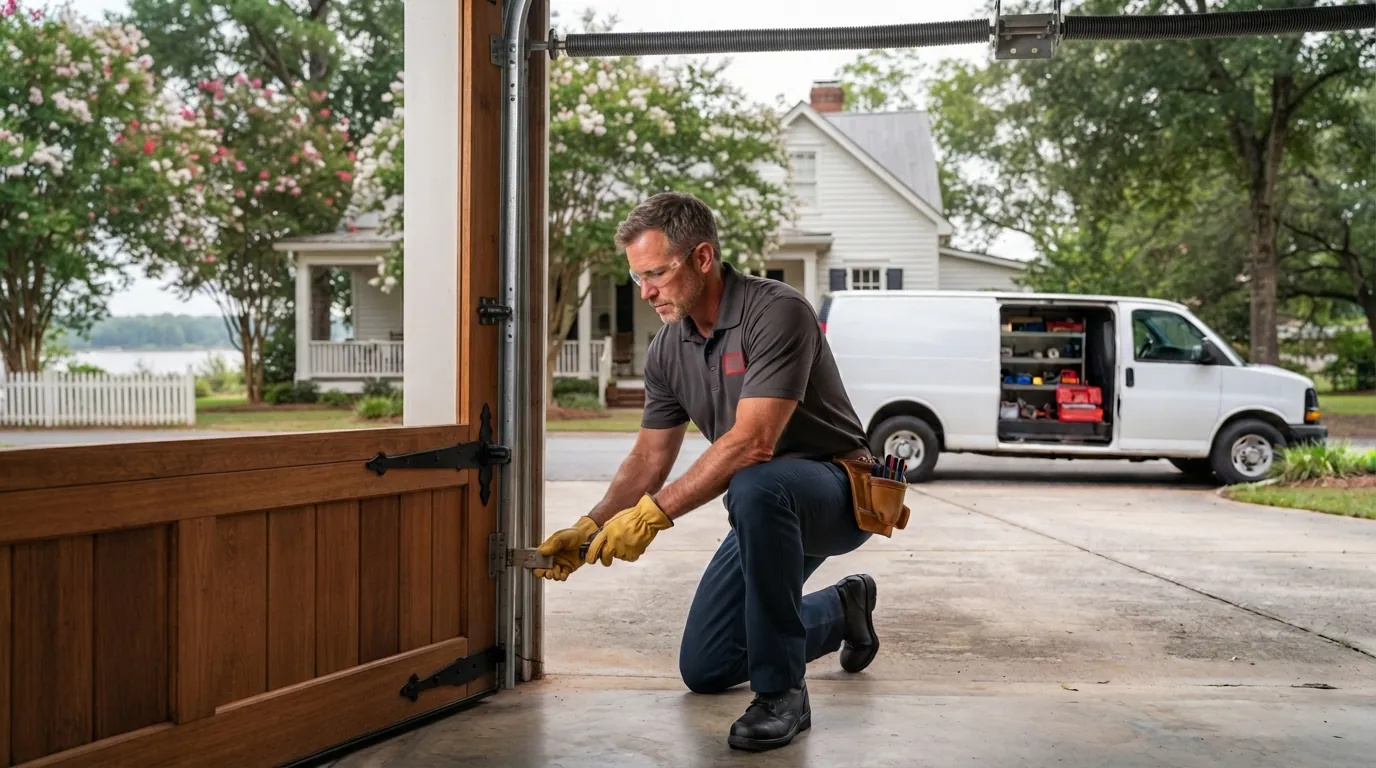
What does a storm-ready garage door in New Bern need fixed first?
A storm-ready New Bern garage door needs sound springs, a working opener, straight track, intact cables and reinforcement that matches its wind-load label. Technicians fix those in that order and quote a 140 mph-rated replacement when the existing door carries no qualifying label.
A wind-load label is the manufacturer’s sticker, usually on an end stile (the vertical edge of a section), that states the pressure the door was tested to resist.
Snapped and rusted springs
The torsion spring above the door lifts almost all of its weight. Damp river air pits the spring wire, and pitted springs break early. Snapped spring replacement fits a matched pair and rebalances the door before storm season.
Openers that stall or ignore the remote
Logic boards fail after power surges, and remotes lose range from a weak battery, lock mode on the wall control or radio interference. The technician traces the cause, then repairs the opener or quotes a replacement.
Crooked doors and bent track
A door that hangs low on one side has a cable or drum fault. Crooked garage door repair re-levels the door and straightens the track, so wind cannot push the rollers out of it.
Frayed lift cables
Lift cables run from the bottom brackets to the drums and carry the door as the springs turn. Galvanized cables corrode at the bottom brackets; new cables go on with the spring tension released and both drums wound evenly.
Wind-load label and reinforcement check
Struts are steel braces fastened across each section to stop bowing. The technician compares the struts, hinges and jamb brackets on your door against the reinforcement listed on its wind-load drawing.
Rated replacement doors
A door with no label meeting the 140 mph zone, or one too damaged to repair, gets a free in-home estimate for a rated replacement and its installation: the technician measures the opening and quotes a door with the matching label.
Heard a bang, or is the door hanging crooked? Stop using the opener, keep cars and children clear of the door and call (716) 328-9097. Calls booked by 12 pm, Monday to Saturday, get a technician the same day.
What does a 140 mph wind zone mean for a Craven County garage door?
A 140 mph zone means a Craven County garage door must resist a stated design pressure: 25 psf by the NC code table at a 15 ft roof, or +14.5/−16.2 psf for a 16×7 door under DASMA’s engineered method. The door’s label proves which value it meets.
Design wind speed is the gust speed a building must be built to withstand; the 2018 NC Residential Code sets it at 140 mph for all of Craven County. Design pressure is that wind converted into force on the door, in psf (pounds per square foot). The plus value is the push of wind against the door, and the minus value is the pull on it. Garage doors are rated in psf, not in mph.
Where the speed reaches 130 mph or more, code section R301.2.1.1 sends design to ASCE 7, ICC 600, the Wood Frame Construction Manual, the IBC or the code’s high wind chapters 45 and 46. Those chapters give a prescriptive table. DASMA, the garage door manufacturers’ association, publishes lower engineered values in its technical data sheet TDS 155h, and the NC Office of State Fire Marshal (OSFM) accepted TDS 155h for garage doors on March 20, 2019.
| Basis | 140 mph value | Applies to |
|---|---|---|
| NCRC Table R4502(b), prescriptive | 25 psf (15 ft roof) · 29 psf (25 ft) · 32 psf (35 ft) | The code-table default |
| DASMA TDS 155h, engineered (accepted by NC OSFM, 2019) | +14.5 / −16.2 psf for a 16×7 door, 15 ft roof, Exposure B | An alternate design pressure |
Exposure B means suburban terrain. Open waterfront sites raise the engineered values: Exposure C multiplies them by 1.49 and Exposure D by 1.81. The building department decides the value for each address. To earn its label, a door is held for 10 seconds at its design pressure and 10 seconds at 1.5 times that pressure, in each direction, under ANSI/DASMA 108.
How does river humidity along the Neuse and Trent wear a garage door?
River humidity rusts spring wire, cables and hinges, and DASMA states that rust pits accelerate spring fatigue cracks. Wood doors also split, bow and rot around hardware fasteners. Lubrication, early cable replacement and sound seals slow the wear on New Bern doors.
- Where New Bern sits
- At the confluence of the Neuse and Trent rivers, the point where the two rivers meet.
- North Carolina climate
- Humid, with very warm summers and moderately cold winters (North Carolina Institute for Climate Studies).
- What rust does to a spring
- Rust pits on the wire accelerate fatigue cracks and cut the spring’s cycle life (DASMA TDS 190).
- Age of Craven County homes
- Half were built in 1989 or earlier; 68.4% of occupied homes are owner-occupied and 12.6% of homes are mobile homes (ACS 2020–2024).
A spring’s cycle life is the number of open-and-close cycles it is built to complete before it breaks. Rust shortens that number, so a door in damp air loses springs sooner than the rating suggests. The threshold seal along the bottom of the door keeps standing water and leaves out; a cracked seal lets damp air sit against the bottom section and its brackets.
What should New Bern homeowners check before, during and after hurricane season?
Before June 1, New Bern homeowners check springs, cables, track and the wind-load label; during a storm they close, lock and disconnect the opener; afterward they inspect first, test second and call for any bent track or panel. The season ends November 30.
The Atlantic hurricane season runs June 1 to November 30 and peaks around September 10 (NOAA). Florence in 2018 set the North Carolina rainfall record of 35.93 inches near Elizabethtown. Sectional doors are not watertight, so wind-driven rain gets in through the section joints, the sides and the bottom even when the door holds.
Before June 1: look and book
Look for rust on the springs, frayed strands on the cables, dents in the track and a readable wind-load label. Book a technician for anything worn; spring and cable work stays with the technician, because both hold the door’s full weight under tension.
During a storm: close, lock, disconnect
Close and lock the door, then disconnect the opener once the door is locked shut. Keep cars away from the door. Add no homemade bracing: DASMA warns that the extra weight overloads springs and track.
After the storm: look first, test second
Look at every panel, both tracks and the hardware before touching the controls. Open the door once only when nothing is bent. A deformed panel, track or bracket means stop, leave the door where it is and call (716) 328-9097.
What affects garage door repair cost in New Bern?
New Bern repair cost depends on the failed part, how far rust has spread, the door’s size and exposure, and whether a replacement must meet 140 mph with extra struts and brackets. The technician gives you the price before any work starts.
Failed part
A single roller is a smaller job than a matched pair of torsion springs or a set of lift cables and drums.
Rust spread
A rusted spring alone is one part; rust that has reached the cables, drums and bottom brackets adds parts to the job.
Door size
A 16×7 double door needs heavier springs and longer cables than a 9×7 single door.
Site exposure
A waterfront home in Exposure C or D needs a higher engineered rating than a suburban home in Exposure B.
Wind rating of a new door
A replacement must meet the 140 mph zone, and its wind-load drawing sets how many struts and brackets go on.
No trip fee anywhere in our North Carolina service area. The work starts only when you say yes.
How soon can a New Bern garage door be repaired?
A New Bern call booked by 12 pm, Monday to Saturday, gets a same-day visit. Phones are answered 24 hours a day, 7 days a week, and emergency service is available 24/7 in every city we serve, and no trip fee applies.
At the door, the visit runs in one order: diagnose the cause, give you the price, wait for your yes, repair, then test the door’s balance and auto-reverse with you. Every repair carries a 1-year labor warranty; parts carry the manufacturer’s warranty, which we register for you.
Craven County’s 140 mph rating also covers Havelock, Trent Woods and River Bend, and Jones County next door carries the same value.
Towns along the Neuse and Trent that New Bern technicians cover
Technicians who work in New Bern cover the city’s historic districts, the towns of Craven County and Pollocksville in Jones County:
- New Bern Historic District
- Riverside Historic District
- Trent Woods
- River Bend
- James City
- Brices Creek
- Fairfield Harbour
- Bridgeton
- Havelock
- Pollocksville (Jones County)