
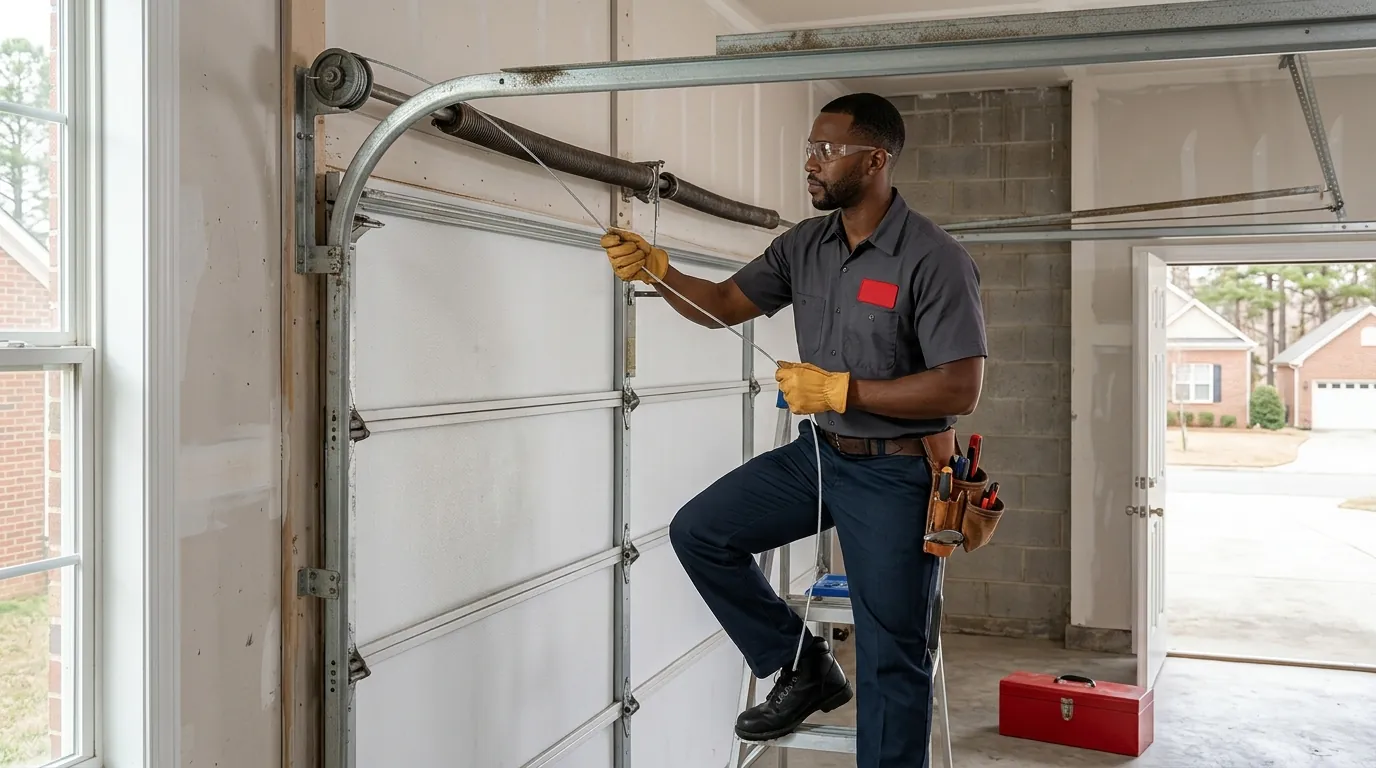
What do garage door cables do?
Garage door cables lift the door: each galvanized steel cable runs from a bottom corner of the door to a drum on the spring shaft, and the springs’ torque winds it up. Extension-spring doors run the cables over pulleys instead, with a separate safety cable inside each spring.
The torsion spring turns the shaft, the shaft turns a grooved drum at each end, and each drum winds its cable and lifts the bottom bracket it is tied to. The two cables are cut to the same length, so the door rises level.
| Cable | Route | Job |
|---|---|---|
| Torsion lift cable | Bottom bracket up to a drum on the spring shaft | Carries the door’s weight while the torsion spring lifts it |
| Extension lift cable | Bottom bracket over pulleys to the track hanger | Carries the door’s weight while the side springs stretch and pull |
| Safety (containment) cable | Through the middle of each extension spring | Holds a broken extension spring in place instead of letting it fly |
What are the signs of a broken garage door cable?
A broken garage door cable shows as frayed or rusted strands, a cable hanging loose beside the door, a door sitting lower on one side, or a door that jerks and stops partway. A snapped cable often follows a loud bang from the garage.
Fraying
Broken strands stick out along the cable, often near the bottom bracket or where the cable leaves the drum.
Rust
Brown or stiff cable no longer flexes into the drum grooves, and rusted strands break first.
Slack
A loose cable hangs beside the track instead of sitting tight from bracket to drum.
Tilt
One side of the door sits lower than the other, or the bottom edge meets the floor at an angle.
Jerking
The door shudders, stops partway or rises faster on one side.
Bang
A loud snap from the garage, then a door that hangs crooked or will not lift.
Seeing any of these? Leave the door where it is, switch the opener off and keep people and cars clear. Call (833) 752-1196: a cable call booked by 12 pm, Monday to Saturday, gets a same-day inspection visit, and the technician prices the job before touching the door. A door hanging on one cable at night calls for garage door emergency repair, available 24/7 in every city we serve.
Why do garage door cables come off the drum?
A garage door cable comes off its drum when it goes slack. The usual triggers are a broken spring, the door closing onto an object, a worn bottom bracket or a door that left its track. Each one lets the cable unspool and wrap unevenly, and uneven wraps tilt the door.
- Broken spring
- The spring stops turning the shaft, the drum stops taking up cable, and the cable falls slack off the drum.
- Obstruction under the door
- The bottom of the door lands on a bin or a car bumper while the opener keeps lowering it, so the cable loosens and jumps its groove.
- Worn bottom bracket
- A rusted or bent bracket loosens its grip on the cable loop and lets that side drop.
- Off-track door
- A roller out of the track lets one side sag, and the cable on that side goes loose.
- Salt-air corrosion
- DASMA notes that saline coastal locations shorten the life of door hardware; galvanizing slows rust but does not stop it, and rusted strands break under load.
How does garage door cable replacement work?
A garage door cable is replaced with the door closed and the spring tension released, and both cables are changed together. The technician fits new cables to the bottom brackets, winds them evenly onto the drums, restores the tension and checks that the door lifts level.
Close
The door is lowered and secured so it cannot move.
Release
The spring tension comes off with the correct tools. This is the technician-only stage.
Inspect
Drums, bottom brackets and springs are checked for the cause of the failure.
Fit
New cables of equal length go on both bottom brackets.
Wind
Each cable sits evenly in its drum grooves, and the drums are locked to the shaft.
Test
Tension goes back on, then the technician checks balance, level travel and auto-reverse. A balanced door stays about 3 to 4 ft above the floor when released.
Both cables go in as a pair. They are the same age and have carried the same load, and two new cables of equal length keep the door level.
No trip fee. The cable visit carries no trip fee.
Price first. Both cables are priced as a pair, and work begins only after you agree to that price.
Parts. Cables and drums carry the manufacturer’s warranty.
Can you replace a garage door cable yourself?
No. The lift cables and bottom brackets carry the springs’ full stored energy, and DASMA directs that only a trained door systems technician adjusts or replaces them. Loosening a cable or bracket under tension releases that energy at once.
A slack cable does not mean the springs are safe. The shaft and the other side still hold stored energy, so the brackets, drums and set screws stay untouched until a technician releases the tension.
What affects the cost of garage door cable repair?
Cable repair cost depends on whether one or both cables are replaced, the door’s height and lift type, and whether the drums, bottom brackets or a broken spring need replacing at the same time. The technician quotes the full job before starting.
Cable count
One side or both; a pair is standard.
Door height and lift type
Standard-lift, high-lift or low-headroom hardware.
Drums
Re-used, or replaced when a cable slip has chewed the grooves.
Bottom brackets
Worn or rusted brackets replaced with the cables.
Springs
A broken spring behind the cable failure.
Published ranges for cables, drums and other single parts sit in the repair price guide, and the cost to replace a broken garage door spring is set out with spring-and-cable job figures.
You hear the full price at the door, with no trip fee, and nothing starts until you agree. Request a garage door quote or Call (833) 752-1196.
Which parts fail with the cable: drums, pulleys and bottom brackets?
A cable failure usually involves a cable drum, an extension-spring pulley, the center bearing plate or a bottom bracket, and most slack cables trace back to a broken spring. A technician checks each part on a cable call, because a new cable on a chewed drum or a rusted bracket fails again.
- Lift cable
- Commonly 1/8 in, 7×19 galvanized aircraft cable, cut in equal pairs. The lift cable carries the door; the safety cable on an extension door only contains a broken spring.
- Cable drum
- A 4 in standard-lift drum suits doors up to 8 ft tall; high-lift doors use larger high-lift drums. A cable that slipped its grooves chews them, and the drum is replaced with the cable.
- Extension pulleys
- On extension-spring doors the cable runs over pulleys at the track hanger and on the spring. A seized or cracked pulley frays the cable where it turns.
- Center bearing plate
- Holds the torsion shaft and springs to the wall above the door. A cracked plate or worn bearing lets the shaft shift, and the drums then wind unevenly.
- Bottom bracket
- Anchors the cable loop at each lower corner and carries the full spring tension. It is technician-only work on every door.
The new spring and the new cables go on in one visit, and the spring hub explains what a spring replacement on a heavy door involves. A door that hung on one cable for a while often twists out of its track; rollers go back in and bent track is straightened or replaced, which is crooked garage door repair.
Waiting for the technician? The guide to a garage door cable snapped or off the drum covers what to leave alone and how to keep the garage safe until the visit.