
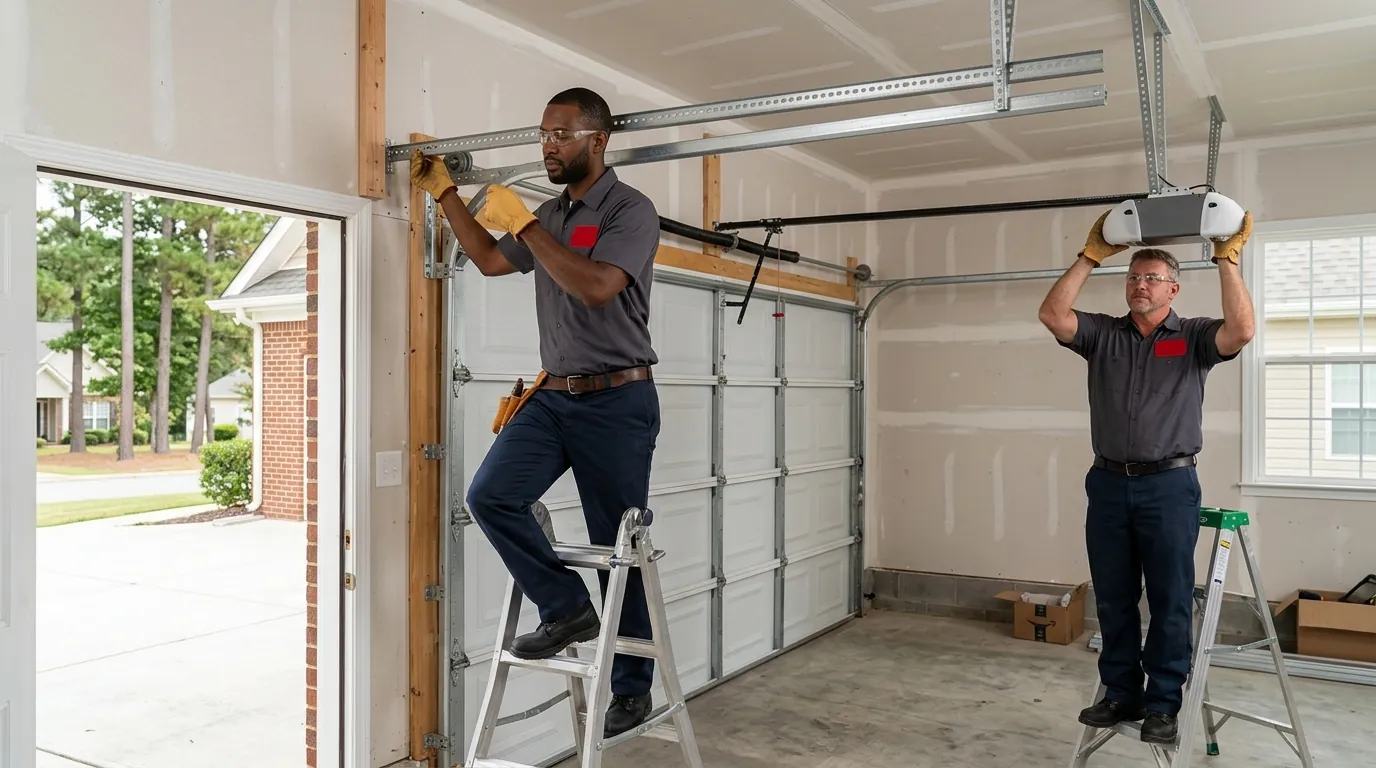
Which garage door opener do you need?
Install a belt-drive opener for the quietest operation, a chain drive for the lowest cost, or a wall-mount jackshaft unit to clear the ceiling on a torsion-spring door. Heavier doors call for more motor capacity, and DC motors support battery backup during power cuts.
| Drive type | How it moves the door | Noise and upkeep | Suits |
|---|---|---|---|
| Chain drive | A metal chain pulls the trolley along the rail | The loudest type; durable and the least expensive | Detached garages and budget replacements |
| Belt drive | A rubber belt replaces the chain | The quietest rail type, with low vibration | Garages under bedrooms or a bonus room |
| Screw drive | The trolley rides a long threaded rod inside the rail | Few moving parts; sensitive to wide seasonal temperature swings | Heavy doors in garages with steady temperatures |
| Direct drive | The motor sits inside the trolley and runs along a fixed chain | The chain stays still; the motor carriage is the one moving part | Standard residential doors on a ceiling rail |
| Wall-mount jackshaft | A motor beside the door turns the torsion spring shaft | No ceiling rail; the most costly type, with the most features | Torsion-spring doors, high ceilings, storage racks and car lifts |
Genie advises against screw drives where seasons swing widely, which matters most in North Carolina’s mountain counties.
Motor capacity
A heavier door, such as an insulated double door, needs a stronger motor. Compare the horsepower rating and the motor type, AC or DC; DC motors start and stop softly.
Battery backup
DC units accept a backup battery, so the door still opens and closes when the power goes out during a storm.
Smart and secure
Wi-Fi and app control (myQ, Aladdin Connect) show whether the door is closed from your phone. Rolling-code remotes (Security+ 2.0, Intellicode) change the code on every press.
What is a wall-mount jackshaft garage door opener?
A wall-mount jackshaft opener is a motor fixed to the wall beside the door that turns the torsion spring shaft directly, so no rail runs across the ceiling. It works only with torsion-spring doors and frees overhead space for storage, high-lift track or a car lift.
A rail opener hangs a powerhead in the middle of the ceiling and pulls the door by its top section. A jackshaft unit sits at the end of the spring shaft and rotates it. Genie puts the ceiling space it frees at 48 in or more.
The door has to be on torsion springs, the springs mounted on a shaft above the opening. Doors on extension springs, which stretch along the horizontal tracks, need a rail opener instead. The technician confirms the spring type and the wall space beside the shaft before quoting a wall-mount unit.
What does a new opener need from your door and garage?
A new opener needs a balanced door, a strut on the top section, the manual lock disabled, enough headroom for the rail, and a grounded or GFCI outlet within cord reach. Rails for 8 ft and 10 ft doors need extension kits.
- Balance
- Lifted by hand to 3 to 4 ft off the floor, the door stays put. A door that drops or rises has a spring problem to fix first.
- Top-section strut
- A steel strut across the top section, where the opener arm attaches, stops the section from bending under the opener’s pull.
- Manual lock
- The door’s slide lock is disabled or removed, so the opener never pulls against a locked door.
- Headroom
- Torsion hardware needs 12 in above the opening with a 12 in radius track, or 15 in with a 15 in radius track; add 3 in for a rail opener.
- Power
- A grounded or GFCI ceiling outlet within reach of the opener’s cord, with no extension cord.
- Rail length
- The standard rail fits a 7 ft door; 8 ft and 10 ft doors take an extension kit.
A missing ceiling outlet is the one item a garage door technician does not install. Plugging in and servicing a cord-connected opener is exempt from electrical licensing in North Carolina, but a new receptacle is electrical contractor work under G.S. 87-43.1(7). The technician tells you at the visit whether you need one.
How is a garage door opener installed?
A garage door opener is installed in 7 stages: balance-check the door, reinforce the top section, fit the header bracket, hang the rail and powerhead, attach the door arm, mount the sensors and wall control, then set limits and force and test reversal.
Check
Check the door’s balance and springs, and fix the door first when it fails.
Reinforce
Reinforce the top section with a strut and disable the manual lock.
Fit
Fit the header bracket to solid framing above the opening.
Hang
Hang the rail and powerhead from the ceiling framing, or mount the jackshaft unit on the wall beside the shaft.
Connect
Connect the door arm to the trolley and to the bracket on the top section.
Mount
Mount the photo-eyes with the beam no higher than 6 in above the floor, the wall control at least 5 ft up and in view of the door, and the red emergency release no higher than 6 ft.
Set and test
Set the travel limits and force, pair your remotes and keypad, then pass the contact-reversal test on a 1-1/2 in board and the photo-eye test.
The technician gives you the price before any work starts, and the work starts only when you say yes. There is no trip fee anywhere in our North Carolina service area. The installation labor carries a 1-year warranty, and the opener carries the manufacturer’s warranty, which we register for you.
Ready for a new opener? Call (716) 328-9097 or request a garage door quote online. Phones are answered 24 hours a day, 7 days a week.
When is it time to replace a garage door opener?
Replace a garage door opener when it has no photo-eye sensors, fails the reversal test, needs parts that are no longer made, or is too loud for rooms above the garage. North Carolina home inspectors report non-reversing openers since June 1, 2026.
No photo-eyes
Openers made on or after January 1, 1993 must reverse within 2 seconds of striking an object and carry a secondary safety device such as photo-eyes (16 CFR 1211). A unit without them predates the rule.
Failed reversal
The door keeps closing on the 1-1/2 in board, or when something breaks the photo-eye beam.
Discontinued parts
The logic board, gear or remotes for the model are no longer made, so the repair has no parts.
Noise under living space
A chain drive under a bedroom or bonus room wakes the house on every early departure.
Radio interference
Military radios use 380 to 399.9 MHz. Older openers near 390 MHz lose range near bases; dual-frequency receivers avoid the overlap.
Selling your home? Since June 1, 2026, North Carolina home inspectors report any opener that does not reverse on resistance, any door that does not reverse when the photo-eye beam is broken, and any opener with no photo-eyes at all (11 NCAC 08 .1107). A new opener clears all three before the inspection.
An opener with one of these signs is due for replacement. Call (716) 328-9097 to have a technician check the door and price a new unit.
What affects the cost of garage door opener installation?
Opener installation cost depends on the drive type, motor capacity and features such as battery backup and Wi-Fi, the door’s height and rail length, and whether the door needs a strut, spring work or a new outlet first. The price comes before any work.
Drive type
Chain, belt, screw or wall-mount jackshaft.
Features
Battery backup, Wi-Fi control, extra remotes or a keypad.
Door height
A rail extension kit for an 8 ft or 10 ft door.
Door work
A strut, spring or balance repair before the opener goes on.
Power
A new ceiling outlet, which is electrical contractor work.
The technician prices the exact opener, its extras and any door work in one quote, and nothing is installed until you say yes. Request your opener quote online or call (716) 328-9097.
Does the door need repair before a new opener?
A new opener is only as good as the door it moves.
Fix the door first: an opener moves a balanced door, and a broken spring or binding track makes a new opener strain and reverse. The technician checks the springs, cables and track before quoting an opener, and quotes both when both need work.
An opener that strains or reverses is often fighting the door. An opener that hums but will not lift often has a broken spring behind it, not a dead motor. Same-day repair visits are available for calls booked by 12 pm, Monday to Saturday.
A door with rusted, cracked or bent sections changes the plan. When you replace an old garage door, the new opener goes on at the end of that job, sized to the new door’s weight, and estimates for new garage doors are free.