
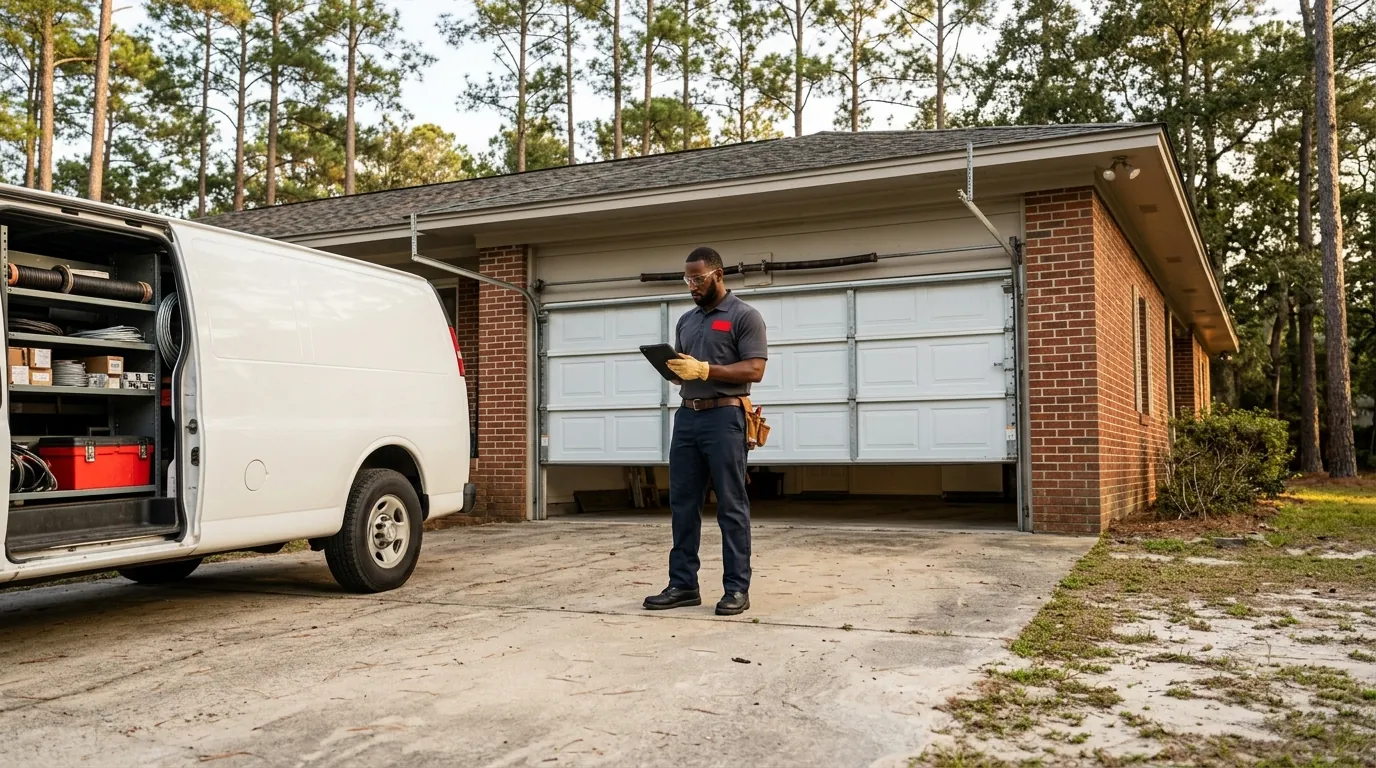
Which garage door symptoms bring Fayetteville homeowners to call?
Six symptoms cover the common garage door failures in Fayetteville homes: a remote that works only up close, a door that opens by itself, a bang followed by a heavy door, a loose cable, a door off its track and an opener that hums. Each symptom points to a different cause and a different fix.
| Symptom | Most common cause | Fix |
|---|---|---|
| Remote works only a few feet away | Dead remote battery, lock mode on the wall control or LED bulbs in the opener. Near military bases, land mobile radios on 380 to 399.9 MHz | Battery and lock-mode check, then a dual-frequency receiver or Wi-Fi control |
| Door opens by itself | Stuck remote button, shorted wall control or wiring, or a neighbor’s remote paired to your opener | Opener memory cleared, your remotes reprogrammed, wiring repaired |
| A bang, then a door too heavy to lift | Broken torsion or extension spring | Matched spring pair fitted, door balance tested |
| Cable hanging loose or door crooked | Spring failure, or the door closed on an obstruction | New lift cables fitted, cable drums rewound |
| Door off its track | Slack cable, bent track or a vehicle impact | Rollers re-seated, track straightened or replaced |
| Opener hums, door stays put | Broken spring, engaged door lock, failed capacitor or stripped drive gear | Cause diagnosed before any part is ordered |
Every row is fixed by garage door repair technicians who test the opener’s auto-reverse after each job. A snapped cable gets broken lift cable service with the spring tension released first, and extension spring replacement includes containment safety cables, steel cables threaded through each spring that stop a broken spring from whipping across the garage.
Heard a bang or see a cable hanging? Stop using the opener, keep cars and children clear of the door and call (716) 328-9097. Phones are answered 24 hours a day, 7 days a week.
Why do garage door remotes lose range near Fort Bragg?
Garage door remotes lose range near military bases because Department of Defense land mobile radios use 380 to 399.9 MHz, overlapping openers that receive around 390 MHz. Openers are unlicensed devices and must accept the interference; openers working at 310 to 320 MHz are unaffected.
A land mobile radio is a two-way voice radio system; the military uses it for base operations. MHz (megahertz) measures the frequency a radio transmits or receives on. The opener’s receiver is the circuit that listens for the remote’s signal. A stronger military signal on the same frequency drowns out the remote, so the remote works only a few feet from the door. Fort Bragg, the U.S. Army installation on Fayetteville’s outskirts, was renamed from Fort Liberty back to Fort Bragg in 2025. Interference is a known cause near military bases in general, not a documented Fayetteville fault, and the same checks apply to every home.
- Military land mobile radio band
- 380 to 399.9 MHz, assigned to the Department of Defense.
- Worst overlap with openers
- 387 to 393 MHz, according to the U.S. Government Accountability Office (GAO-06-172R).
- Distance of recorded complaints
- Up to about 10 miles from a base, in the same GAO report.
- Openers affected and unaffected
- Openers receiving around 390 MHz, including older Chamberlain, LiftMaster and Genie models, were affected. Openers working at 310 to 320 MHz were not (DASMA, the garage door manufacturers’ association).
- Manufacturer advice
- Genie tells owners within 50 miles of a military base or airport to check for frequency interference.
Garage door openers are unlicensed devices under Part 15 of the FCC rules. Part 15 devices have no protected frequency and must accept interference from authorized radio users, so the fix happens at the opener, not at the base.
How is military-band interference with a garage door opener fixed?
Military-band interference is fixed at the opener, not the remote: a technician rules out batteries, lock mode and LED bulbs, confirms the receiver frequency, then fits a dual-frequency receiver, adds Wi-Fi control or replaces the opener. A new remote alone changes nothing.
A new remote transmits on the same frequency the old one did, so the radio still drowns it out. Rolling-code remotes, which send a new code on every press, protect against code copying, not against a stronger signal on the same band. The first three steps are safe for any homeowner:
Replace the remote battery and turn off lock mode
A weak battery shortens range on its own. Lock mode, set from the wall control, blocks every remote until it is switched off.
Remove LED bulbs from the opener for a test
Some LED bulbs emit radio noise near the opener’s antenna. Range that returns with the bulbs out points to the bulbs, not the base.
Read the opener’s frequency from its label
The label on the motor unit lists the frequency. An opener around 390 MHz sits in the military band; one at 310 to 320 MHz does not.
Book a receiver retrofit or Wi-Fi control
A dual-frequency receiver listens on 315 and 390 MHz and switches away from the crowded band. Wi-Fi control opens the door from a phone and skips radio range altogether. An opener past repair is replaced with a unit outside the affected band. Call (716) 328-9097 to book the visit.
Which wind zone is your Fayetteville home in?
A Fayetteville home west of I-95 is in the 120 mph design wind speed zone, and a home east of I-95 is in the 130 mph zone, under the 2018 NC Residential Code. A replacement garage door needs a rating that meets its side of the highway.
Design wind speed is the gust speed a building, garage door included, must be built to withstand. Cumberland is the only North Carolina county the code splits at I-95.
| Location | Design wind speed | What it means for a garage door |
|---|---|---|
| West of I-95 | 120 mph | A door labeled for the 120 mph zone’s design pressure |
| East of I-95 | 130 mph | Design follows R301.2.1.1 (ASCE 7, ICC 600, the Wood Frame Construction Manual, the IBC or NCRC Chapters 45 and 46). DASMA TDS 155h gives +12.5 / −13.9 psf for a 16×7 door on a single-story home |
Garage doors are labeled in psf (pounds per square foot of design pressure), not in mph. The plus value is the push of wind against the door, and the minus value is the pull on it. The DASMA figures assume a 15 ft roof height in suburban terrain (Exposure B). Every new door comes with a free in-home estimate: the technician measures the opening, confirms which side of I-95 the home is on and quotes a door with the matching label.
What changes the cost of garage door repair in Fayetteville?
The cost of a Fayetteville repair depends on the symptom’s actual cause, the part replaced, the opener’s model and receiver, the door’s size and weight, and the wind rating a new door needs. The technician gives you the full price before any work starts.
Actual cause
A remote fault traced to a battery is a smaller job than one traced to the opener’s receiver.
Part replaced
A single roller is a smaller job than a pair of torsion springs or a set of lift cables and drums.
Opener model and receiver
Some 390 MHz openers take a dual-frequency receiver; others are past a retrofit and need a new opener.
Door size and weight
A 16×7 double steel door needs heavier springs and longer cables than a 9×7 single door.
Wind rating
A new door east of I-95 must meet the 130 mph zone, which narrows the models that qualify.
There is no trip fee anywhere in our North Carolina service area. The work starts only when you say yes.
When can a Fayetteville technician arrive?
A Fayetteville call booked by 12 pm, Monday to Saturday, gets a same-day visit. Phones are answered 24 hours a day, 7 days a week, and emergency service is available 24/7 in every city we serve, with no trip fee.
At the door, the visit runs in one order: diagnose the cause, give you the price, wait for your yes, repair, then test the door’s balance and auto-reverse with you. Every repair carries a 1-year labor warranty; parts carry the manufacturer’s warranty, which we register for you.
The same symptoms and the same wind-zone line apply across Cumberland County’s towns.
Fayetteville neighborhoods and Cumberland County towns
Technicians who work in Fayetteville cover the city, the towns of Cumberland County and nearby Raeford:
- Haymount
- Hope Mills
- Spring Lake
- Eastover
- Stedman
- Wade
- Godwin
- Vander
- Raeford (Hoke County)
- Fort Bragg: on-post and off-post homes
Half of Cumberland County’s homes were built in 1988 or earlier, and 55.0% of occupied homes are owner-occupied (ACS 2020–2024).