
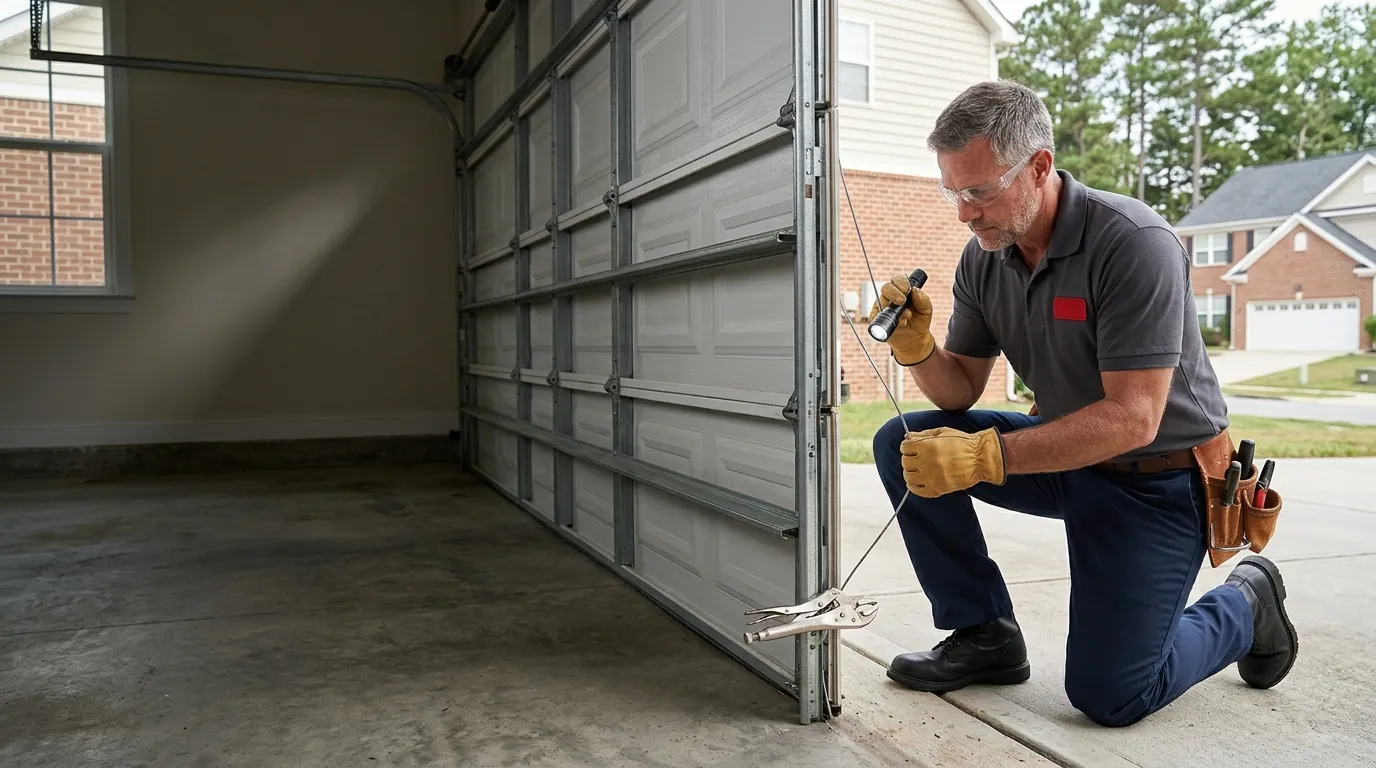
What garage door repairs do technicians handle?
Technicians handle 6 kinds of garage door repair: torsion and extension spring replacement, lift cable repair, roller replacement, off-track and track repair, damaged panel replacement, and opener repair. Each one starts with a diagnosis at your home and a price before any work begins.
Spring replacement
A broken spring leaves the door too heavy to lift, by hand or by opener. The technician fits a matched torsion or extension pair sized to the door’s weight, sets the tension and balance-tests the door. Spring types, cycle ratings and warning signs are on the counterbalance spring replacement page.
Cable repair
A frayed or snapped lift cable drops one side of the door. Both 1/8 in galvanized cables are replaced as a pair, the drums re-seated and the door set level. Signs and causes are on the broken lift cable service page.
Roller replacement
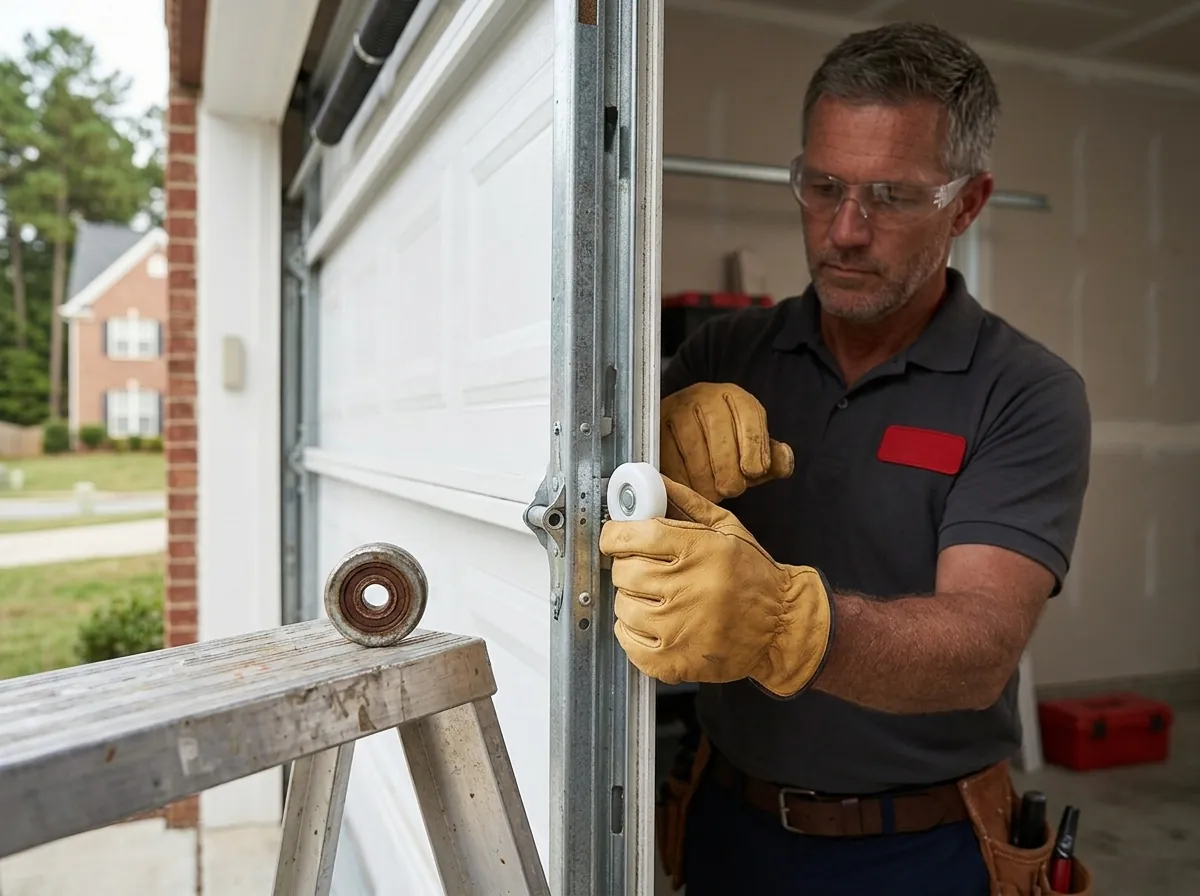
Cracked, flat-spotted or seized rollers grind, shake and wear the track. They are swapped for sealed-bearing nylon rollers, which run quieter, or for steel rollers.
Off-track and track repair
A door with rollers out of the track hangs crooked and binds. The technician straightens or replaces the bent track, returns the rollers and sets both tracks plumb and parallel.
Panel replacement
One dented or cracked section is replaced on its own when the manufacturer still makes that door model, so the rest of the door stays in place.
Opener repair
Openers that hum, reverse or ignore the remote get their gears, capacitors, logic boards, sensors and travel settings repaired, on chain, belt and wall-mount units.
Why won’t my garage door open or close?
A garage door that won’t open usually has a broken spring, lock mode switched on, a dead remote battery or a pulled emergency release. One that won’t close usually has a blocked or misaligned photo-eye, wrong travel limits or an object in its path.
Each symptom points to a part, and the part decides who fixes it. Anything under spring tension is technician work.
| Symptom | Likely cause | Who fixes it |
|---|---|---|
| Won’t open | Broken spring, lock mode on, dead remote battery, pulled emergency release, no power at the outlet | Owner checks lock mode, battery, release and power first; a broken spring is technician work |
| Won’t close | Blocked or misaligned photo-eyes, wrong travel limits, an object in the path | Owner clears the path and cleans and aligns the photo-eyes; technician for limits |
| Loud bang, then the door won’t lift | Broken torsion spring | Technician |
| Door hangs crooked | Broken spring, slack cable or a cable off its drum | Technician |
| Door off its track | Slack cable, bent bracket or a knock from a car | Technician |
| Door feels heavy by hand | Weak or broken spring | Technician |
| Grinding or scraping | Worn rollers, dry hinges or bent track | Owner lubricates hinges; technician replaces rollers and track |
| Light or drafts under the closed door | Worn bottom seal | Owner |
The owner checks, in the order to try them, are in the garage door won’t open or close guide.
Heard a bang, or is the door hanging crooked? Leave it where it is, unplug the opener and keep cars and people clear. Call (716) 328-9097: calls booked by 12 pm, Monday to Saturday, get a same-day visit, and there is no trip fee.
Which garage door parts fail, and what does each one do?
The parts that fail are the springs that lift the door, the cables that connect it to the drums, the rollers and tracks that guide it, the sections that form it, and the opener that moves it. Springs fail most often, from cycle fatigue.
The springs, not the opener, carry the door. A counterbalance system of springs, cables and drums holds the door’s weight, and the opener only moves a door that is already balanced. That is why an opener hums, strains or stops when a spring breaks, even though its motor still works.
| Part | Job | Specification | Failure sign |
|---|---|---|---|
| Torsion spring | Lifts the door by twisting on the shaft above the opening | Standard springs are rated for about 10,000 cycles; high-cycle springs for 25,000 to 100,000+ | A gap in the coil, a loud bang, a door too heavy to lift |
| Lift cable | Connects each bottom bracket to a drum on the spring shaft | 1/8 in, 7×19 galvanized steel cable | Frayed strands, slack cable, one side lower |
| Roller | Rides in the track and guides the door | Nylon with sealed bearings, or steel | Wobble, grinding, a cracked wheel |
| Track | Channels the rollers from vertical to horizontal | 2 in steel channel with a 12 in or 15 in radius curve | Bends, dents, loose brackets |
| Section | Forms the door, panel by panel | 3 to 8 hinged sections per door | Dents, cracks, bowing |
| Opener | Moves the balanced door | Chain, belt or wall-mount drive | Hums without lifting, reverses, ignores the remote |
| Photo-eye sensors | Reverse the opener when the beam is broken | Beam no higher than 6 in above the floor | Blinking sensor light, a door that reverses before closing |
Since June 1, 2026, North Carolina home inspectors report any opener that does not reverse on resistance, any door that does not reverse when the photo-eye beam is broken, and any opener without photo-eyes (11 NCAC 08 .1107). A technician repairs the sensors and reverse settings that fail that check.
How does a garage door repair visit work?
A repair visit runs in 5 steps: the technician checks the whole door, names the failed part and its cause, gives the price, makes the repair once you say yes, and finishes with balance and auto-reverse tests. There is no trip fee.
Inspect
Check the whole door: springs, cables, drums, rollers, track, sections, opener and sensors.
Name
Show you the failed part, why it failed and which parts near it are worn.
Quote
State the full price before any work starts.
Repair
Start the work only when you say yes.
Test
Check the door’s balance and the opener’s auto-reverse before leaving.
No trip fee
No trip fee anywhere in our North Carolina service area.
Price first
The technician gives you the price before any work starts, and the work starts only when you say yes.
Same-day visits
Same-day visits for calls booked by 12 pm, Monday to Saturday.
Phones 7 days
Phones are answered 24 hours a day, 7 days a week, and emergency service is available 24/7 in every city we serve.
Warranty
1-year labor warranty on every repair; parts carry the manufacturer’s warranty, which we register for you.
Which garage door repairs are safe to do yourself?
Safe owner repairs are replacing remote batteries, turning off lock mode, cleaning and aligning photo-eyes, lubricating hinges and replacing a bottom seal. Springs, cables, bottom brackets and off-track doors hold stored spring energy, and DASMA directs that work to trained technicians.
Safe for owners
Remote batteries
Replace the battery when the remote works only up close or not at all.
Lock mode
Turn off lock or vacation mode on the wall control when remotes stop working but the wall button still runs the door.
Photo-eyes
Clean the lenses and align the two sensors until both lights stay steady.
Hinge lubrication
Lubricate the hinges with a garage door lubricant to quiet squeaks.
Bottom seal
Replace a cracked or flattened seal that lets light or water under the door.
Technician work
Springs
A wound torsion spring stores the energy that lifts the whole door, and it releases that energy at once when handled wrong.
Cables
Lift cables carry the spring’s full load between the drum and the bottom bracket.
Bottom brackets
The bottom bracket anchors the cable, and loosening it under tension releases the spring’s load.
Off-track doors
A door out of its track is held up by uneven cable tension and can fall when moved.
Bent track
The track holds the rollers that keep the door up, so it is straightened or replaced with the door secured.
What affects the cost of garage door repair?
Garage door repair cost depends on the failed part, how many parts failed together, the door’s size and weight, the spring or opener type, and whether matching parts are still made. The technician states the full price before any work starts.
Failed part
A photo-eye realignment, a roller swap and a spring pair are different jobs with different parts.
Parts count
One failure often brings another: a broken spring leaves a cable slack, and a slack cable pulls a door off its track.
Door size and weight
A double-wide or insulated steel door needs heavier springs and stronger hardware than a single door.
Spring or opener type
Torsion and extension springs, and chain, belt and wall-mount openers, each use their own parts.
Parts availability
A section or opener board for a discontinued model is harder to match than a current one.
There is no trip fee, so the diagnosis costs nothing when you decide not to go ahead. Request a repair quote or call (716) 328-9097 and describe the symptom.
The same repairs, and the same policies, apply in every city on the service list.
Where do our technicians repair garage doors in North Carolina?
Technicians repair garage doors across North Carolina, with city pages for Charlotte, Raleigh, Greensboro, Wilmington, Winston-Salem, Fayetteville, Durham, Cary, Asheville, Concord and more. The same policies apply everywhere, including no trip fee and the price before any work.
- garage door repair in Charlotte
- garage door repair in Raleigh
- garage door repair in Greensboro
- garage door repair in Wilmington
- garage door repair in Winston-Salem
- garage door repair in Fayetteville
- garage door repair in Durham
- garage door repair in Cary
- garage door repair in Asheville
- garage door repair in Concord
- garage door repair in Mooresville
- garage door repair in Huntersville
- garage door repair in Marvin
- garage door repair in New Bern