
Which parts of an older Lexington garage opening decide the repair?
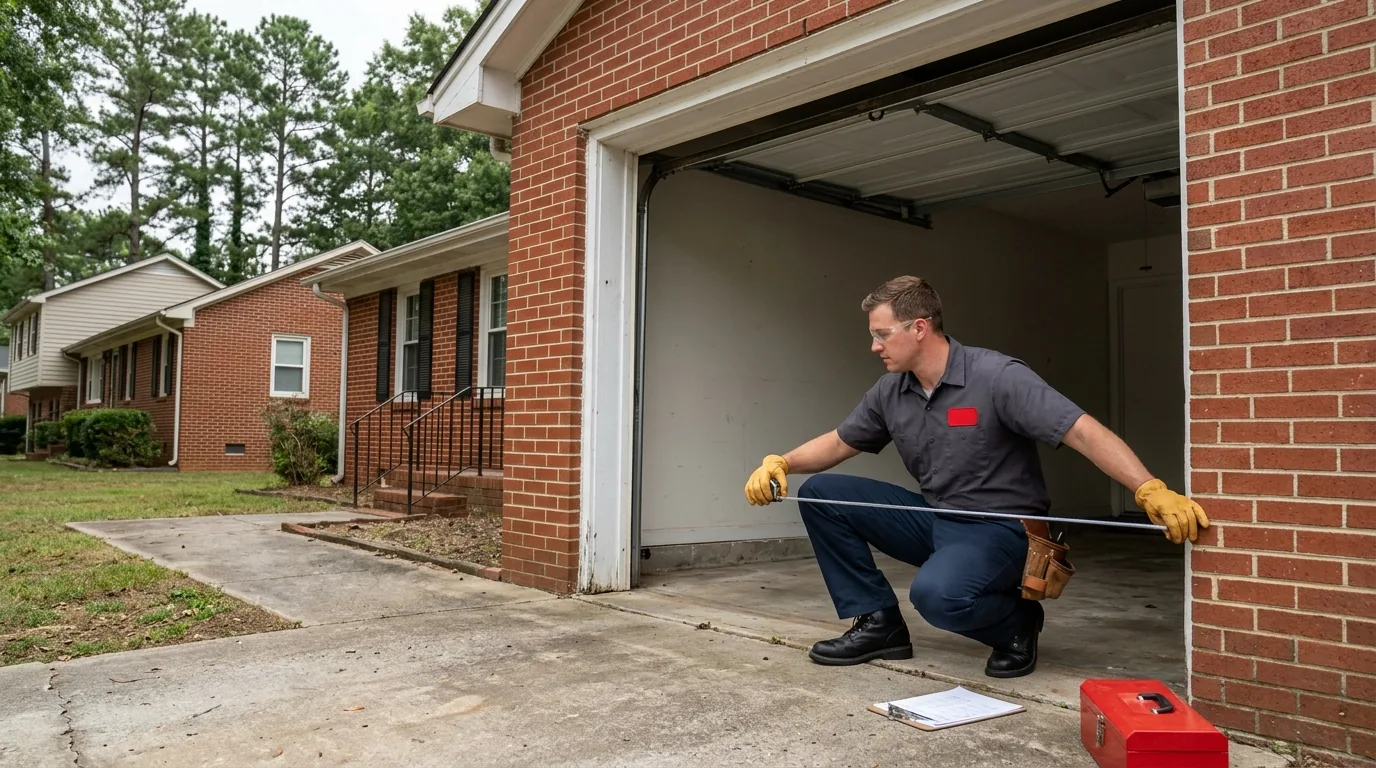
Five parts of the opening decide how a Lexington garage door is repaired or replaced: the floor slab, the side jambs, the header and the headroom above it, the ceiling depth behind it, and the width and height of the opening. A technician checks each one before pricing the work.
The opening is the framed hole the door fills. Jambs are the vertical boards on each side that the track brackets bolt into; the header is the beam across the top. Each row below names a part, what the technician checks there, and what the result decides.
| Part of the opening | What the technician checks | What it decides |
|---|---|---|
| Floor slab | Whether the concrete is level across the width, and any crack or raised edge where the bottom seal lands. | How the gap under a closed door is sealed; the technician fits the threshold and the side weatherstripping to match. The guide to threshold and bottom seal options covers each profile. |
| Side jambs and sideroom | Plumb, solid wood with no rot at the bottom, and 3-3/4 to 5-1/2 in of clear wall beside the opening for track and brackets. | Whether the vertical track runs straight. Out-of-plumb or soft jambs come first, then track realignment. |
| Header and headroom | A straight header, and 12 in of space above the opening for torsion track with a 12 in radius, 15 in for a 15 in radius, plus 3 in for an opener. | Whether the door keeps standard track with a torsion spring above it; an old extension-spring door with enough headroom can be converted to torsion. |
| Ceiling depth | Clear depth into the garage equal to the door height plus 18 in. | Whether the horizontal track, and later an opener rail, fit under the ceiling. |
| Width and height | The finished opening against standard sizes: 8 or 9 ft wide by 7 ft high for a single door, 16 by 7 ft for a double. | Whether a standard door fits. See standard garage door sizes and measurements. |
Door binding in its opening, or daylight showing under it? Describe what it is doing and Call (833) 752-1196. The line is staffed at 2 am and at 2 pm alike.
Does a 1950s or 1960s opening take a standard replacement door?
A standard replacement door fits when the opening measures to a standard width and height and its jambs and header are sound. An opening between sizes is framed in to the nearest standard size, and an opening that has to grow is a header job; the technician prices the route before any work starts.
Lexington garages framed in the 1950s and 1960s are measured before a door is ordered, because a new door is built to a size and the opening has to match it. Three outcomes come from that measurement:
The opening matches a standard size
A new door goes into the existing framing, with new track bolted to sound jambs. An 8 ft opening takes an 8 ft door, which the technician fits like any other size.
The opening falls between sizes
The technician builds out the jambs or header so the opening matches the nearest standard door, with no carpenter needed for that framing.
The opening has to be wider or taller
The header changes, which is load-bearing work and needs a building permit.
Each route ends with a replacement door fitted to an older opening, balanced and tested before the technician leaves. Replacing a door in the same opening is not treated as load-bearing work under North Carolina law.
Can an opener be added to a manual garage door?
Yes, once the door is balanced and the opening has room for the opener and its rail. The springs, not the opener, carry the door’s weight, so a technician checks balance and spring condition first, then fits the opener, its photo-eyes and a wall button.
A manual door that feels heavy to lift has springs that have lost tension or broken. An opener is built to move a balanced door, not to lift its full weight, so the door is brought back into balance first. Four checks come before the opener goes up:
The door is balanced
Disconnected from any opener, a balanced door stays put 3 to 4 ft above the floor.
The springs are sound
Worn or mismatched springs are replaced in a matched pair before an opener is added; this is spring replacement on an older door.
An outlet is within cord reach
The opener plugs into a grounded outlet near the ceiling, with no extension cord. North Carolina law lets a door technician plug in and service a cord-connected opener; adding a missing outlet is wiring work for an electrician.
There is room for the rail
The opener adds 3 in to the headroom the track needs, and the rail runs back along the ceiling; where the ceiling is tight, a rail kit sized to the room goes in.
Every opener made since January 1, 1993 reverses within 2 seconds of touching an obstruction and carries a secondary safety device such as photo-eyes, mounted no higher than 6 in above the floor. The technician sets both and runs the reversal test on the opener installed on a manual door.
How does a one-piece tilt-up door differ from a sectional door?
A one-piece tilt-up door is a single panel that tilts up and out through the opening, where a sectional door folds along tracks. Technicians repair both kinds.
An older garage can still hang a one-piece door. Its springs and pivot hardware bolt to the jambs, so the opening matters as much here as it does for a sectional door: the technician checks the jambs and header first, then prices the springs, hinges and pivots that need work. The page on one-piece tilt-up door repair covers the parts in detail.
Why do Lexington’s older homes put the opening before the door?
The median Lexington home dates from 1969, 68.1% of homes were built before 1980, and 19.4% were built before 1950. A garage framed before 1980 has stood at least 46 years, long enough for a slab to crack and a jamb to soften, so the opening is checked before any new hardware goes in.
- Median year built
- 1969 in Lexington and 1985 across Davidson County (ACS 2020-2024 5-year).
- Built before 1980
- 68.1% of Lexington housing units, including 19.4% built before 1950 (ACS 2020-2024 5-year).
- Largest building decade
- The 1950s, with 19.1% of Lexington housing units (ACS 2020-2024 5-year).
- Owner-occupied
- 41.6% of occupied homes in Lexington and 74.4% across Davidson County (ACS 2020-2024 5-year).
Lexington, the Davidson County seat, was incorporated in 1828 and sits 20 miles south of Winston-Salem. Its economy ran on textile and furniture manufacturing until the late 1990s. The Lexington Residential Historic District alone counts 804 contributing buildings built between about 1854 and 1957, from Queen Anne houses to bungalows.
What drives the price of garage door repair in Lexington?
The price follows the failed part or the new door, the size of the opening, any framing or seal work the opening needs first, and whether matching parts are still made. No trip fee applies anywhere in our area.
Part or new door
A bottom seal or a roller is a smaller job than a spring pair, an opener or a whole door.
Opening size
A 16 ft double door has more sections and heavier springs than a single door.
Opening work
Built-out jambs, a threshold seal or a straightened track add to the door work.
Part availability
Sections for an older door that are no longer made turn a repair into a new door.
Nothing goes on the door until you approve the price. With 41.6% of Lexington homes owner-occupied, many garages belong to a landlord: a tenant can book the visit, and the technician gets the landlord’s approval by phone. Third-party figures for new doors are on the page for garage door installation prices.
How soon can a technician measure an older opening?
For a same-day inspection visit, book by 12 pm on any day from Monday to Saturday. Emergency service for a door that will not close runs 24/7, whichever city you call from.
Lexington’s historic districts and the Davidson County communities nearby
Technicians who work in Lexington cover its older districts and the Davidson County communities around the city, where I-85, US 29, US 52, US 64 and US 70 meet:
- Uptown Lexington
- Erlanger Mill Village
- Lexington Residential Historic District
- Welcome
- Tyro
- Linwood
- Silver Valley
- Churchland
- Reeds
- High Rock Lake
Service visits cover these Lexington zip codes and nearby towns:
- 27294
- 27295
- 27374 (Welcome)
Northeast on I-85, see Thomasville garage door service. Southwest across the Yadkin River, see Salisbury garage door technicians.