
Garage Door Opener Not Working? 9 Causes Checked in Order
Nine causes stop most garage door openers; five need no tools. This guide checks them in order on LiftMaster, Chamberlain and Genie units that hum, click, reverse or do nothing: power, lock mode, the remote battery, photo-eyes and the release first, then travel limits, a broken spring, a stripped gear and a failed capacitor or logic board. Each step says what a North Carolina homeowner tests safely.
Request a call back
Why is my garage door opener not working?
A garage door opener stops working for 9 common reasons: no power, lock mode, a dead remote battery, blocked photo-eyes, a disconnected trolley, wrong travel limits, a broken spring, a stripped drive gear or a failed capacitor or logic board. The first five are homeowner checks.
A garage door opener is the motorized unit that moves a balanced door. The springs carry the door’s weight; the opener only drives it up and down. Its powerhead, the box on the ceiling or beside the door, holds the motor, the drive gear and sprocket, a start capacitor on AC motors, the logic board, the radio receiver and the light.
The symptom narrows the list before you touch anything:
Silent powerhead, no light
Power: the outlet, GFCI or breaker.
Remotes dead, wall button works
Lock mode, a remote battery or lost pairing.
Door reverses or will not close, lights flash
Photo-eyes blocked or out of line.
Motor runs, door stays put
Disconnected trolley, broken spring or stripped gear.
Hum or click, no movement
Broken spring, lock engaged or failed capacitor.
Causes 6 to 9 are garage door opener repair work: limits, gears, capacitors and boards are set or replaced inside the powerhead.
Garage door opener troubleshooting: which checks come first?
Opener troubleshooting starts with power and the wall control, then remotes, photo-eyes and the release, because these five need no tools. Travel limits, springs, the drive gear and the capacitor or logic board come last, since each involves a technician, the powerhead or spring tension.
Work down the list and stop at the first check that fixes the door. Each step names who does it.
Check the outlet, GFCI and breaker (You)
Look for a lit powerhead light or wall control. Reset a tripped GFCI outlet or breaker. DASMA’s guidance calls for a grounded or GFCI receptacle and no extension cord.
Turn off lock mode on the wall control (You)
Lock mode blocks every remote while the wall button still works. On Chamberlain and LiftMaster units the lights flash twice when a remote is pressed in lock mode.
Replace the remote or keypad battery and re-pair it (You)
A fresh battery fixes most dead remotes. A remote that still fails needs pairing again with the learn button on the powerhead.
Clean and align the photo-eyes (You)
Wipe both lenses, clear the beam and turn the eyes until both LEDs glow steadily. Low sun shining straight into a sensor also stops the door.
Reconnect the trolley, with the door closed (You)
A pulled red release separates the door from the drive, so the opener runs and the door stays still. Reconnect it only with the door down: with a broken spring, an open door drops.
Reset the travel limits and force (Technician recommended)
A down limit set past the floor makes the door reverse; one set short stops it early. Force stays at the minimum needed and never makes up for a door that binds.
Inspect the springs from the floor (Technician)
Look only. A gap in a torsion coil above the door, or a stretched extension spring, means stop: leave the door where it is and unplug the opener.
Replace a stripped drive gear or rack (Technician)
White plastic shavings under the powerhead and a motor that runs without moving the trolley point to the gear. The powerhead is opened and the limits reset afterwards.
Replace a failed capacitor or logic board (Technician)
A brief hum with no start points to the capacitor on AC units. A dark powerhead with power present, after a storm or surge, points to the logic board.
Reached step 6 and the door still will not move? The rest is technician work, and you get the price before any work starts. Call (716) 328-9097.
Why does my garage door opener hum but the door does not move?
An opener that hums without moving the door is running against something it cannot move or is not connected to. Chamberlain’s list: a broken spring, the lock engaged, a trolley stuck on its stop bolt, a disconnected door, a stripped gear or rack, or a failed capacitor.
Chamberlain’s support page reads the length of the hum as a clue to the cause, and the clue changes with the drive type.
| Drive | Hum | Chamberlain’s stated cause |
|---|---|---|
| Chain or belt | Brief | Broken springs, the door lock activated, or the trolley stuck on the stop bolt |
| Chain or belt | About 30 seconds | Door not connected to the opener |
| Screw drive | Brief | Broken springs, the door lock activated, or a capacitor problem |
| Screw drive | Longer than 5 seconds | Rack stripped |
| Screw drive | Until unplugged | Receiver logic board damaged |
| Wall-mount | 1 to 2 seconds | Door disengaged |
| Wall-mount | More than 2 seconds | Collar slipping on the torsion bar |
Stop pressing the button after the first hum. A motor straining against a door it cannot lift wears the drive gear, and a broken spring is the most dangerous cause on the list. Chamberlain adds that a brief hum which continues after a new capacitor means a damaged motor.
Why does my garage door reverse or refuse to close?
A garage door reverses or refuses to close when the photo-eyes see a blocked or misaligned beam, when the down travel limit is set past the floor, or when the door binds in its tracks. Chamberlain openers flash their lights 10 times for a sensor fault.
The photo-eyes are the two small sensors near the floor on each side of the door. They send an invisible beam across the opening, and a break in that beam stops a closing door and sends it back up. A box, a cobweb or a sensor knocked off line is enough.
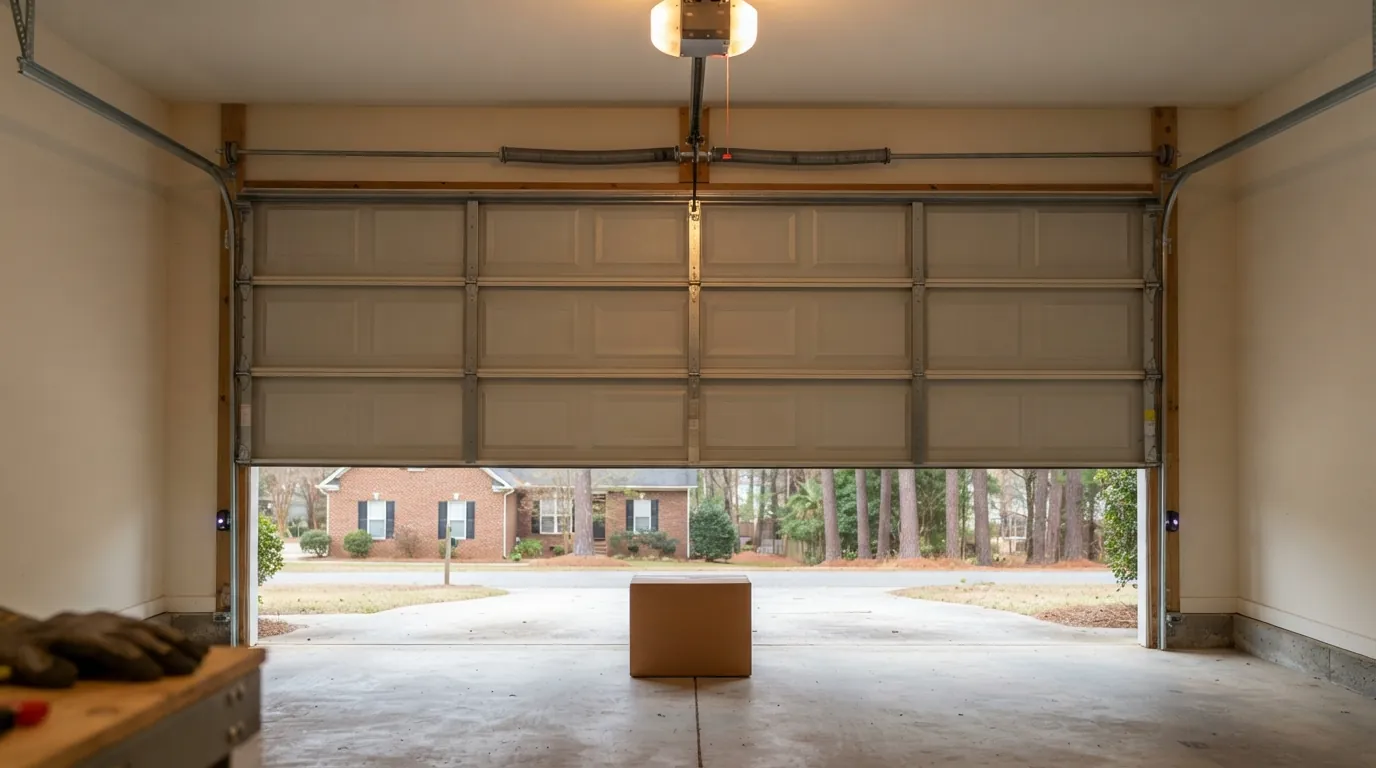
A door that touches the floor and then reverses is a limit problem: the opener reads the floor as an obstruction. A door that stops and reverses part-way with a clear beam is binding in its tracks, and raising the force setting only hides that fault. Both are adjustments a technician makes after checking that the door moves freely by hand.
Why is my garage door remote not working?
A garage door remote stops working because of a dead battery, lock mode on the wall control, lost pairing or radio interference. Near North Carolina military bases, land mobile radios on 380 to 399.9 MHz swamp openers that receive around 390 MHz.
A rolling-code remote sends a new code on every press, and the receiver in the powerhead accepts only remotes paired to it. Replace the battery first. A remote that works only a few feet from the door, with a fresh battery, points to interference.
Military land mobile radios use 380 to 399.9 MHz, with the worst overlap at 387 to 393 MHz. The GAO recorded complaints from up to about 10 miles from bases. Garage door openers are unlicensed devices that must accept that interference. DASMA notes that openers working near 390 MHz, including older Chamberlain, LiftMaster and Genie units, were affected, while 310 to 320 MHz units were not.
North Carolina bases near homes include Fort Bragg, Camp Lejeune and MCAS New River, MCAS Cherry Point and Seymour Johnson AFB. Genie tells owners within 50 miles of a military base or airport to check for frequency testing, and offers a dual-frequency 315/390 MHz retrofit kit or Wi-Fi control as the fix.
Why is my LiftMaster, Chamberlain or Genie opener not working?
LiftMaster, Chamberlain and Genie openers fail for the same 9 causes, but each brand reports them differently. LiftMaster and Chamberlain flash lights or UP/DOWN arrow codes and log a hum or click as code 1-5; Genie Excelerator units blink a status light.
LiftMaster and Chamberlain light flashes
10 flashes mean a sensor fault; 2 flashes mean lock mode is on.
Security+ 2.0 and 3.0 arrow codes
The UP and DOWN arrows on the powerhead blink a two-part code; 1-5 means the opener hums or clicks and the door barely moves.
Genie Excelerator status light
5 blinks point to the Safe-T-Beam sensors.
Checks 7 to 9 are where the homeowner’s list stops and the powerhead comes apart.
When to call a technician about a garage door opener
Call once the first five checks are done and the door still hums, clicks, reverses at the floor or sits dark with power present. From that point the fault is inside the powerhead or in the door’s springs, and both call for tools, parts and spring knowledge.
An opener never lifts the weight a spring carries: with a broken spring, leave the door where it is, keep people and cars clear, and unplug the opener.
A technician checks the door’s springs and balance first, then the sensors, controls and powerhead. The technician gives you the price before any work starts, and the work starts only when you say yes. Same-day visits for calls booked by 12 pm, Monday to Saturday, and no trip fee anywhere in our North Carolina service area.
Some openers are not worth fixing. A unit made before 1993, or one needing a new board and gear together, is usually better served by an opener replacement.