
Chain, Belt, Screw and Wall-Mount Garage Door Opener Types
Garage door opener types come in five drives, chain to wall-mount. Chain, belt, screw and direct drives ride a ceiling rail; a wall-mount jackshaft unit turns the torsion shaft. This guide compares the five on noise, ceiling space, climate tolerance and door fit, and explains horsepower and HPc ratings. It matches each drive to North Carolina garages, from bonus rooms to detached shops and mountain homes.
What are the garage door opener types?
Residential garage door openers come in 5 drive types: chain drive, belt drive, screw drive, direct drive and wall-mount jackshaft. The first four move a trolley along a ceiling rail; the jackshaft unit mounts beside the door and turns the torsion shaft.
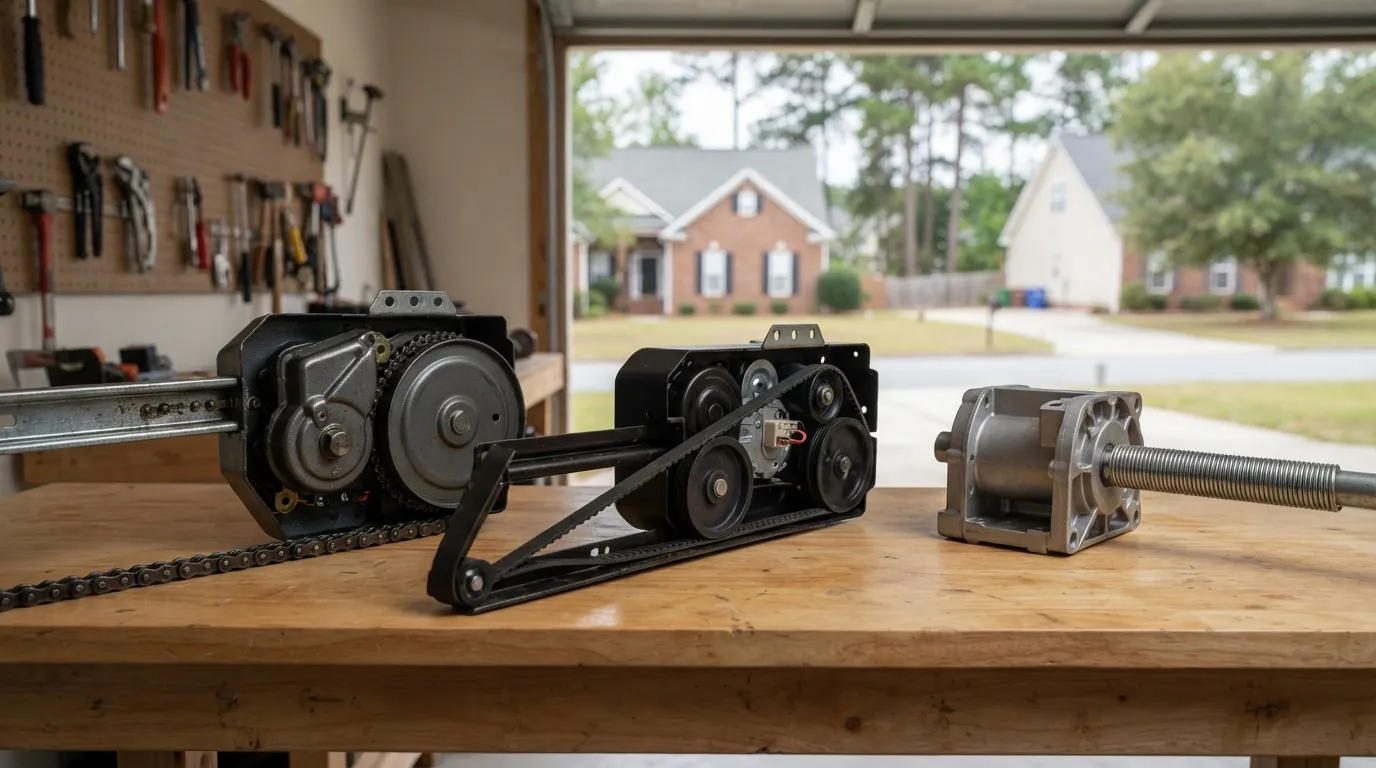
The drive is the part that carries the motor’s force to the door. A trolley rides the rail, an arm joins the trolley to the top of the door, and the drive pulls the trolley back and forth. Genie’s buyer’s guide groups its openers by this drive, because the drive sets the noise, the price tier and the doors an opener suits.
Garage door opener installation starts with a balance check of the door, then a strut on the top section and a grounded outlet within cord reach. A technician reading that list, and the drive you pick, decides how the garage door opener installation goes.
Belt vs chain garage door opener: which is better?
A belt drive is better for garages under or beside living space because it is the quietest drive; a chain drive is better on cost and suits detached garages. Both lift the same doors, and DC-motor chain units now run quieter than older ones.
All five drives lift a balanced residential door; they differ in noise, where they mount and which doors they fit. The table puts them side by side. A dash means Genie’s guide makes no noise statement for that drive, so this page makes none either.
| Drive | How it moves the door | Noise | Mounting and space | Door fit | Cost tier |
|---|---|---|---|---|---|
| Chain | Metal chain pulls the trolley | Loudest; quieter on DC soft-start models | Ceiling rail | All sectional doors; detached garages | Least expensive |
| Belt | Steel-reinforced belt pulls the trolley | Quietest | Ceiling rail | Attached garages near living space | Between chain and wall-mount |
| Screw | Threaded rod turns | — | Ceiling rail | Heavy doors; not for wide temperature swings | Between chain and wall-mount |
| Direct | Motor travels along a fixed chain | — | Ceiling rail | Standard sectional doors | Between chain and wall-mount |
| Wall-mount jackshaft | Turns the torsion shaft | — | Wall beside the door; frees 48 in or more of ceiling | Torsion-spring doors only | Most expensive |
The choice between belt and chain comes down to what sits above and beside the garage. A bonus room over the bay hears every opening, so the belt earns its extra cost there. A detached shop has no sleeping family nearby, so the chain’s lower cost wins. The Cary garage door service page applies the same split to homes with a bonus room over the garage.
What is a wall mount garage door opener?
A wall mount garage door opener, also called a jackshaft opener, is a unit fixed to the wall beside the door that turns the torsion shaft directly. It removes the ceiling rail, frees at least 48 in of ceiling space and works only on torsion-spring doors.
The torsion shaft is the bar above the door that carries the springs and cable drums. The jackshaft motor turns that shaft the same way the springs do, so the door lifts from the top instead of being pulled from the center. A door on extension springs has no torsion shaft, which rules a wall-mount unit out. The comparison of an extension spring vs torsion spring shows how to tell which one a door has.
Genie lists the wall-mount unit as its most expensive drive. The payoff is space: the ceiling above the door stays clear of a rail and a motor head, so storage racks and tall ceilings keep their room. The side-mount (jackshaft) openers page covers the fit limits.
What is a screw drive or direct drive garage door opener?
A screw drive opener moves the trolley with a threaded steel rod, and a direct drive opener moves its motor along a fixed chain inside the rail. Screw drives have few moving parts and suit heavy doors, but Genie advises against them where seasons swing sharply.
That advice matters most in the North Carolina mountains, where cold winters give a garage wide temperature swings. Genie’s concern is the swing itself, so a belt or chain drive is the safer pick for a mountain home. The same advice guides garage door opener repair in Asheville when a worn screw-drive unit is replaced rather than fixed.
The direct drive’s motor itself travels in the trolley. The chain stays fixed, as Wikipedia’s entry on the garage door opener describes, so only the motor moves along it.
What size garage door opener do I need?
The opener size a door needs is set by the door’s width, height, construction and weight, not by the garage. Genie’s residential openers run from 1/2 to 2 HPc; heavier insulated, wood or oversized doors call for the higher ratings, and doors over 7 ft need a rail extension.
- Power rating
- Set by the door’s width, height, construction and weight. Genie’s residential range runs from 1/2 to 2 HPc.
- HPc
- “Horsepower comparable”: a DC motor’s rating expressed against AC horsepower, so a 1/2 HPc opener compares with a 1/2 hp AC motor.
- Motor
- AC motors use a start capacitor. DC motors start and stop softly, so DC chain drives run quieter than older chain units.
- Lift capacity vs HP
- Lift capacity is the weight the opener can raise. HPc only compares a DC motor with AC horsepower; it does not state the weight lifted.
- Rail length
- The standard rail fits a 7 ft door. Chamberlain sells extension kits for 8 ft and 10 ft doors.
- Door weight
- Wood, insulated and oversized doors weigh more and call for the higher ratings. Springs carry that weight; the opener only moves it.
No published chart is quoted here that matches door size to horsepower. Genie’s own page names the factors without one, and a technician sizes the opener to the door in front of them.
Which garage door opener is right for a North Carolina home?
The right garage door opener for a North Carolina home is the drive that fits the garage: a belt drive under a bonus room, a chain drive in a detached shop, a wall-mount unit for high ceilings on torsion doors. Coastal and storm-prone homes add battery backup.
Bonus room over the garage
A belt drive fits, because it is the quietest and the room sits right above the rail.
Detached shop or outbuilding
A chain drive fits, because it costs least and nobody sleeps beside it.
Tall ceiling or storage racks on a torsion door
A wall-mount jackshaft fits, because it frees at least 48 in of ceiling.
Heavy wood or oversized door
A higher-HPc chain or screw drive fits, because door weight sets the power needed.
Mountain home with wide temperature swings
A belt or chain drive fits, because Genie advises against screw drives where seasons swing sharply.
Coastal home in hurricane season
Any drive with battery backup fits, because storms cut power for days and the door stays usable.
NOAA’s state climate summary puts hurricane-force winds in North Carolina about once every 3 years, and battery backup openers keep the door moving through the outage that follows.
When to call a technician to install a garage door opener
Picking the drive is half the job; fitting it to a balanced door is the other half. Call a technician when the drive is chosen, when the door is hard to lift, or when a wall-mount conversion needs the torsion shaft checked. The technician tests the door’s balance first, because an opener moves a balanced door; it does not carry the door’s weight.
You hear the price of the fitting before any work starts. Calls booked by 12 pm, Monday to Saturday, are seen in a same-day inspection visit. Trip fees are not part of opener pricing.
Ready to book? Call (833) 752-1196, or request a garage door quote from your phone.
The garage door opener installation cost page lists what moves the price: drive type, battery backup, smart features and rail length.