
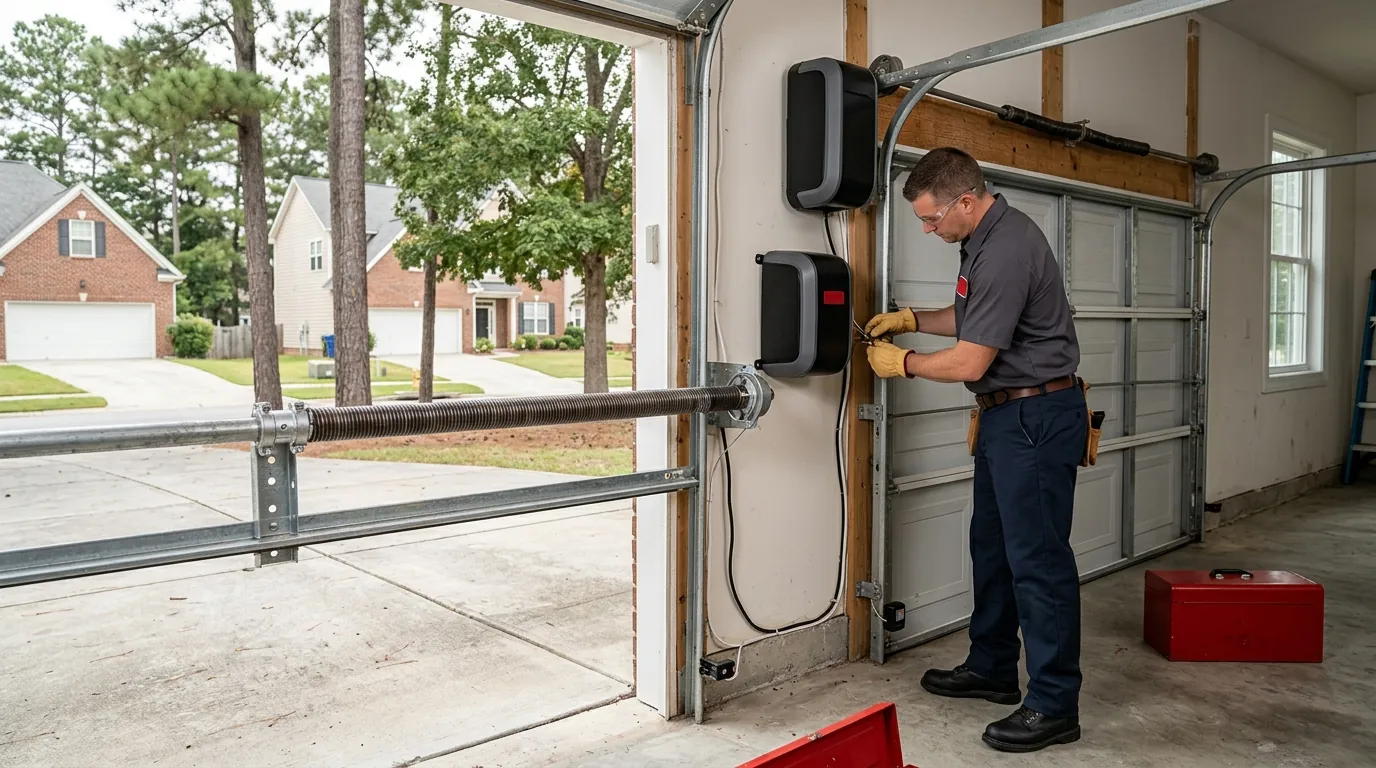
What is a side mount garage door opener?
A side-mount opener, also called a wall-mount or jackshaft opener, is a motor fixed to the wall at one end of the torsion spring shaft. It turns the shaft to raise and lower the door, so no rail or powerhead hangs from the ceiling. The springs still carry the door’s weight; the motor only turns a balanced shaft.
| Attribute | Side-mount (jackshaft) opener | Ceiling-rail opener |
|---|---|---|
| Where it mounts | On the wall beside the door, at the end of the torsion shaft | On the ceiling, with a header bracket above the door and a powerhead behind it |
| What it moves | The torsion shaft and its two cable drums | The top section, pulled along the rail by a door arm |
| Ceiling above the door | Left clear for racks, lifts or a tall ceiling | Taken by the rail and the powerhead |
| Springs it needs | Torsion springs only | Torsion or extension springs |
| Safety devices | Force-sensing reversal plus photo-eyes (UL 325) | Force-sensing reversal plus photo-eyes (UL 325) |
LiftMaster’s 8500W, a widely sold wall-mount model, runs only on torsion-spring doors, and dealer listings state that a door on extension springs is converted before it goes on. Every other wall-mount unit works the same way, because the motor turns the shaft that the torsion springs sit on.
Which doors can take a wall-mount opener: torsion shaft, side room and outlet?
A wall-mount opener fits a door that runs on torsion springs, stays balanced when lifted by hand, has clear wall space beside one end of the shaft, and has a receptacle within the opener’s cord reach. A door on extension springs is converted to torsion springs before the unit goes on.
- Torsion shaft
- The springs sit on a steel shaft above the opening, with a cable drum at each end. The opener couples to one end of it. Extension springs stretch beside the horizontal tracks and leave no shaft to turn.
- Balance
- Raised halfway by hand and let go, the door stays put. A door that drifts down or climbs has a counterbalance fault that is fixed before any opener goes on.
- Side room
- The wall at the shaft end needs room for the motor body, with no window frame, post or shelf in the way. The technician measures it at the visit.
- Power
- The unit plugs into a receptacle within its cord’s length; DASMA rules out extension cords. In North Carolina a new receptacle is electrical contractor work under G.S. 87-43.1(7), so an electrician adds one where it is missing.
- Door weight
- The springs are sized to what the door weighs. Overlays, windows and decorative hardware add weight, and DASMA TDS 190 notes that added components push a door past its spring specification.
Door on extension springs? The technician can convert extension springs to torsion: a shaft, two drums, bearing plates and springs matched to the door take the place of the stretched springs and pulleys, and the wall-mount unit is coupled to the new shaft afterward.
Not sure which springs your door has? Call (833) 752-1196 and describe the bar above the opening, or send photos with a quote request.
Why choose a wall-mount opener for high lifts, vaulted ceilings and storage lifts?
Choose a wall-mount opener when the ceiling above the door has another job: high-lift track that carries the door further up the wall, a vaulted or cathedral ceiling with no framing at rail height, an overhead storage rack, or a car lift. A rail opener needs a clear line from the header straight back into the garage.
High-lift track
High-lift track runs the door vertically past the top of the opening before it turns, so a ceiling rail would sit in its path. The wall unit stays at the shaft, out of the door’s travel.
Vaulted ceilings
A rail hangs from framing at the header and above the powerhead. A tall or sloped ceiling leaves nothing to hang it from; the wall unit needs only the wall beside the door.
Racks and lifts
Overhead racks, kayak hoists and car lifts claim the space a rail and powerhead fill. With the motor on the wall, that space stays theirs.
Two kinds of North Carolina garage show the pattern. On a lake house near Mooresville and Lake Norman, the ceiling goes to paddleboards, kayaks and life jackets. On an estate home in Marvin with a wide carriage-style door, the overlays add weight that the springs carry, and the wall unit keeps a tall ceiling clear.
Low headroom, the space between the top of the opening and the ceiling, is a separate question. Low-headroom track and rear-mounted spring layouts move the shaft away from the usual spot, so the technician checks where the shaft sits and whether a wall unit reaches its end before recommending one.
How is a jackshaft garage door opener installed?
A jackshaft opener is installed in 6 stages: confirm torsion springs and balance, measure the side room and find the outlet, mount the unit at the shaft end, fit the photo-eyes, wall button and release, program the controls, then set the limits and force and test the reversal.
Check
Check for torsion springs and a balanced door; convert or rebalance it first when it fails.
Measure
Measure the wall space beside the shaft end and locate the receptacle the cord will reach.
Mount
Mount the unit’s bracket on the wall and couple the motor to the end of the torsion shaft.
Fit
Fit the photo-eyes low on both sides of the opening, the wall button at least 5 ft above the floor, and the red release handle no higher than 6 ft, the heights DASMA TDS 198 lists.
Program
Program your remotes, the keypad and any HomeLink or Wi-Fi control.
Test
Test the door after setting travel limits and force: it reverses on contact and when the photo-eye beam is broken.
Federal law has required force-sensing reversal plus photo-eyes or another UL 325 secondary device on residential openers made after 1992 (DASMA TDS 198), and a wall-mount unit meets that rule exactly as a rail unit does.
A call booked by 12 pm, Monday to Saturday, gets a same-day inspection visit: the technician looks over the springs, the shaft and the wall, states the price, and fits nothing until you agree to it.
Want the opener off the ceiling? Call (833) 752-1196 at any hour to book the visit.
What sets the price of a wall-mount opener installation?
The price of a wall-mount opener installation follows the unit and its features, whether the door needs a spring conversion or new springs first, the door’s height and track, the controls you add, and whether an electrician has to add a receptacle. The technician quotes all of it before any work.
Unit and features
The wall-mount model, with or without a backup battery and Wi-Fi control.
Spring work
An extension-to-torsion conversion, or new torsion springs sized to the door.
Door height and track
A tall door or high-lift track changes the parts list.
Controls
Extra remotes, a keypad or a HomeLink bridge for the car.
Power
A new receptacle, which an electrician installs and prices separately.
There is no trip fee for the visit. Published third-party ranges for wall-mount units and labor are collected under side-mount opener prices.
Side-mount or ceiling rail: which opener suits your garage?
A wall-mount opener solves a ceiling problem; it is not the default for every garage.
A ceiling-rail opener suits a standard ceiling with nothing stored above the door, or a door on extension springs you want to keep; a side-mount opener suits a torsion-spring door whose ceiling has another use. Both carry the same photo-eyes and reversal.
Power cuts are a separate choice. Battery-backup openers are fitted on any visit, and the guide to battery backup explains what keeps working when the power drops.
For a door that keeps its rail, standard opener installation compares chain, belt and screw drives and the checks a door needs before any new opener goes up.