
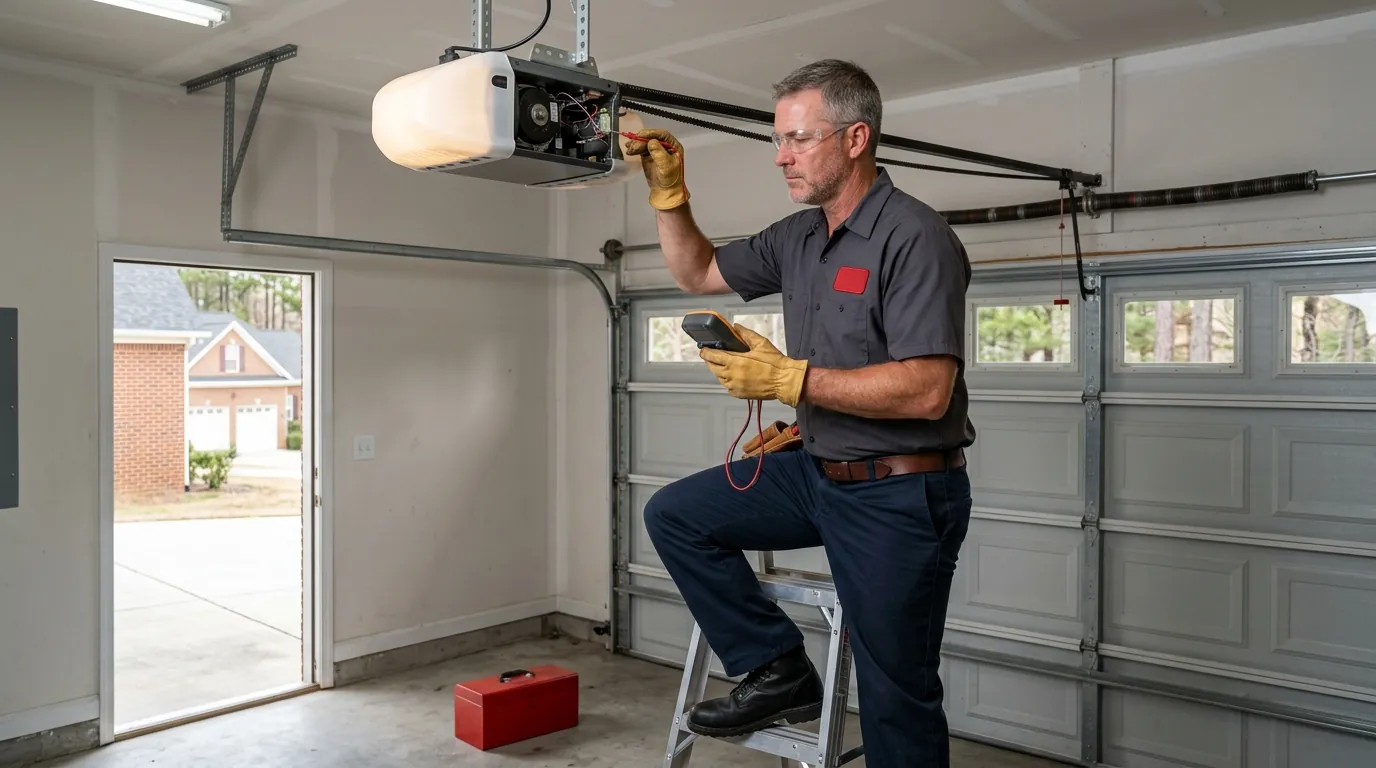
Why is my garage door opener not working?
A garage door opener stops working because of a broken door spring, a blocked or misaligned photo-eye, lock mode on the wall control, a dead remote battery, a failed capacitor or logic board, or a stripped drive gear. A humming motor with a still door usually means the spring.
The opener only moves the door. The springs carry its weight, so a door with a broken spring is too heavy for the motor, and the opener hums, strains or reverses. That is why a technician rules out the spring before opening the powerhead.
| Symptom | Likely causes | What happens next |
|---|---|---|
| Motor hums, door stays still | Broken spring, lock engaged, trolley disconnected or stuck on its stop bolt, failed capacitor, stripped drive gear | Technician: spring, capacitor and gear. Turn lock mode off yourself. |
| Door goes down, then back up | Photo-eye beam blocked or misaligned, an object in the door path, down limit set past the floor | Clear the path; a technician realigns the eyes and resets the limit. |
| Door reverses at the floor | Down travel limit or force setting wrong, door binding in its track | Technician resets limits and force after checking the door moves freely. |
| Lights flash 10 times | Safety-sensor fault on Chamberlain and LiftMaster units | Clear the beam; a technician fixes eye wiring or alignment. |
| Remote dead or short range | Battery, lock mode, lost pairing, LED bulbs near the receiver, military radio interference | Replace the battery yourself; pairing and receiver upgrades are technician work. |
| Door opens by itself | Stuck remote or keypad button, shorted wall control or wiring, a remote on a shared code | Technician tests the controls and wiring and clears stored codes. |
The step-by-step checks for each symptom are in the guide to a garage door opener not working.
Opener humming, reversing or ignoring the remote? Stop pressing the button: a motor straining against a heavy door strips its gear. Call (716) 328-9097 for a same-day visit when you book by 12 pm, Monday to Saturday.
Which garage door opener parts fail most?
The opener parts that fail most are the plastic drive gear, the start capacitor on AC motors, the logic board, the photo-eye sensors, and the remotes and keypads. Wrong travel limits or force settings cause doors that stop short or reverse at the floor.
Drive gear and sprocket
The plastic drive gear transfers motor power to the chain or belt. When it strips, the motor runs, the trolley stays put and white plastic shavings collect under the powerhead.
Capacitor
The capacitor starts an AC motor. A failed one leaves the motor humming without turning, the same sound a broken spring causes, so both get checked.
Logic board
The board reads the controls, sensors and limits and switches the motor. Storms and power surges damage it, leaving a dead unit or one that ignores its controls.
Photo-eye sensors
Two eyes, mounted no higher than 6 in above the floor, send a beam across the door path. A dirty, knocked or loose eye stops the door closing.
Remotes and keypads
Rolling-code remotes change code on every press: Security+ 2.0 on LiftMaster and Chamberlain, Intellicode on Genie. Dead batteries, lost pairing and radio interference stop them.
Travel and force settings
Limits set where the door stops open and closed; force sets how hard it pushes before reversing. More force never fixes a binding door; it only hides the fault.
Do you repair LiftMaster, Chamberlain and Genie openers?
Yes. Technicians repair LiftMaster, Chamberlain, Genie and Craftsman openers in chain-drive, belt-drive, screw-drive and wall-mount jackshaft versions. Rolling-code remotes such as Security+ 2.0 and Intellicode are re-paired to the receiver after a board or opener repair.
| Drive type | Noise | Suited to | Checked at the repair |
|---|---|---|---|
| Chain drive | Louder than belt; metal chain on a sprocket | Garages away from living space; durable | Drive gear, sprocket, chain tension, trolley |
| Belt drive | Quietest rail type | Garages under bedrooms and living space | Drive gear, belt wear and tension, trolley |
| Screw drive | Louder than belt | Few moving parts; Genie notes it is sensitive to temperature swings | Carriage, threaded rod, motor start |
| Wall-mount jackshaft | No ceiling rail; mounts beside the door | Torsion-spring doors only; frees the ceiling | Mounting on the spring shaft, sensors, controls |
A new logic board or receiver forgets every remote and keypad it knew. The technician re-pairs your remotes and keypad before leaving, so the door works from every button you use.
How does a garage door opener repair visit work?
An opener repair visit starts at the door, not the motor: the technician releases the opener and checks the door’s balance, then tests the sensors, controls and powerhead. You get the price before any work starts, and reversal is re-tested before the technician leaves.
Release
Release the opener and lift the door by hand to check the springs and balance.
Test
Test the photo-eyes, wall control, remotes and keypad.
Open
Open the powerhead to check the gear, capacitor and logic board.
Quote
Quote the repair; the work starts only when you say yes.
Reset
Reset travel limits and force, then run the 1-1/2 in contact-reversal and photo-eye tests.
No trip fee
No trip fee anywhere in our North Carolina service area.
Price first
The technician gives you the price before any work starts, and the work starts only when you say yes.
Warranty
1-year labor warranty on every repair; parts carry the manufacturer’s warranty, which we register for you.
Servicing a cord-connected opener is exempt from electrical licensing under North Carolina law (G.S. 87-43.1(7)), so the repair needs no electrician. A garage with no ceiling outlet for the opener is different: adding a receptacle is work for an electrical contractor.
When should a garage door opener be replaced instead of repaired?
Replace a garage door opener when it has no photo-eye sensors or fails to reverse, when replacement parts are no longer made, or when the logic board and motor fail together. Openers made before January 1, 1993 predate the federal entrapment rule.
No photo-eyes
No sensors, or a failed reversal test that a repair does not cure.
Discontinued parts
Gears, boards or receivers for the model are no longer made.
Board and motor
Both failing at the same time.
Pre-1993 manufacture
Built before the federal entrapment rule (16 CFR 1211, UL 325) required photo-eyes and auto-reverse.
Noise
A chain unit under a bedroom, where a belt drive is quieter.
Selling your home? Since June 1, 2026, North Carolina home inspectors report an opener that fails to reverse or has no photo-eyes (11 NCAC 08 .1107). The technician tells you at the visit whether a repair clears that item or only a replacement does.
When the answer is a new unit, the technician prices an opener replacement at the same visit, before any work.
What affects the cost of garage door opener repair?
Opener repair cost depends on the failed part, the drive type and brand, whether parts for that model are still made, and whether a door fault such as a broken spring caused the failure. The price is stated before any work starts.
Failed part
A sensor realignment or remote pairing, against a new gear, capacitor or logic board.
Drive type and brand
Chain, belt, screw or wall-mount, and the maker’s parts for that unit.
Parts availability
Current parts, or a model whose parts are discontinued.
Door faults
A broken spring or binding track found at the visit and fixed with the opener.
You hear the full price at the door, with no trip fee, and nothing starts until you agree. Request an opener repair quote or Call (716) 328-9097.
What if the opener is fine but the door is not?
Some faults that look like the opener start at the door. A door fault is behind many opener complaints: a broken spring leaves the motor humming, and a binding track makes the opener reverse. Fixing the door restores the opener, while forcing the opener harder damages its gear.
A snapped spring, a slack cable or a roller out of its track all need the door fixed first, and the technician checks each one on an opener visit. Those jobs are covered under broken garage door repair.
A door stuck open at night with a broken spring is a security problem, not only an opener one. Leave it where it is and do not pull the release cord: without the spring, the door’s full weight drops. Phones are answered 24 hours a day, 7 days a week, and the page on after-hours garage door help covers what to do until the visit.