
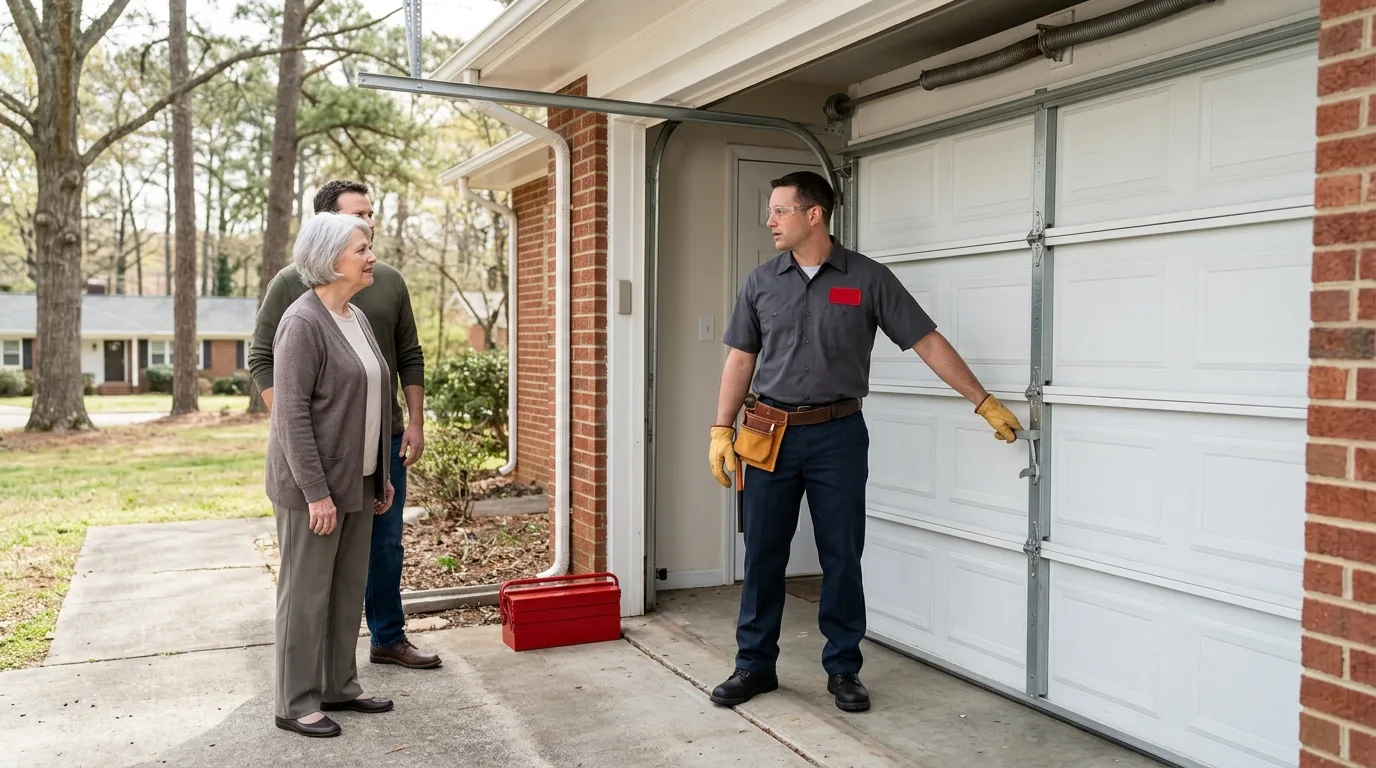
Is your garage door easy and safe for everyone who uses it?
An easy, safe garage door lifts by hand without straining, reverses when it meets an object or a broken photo-eye beam, has controls the household can reach, runs without grinding, and opens a safe way when the power is out. Each check below names what you look for and when a technician takes over.
Lifting effort
Lifted by its handle, the door rises without straining and stays put 3 to 4 ft above the floor.
Reversing safety
The closing door reverses on a 1-1/2 in board laid flat under its center and when the photo-eye beam is broken.
Controls
The wall button sits in clear view of the door, and every remote and the keypad open it on the first press.
Smooth running
The door travels without grinding or lurching.
Power cuts
Everyone who uses the garage knows where the red release handle hangs and when it is safe to pull.
A door that is hard to lift, or one that fails a reversal test? Leave it closed and Call (833) 752-1196. Calls are answered around the clock.
How heavy does a balanced garage door feel when you lift it by hand?
A balanced garage door rises by hand without straining, moves no faster than you push it, and stays put when let go 3 to 4 ft above the floor. A door that feels heavy, slams down or drifts upward has springs that are worn, broken or set wrong.
The springs carry the door’s weight, not the opener and not the person lifting. A torsion spring is the coiled spring on a steel shaft above the door; extension springs stretch along the tracks on each side, each with a safety cable through its center, and a technician fits a missing cable and services enclosed springs. On a door with an opener, the hand-lift test starts with the door fully closed and the red release pulled, and it is skipped when a spring shows a gap in its coil. Hold the door by its handle or a gripping point clear of the section joints, where fingers get pinched.
DASMA, the door manufacturers’ association, leaves spring adjustment to a trained door systems technician because springs are under high tension. Ask for springs set for a light, balanced lift: the technician replaces worn springs, sets them to the door’s weight, and repeats the hand-lift test with you watching.
Which comes first on a door still lifted by hand: the springs or an opener?
The springs come first: an opener is fitted only to a door that is already balanced, because the springs lift the door and the opener only moves it. A technician checks the balance, corrects the springs where needed, and then prices the opener installation.
An opener removes the daily lift. Fitting one includes disabling the door’s manual lock, which DASMA’s checklist calls for once an opener is installed, and attaching the opener arm to the top section, reinforced where the door needs it. The opener plugs into a grounded or GFCI outlet within cord reach; extension cords are not permitted, and a missing ceiling outlet is work for an electrician.
Ask for an opener for a door lifted by hand once the balance is right.
Does your opener stop and back up when something is in its path?
An opener made after 1992 reverses when the closing door touches an object and when anything breaks the photo-eye beam, as federal law and the UL 325 safety standard require. An opener that fails either test, or has no photo-eyes at all, needs repair or replacement.
Photo-eyes are the two small sensors near the floor, one on each side of the opening, and their beam sits no higher than 6 in above the floor. DASMA’s checklist runs 2 tests, standing clear of the door: wave an object through the beam while the door closes, then close the door on a 1-1/2 in board, such as a 2×4 laid flat, under its center. The door reverses both times. The same checklist says an opener without entrapment protection is replaced.
A door that is hard to lift by hand also makes the opener strain and stall, so the springs are checked on every opener call. Book a technician for an opener that reverses or stalls. Between repairs, a balance and reversing safety check covers both tests, the springs and the rollers in one visit.
Where do the wall button, remotes and keypad belong for the people who use the door?
The wall button belongs in clear view of the door, away from its moving parts and at least 5 ft above the floor, and every remote and keypad paired to the opener opens the door on one press. The 5 ft height keeps the button out of children’s reach.
Within that rule, the handiest spot is beside the door the household walks through, clear of a parked car. A remote on the car visor opens the door before anyone leaves the seat. A wireless keypad outside takes a PIN, so a family member or caregiver who arrives on foot gets in without a remote.
The red emergency release handle hangs no more than 6 ft above the floor, within easy reach and clear of the car. On a visit, the technician tests each control, replaces a worn wall button, and carries remotes and wireless keypads to program to the opener. The old code of a lost remote is erased, so no stray remote can open the door. A Wi-Fi retrofit lets a family member check from a phone that the door is closed.
Why does a Reidsville garage door grind or jerk on its way up?
A garage door grinds, shudders or lurches when its rollers are worn, cracked, seized or dry, so the door no longer glides from closed to open. Nylon rollers with sealed ball bearings run quietly and need no grease.
Rollers are the small wheels on stems that ride inside the steel track at each hinge. Nylon rollers run quieter than steel ones, which rattle in the track, and Creative Door rates a 13-bearing nylon roller at about 20,000 cycles against 10,000 to 15,000 for a 10-bearing roller.
The bottom rollers sit in the bottom brackets, which hold the lift cables under spring tension, so changing rollers is technician work. Ask for rollers that let the door glide when grinding or shuddering comes back after lubrication.
What happens to a closed garage door when the power goes out?
An opener stops working without power, and the door stays where it is until the power returns or someone lifts it by hand. With the door fully closed and both springs intact, the red release disconnects the door so it lifts by hand; with a broken spring, the door stays shut.
Pull the release only with the door fully closed, and stand clear: DASMA warns that a disengaged door can begin to open on its own.
A spring with a gap in its coil, or a door far heavier than usual after the release, points to a broken spring, and DASMA’s rule is not to operate the door until the spring is replaced. A battery-backup opener, which the technician can fit, keeps the opener lifting the door through a cut, and a surge protector on its outlet guards the logic board when power returns. Leave a broken-spring door closed and call. The line is staffed at any hour, and with a car shut inside, ask for 24/7 help for a door that will not open.
How many Reidsville residents are 65 or older, and how old are their homes?
Of Reidsville’s 14,585 residents, 22.6% are 65 or older, against 17.2% across North Carolina, and the city’s median home was built in 1967. Many Reidsville garage doors are opened every day by long-time owners, in houses built before the 1993 federal opener safety rule.
- Residents 65 or older
- 22.6% in Reidsville, 21.1% across Rockingham County and 17.2% across North Carolina (ACS 2020-2024 5-year).
- Median year built
- 1967 in Reidsville, against 1978 across Rockingham County and 1991 statewide (ACS 2020-2024 5-year).
- Built before 1980
- 68.4% of Reidsville’s housing units; the 1950s are the largest building decade at 20.2%, followed by the 1960s at 17.9%.
- Long-time householders
- 17.1% of occupied homes have a householder who moved in during 1989 or earlier, against 9.3% statewide (ACS 2020-2024 5-year).
- Owner-occupied
- 52.8% of occupied homes in Reidsville, against 72.1% across Rockingham County (ACS 2020-2024 5-year).
Reidsville sits in east-central Rockingham County and is part of the Greensboro-High Point metropolitan area. Incorporated in 1873, it grew around the American Tobacco Company, the mainstay of the local economy until its sale and closure in 1994.
What changes the price of garage door repair in Reidsville?
The price depends on the work the door needs: spring replacement and balancing, an opener repair or a new opener, new rollers, and the number of controls to pair. Each figure is stated to you first, and the technician begins only on your go-ahead.
Springs and door weight
A heavier door needs heavier springs, and extension springs add safety cables.
Opener repair or a new opener
An opener whose parts are no longer made, or one with no photo-eyes, is replaced instead of repaired.
Rollers
A full set of sealed-bearing nylon rollers is a larger job than one cracked roller.
Controls
Each remote, keypad and wall button paired or replaced adds to the job.
Third-party figures for opener installs are on the page for new opener prices in NC. The visit carries no trip fee.
When can a technician inspect your door, and who can book the visit?
A call booked by 12 pm, Monday to Saturday, gets a same-day inspection visit in Reidsville and the Rockingham County communities around it. A son, daughter or caregiver can book it for a parent, and the price is approved by phone before any work starts. Emergency service runs 24/7 in every city we serve.
Reidsville, Wentworth and the Rockingham County communities around them
Technicians who work in Reidsville also cover its downtown and the communities around it, in Rockingham County and across the Guilford and Caswell county lines:
- Downtown Reidsville
- Wentworth
- Ruffin
- Monroeton
- Oregon Hill
- Browns Summit
- Casville
Service visits cover these Reidsville zip codes and nearby towns:
- 27320
- 27025 (Madison)
- 27027 (Mayodan)
- 27048 (Stoneville)
- 27326 (Ruffin)
- 27212 (Blanch)
- 27379 (Yanceyville)
- 27311 (Pelham)
- 27314 (Prospect Hill)
- 27315 (Providence)
South across the Guilford County line, homeowners call for Greensboro garage door repair. Elsewhere in Rockingham County, see garage door repair in Eden.