
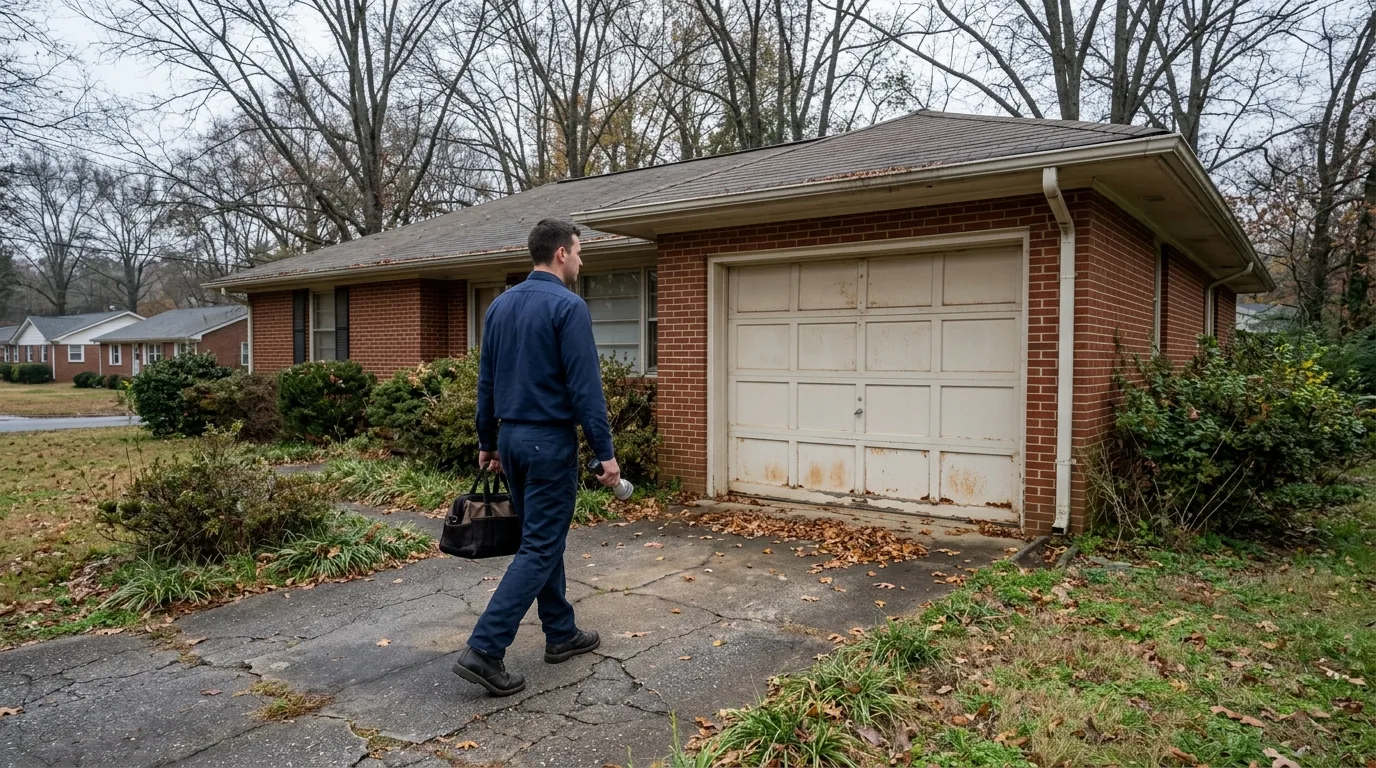
What happens to a garage door that sits unused for months?
A garage door that sits unused for months keeps its springs under full tension while moisture rusts the coils, cables and bearings, lubricant dries, rollers and hinges stiffen, the bottom seal sticks to the slab and the remotes lose battery power. None of that shows until the door moves.
A sectional door is steel, rubber and a motor, and each part ages in place in its own way. These are the parts a technician looks at first on an Eden door that has stood closed:
Springs
The torsion spring is the coiled spring on the steel shaft above the door; extension springs stretch along the tracks on each side. Both carry the door’s weight. DASMA’s spring guidance notes that rust pits speed up fatigue cracks and cut a spring’s cycle life, so a rusted coil starts its next cycles weaker.
Lift cables
The galvanized steel cables run from the bottom brackets at the floor corners up to the drums or pulleys. Rust and broken strands show first near the bottom brackets, where the cable sits closest to the damp slab.
Rollers and hinges
Steel rollers with open bearings rust and stop turning, so a seized roller scrapes along the track instead of rolling. Hinge pivots between the sections stiffen the same way.
Lubricant
Grease on the hinges, roller bearings and spring coils dries out and collects dust, so parts that once slid now bind and squeal.
Bottom seal
The rubber strip along the bottom edge sits pressed against the concrete the whole time. It flattens, cracks and sticks to the slab, and in a freeze, water under it holds it to the floor.
Opener and controls
Remote batteries run down, an unplugged opener stays dark, and a wall control left in lock mode ignores every remote. Insects and mice nest in the motor housing, and a web on a photo-eye, one of the 2 sensors near the floor that beam across the opening, blocks the beam.
Is it safe to open a garage door that has been closed for years?
Yes, after a look from the floor and with no force: check both springs and both cables for gaps, rust and frayed strands, then run the door once from the wall control and stop at the first strain. A broken spring or snapped cable means the door stays shut until a technician comes.
The first opening is the risky moment because it is the first full load on parts that aged without moving. The opener pushes and pulls with a force that a seized roller, a stuck seal or a broken spring cannot take back, and that force goes into the top section of the door and the opener’s own gears.
Leave the red emergency release cord alone on a door with a gap in a spring coil. The emergency release disconnects the door from the opener’s trolley, and DASMA’s guidance is to pull it only with the door fully closed. With a broken spring, nothing holds the door’s weight: a partly open door drops, and a closed one is too heavy to lift safely. DASMA also says a door with a broken spring stays out of use until the spring is replaced.
Look at the springs from the floor
A gap in a torsion coil, or an extension spring hanging loose, means stop here.
Look at both lift cables
Broken strands, heavy rust or a slack cable at a bottom corner means stop here.
Clear the floor line and the photo-eyes
Sweep leaves and debris from under the door and wipe webs or nests off both sensor lenses.
Power the opener and the controls
Plug the opener in, take the wall control out of lock mode, and fit fresh batteries in the remotes.
Run the door once and watch
Stand clear, watch the first foot of travel, and press the wall control again to stop the door at a hum, a grind, a jerk or one side rising first.
Gap in a spring, frayed cable or a door that strains on its first run? Leave it closed and Call (833) 752-1196. Night or weekend, a person picks up, and emergency service runs 24/7.
What does a garage door need after weeks, months or years closed?
An Eden garage door closed for a few weeks needs power, batteries and a test run; one closed for months needs lubrication, adjustment and any seized rollers replaced; one closed for years needs its springs, cables and opener judged part by part, and sometimes a new door. The technician prices each step before it starts.
Weeks closed: power, batteries and a test run
The parts are intact after a few weeks, and the faults sit in the controls: an opener left unplugged, a tripped breaker, a wall control in lock mode or a remote with a dead battery. When the opener still ignores every control, book a technician for an opener that stopped responding.
Months closed: lubrication, adjustment and rollers
Dry hinges and bearings, stiff steel rollers and a bottom seal stuck to the slab build up over a season or more. A lubrication and adjustment visit covers lubrication, tightening of hardware that carries no spring tension, and the balance and auto-reverse tests. The guide to lubricant for a door that sat unused names the parts that take it and the track surfaces that stay dry. Where leaves and damp slip under the door or along the jambs, the technician fits new threshold and side weatherstrip. Rollers that no longer turn go to seized roller replacement; the bottom rollers sit on brackets under cable tension, so a technician changes them.
Years closed: springs, cables, opener and the door itself
Years of damp air reach the parts under tension. Coils with rust pits go to rusted spring replacement, and cables with broken strands go to rusted lift cable replacement, with both cables replaced as a pair. An opener made before January 1, 1993 predates the federal rule that requires photo-eyes or another secondary safety device, so it is a candidate for replacement or a retrofit: technicians fit battery-backup openers, which lift the door through the outages that follow a storm, and Wi-Fi retrofits, which let an owner who lives elsewhere check from a phone that the door is closed. When the wood jamb or header that the track bolts to has rotted, the technician builds it out so the track holds a bolt again. Sections that have rusted through, split or rotted are the point where the technician prices the job to replace a door past saving.
How many Eden homes stood vacant in the latest census survey?
In Eden, 13.8% of housing units were vacant in the 2020-2024 American Community Survey, against about 9.7% across Rockingham County, and the city’s median home was built in 1967. Vacant covers homes for rent, for sale, held for seasonal use and empty for other reasons.
- Vacant housing units
- 1,024 of Eden’s 7,434 housing units, or 13.8%, including 255 for rent and 34 for sale only (ACS 2020-2024 5-year).
- Median year built
- 1967 in Eden, against 1978 across Rockingham County (ACS 2020-2024 5-year).
- Built before 1980
- 69.0% of Eden’s housing units; 26.2% were built before 1950, and 17.0% before 1940.
- Built in 2000 or later
- 9.2% of Eden’s housing units.
- Owner-occupied
- 55.0% of Eden’s occupied homes; the other 45.0% are rented (ACS 2020-2024 5-year).
An estate waiting to be settled, a rental between tenants or a garage used only for storage keeps a door closed for months, and in a house built before 1980 the door and opener are older parts to begin with. Eden itself dates from September 12, 1967, when Leaksville, Spray, Draper and the Meadows Greens Sanitary District voted to consolidate, and the city still has 3 downtown areas in the former towns. The Smith River crosses the city from the north to meet the Dan River on its south side, and Rockingham County borders Virginia.
What sets the price of garage door repair in Eden after time closed?
The price of bringing an Eden garage door back into service depends on how far idle time has reached: the opener and controls, the rollers and hinges, the springs and cables under tension, or the door sections themselves. Each price is stated first, and the visit carries no trip fee.
Time closed
A door closed for weeks needs fewer parts than one closed for years.
Parts under tension
Springs and lift cables are larger jobs than rollers, hinges or a bottom seal.
Opener age
Technicians source parts for discontinued opener models; an opener that cannot be repaired is replaced.
Door condition
Sections rusted through or rotted move the job from repair to a new door.
Third-party figures for common repairs are on the page for garage door repair cost ranges in North Carolina.
When can a technician inspect a garage nobody has used?
A call booked by 12 pm, Monday to Saturday, gets a same-day inspection visit anywhere in Eden, from Leaksville to Draper. The line is staffed through the night, and emergency service runs 24/7 in every city we serve.
A door stuck open on a house nobody lives in is an emergency: it leaves the garage, and any door from the garage into the house, open to anyone. The visit can take place at a vacant house. Photos of the door sent before the visit help the technician plan the parts, and the owner, an estate’s representative or a property manager approves the price by phone, so nobody has to wait in the garage. The technician leaves a written service record of what was checked and what was changed.
Leaksville, Spray, Draper and the Rockingham County towns near Eden
Technicians who work in Eden cover all 3 former towns, the older neighborhoods between them and the towns to the west and south:
- Leaksville
- Spray
- Draper
- Central Leaksville
- Boone Road
- Meadow Summit
- Fairview
- Sunset Hills
- Stoneville
- Madison
- Mayodan
- Wentworth
Service visits cover this Eden zip code:
- 27288
Southeast along NC 14, homeowners call for Reidsville garage door service. Farther south in Guilford County, see garage door repair in Greensboro.