
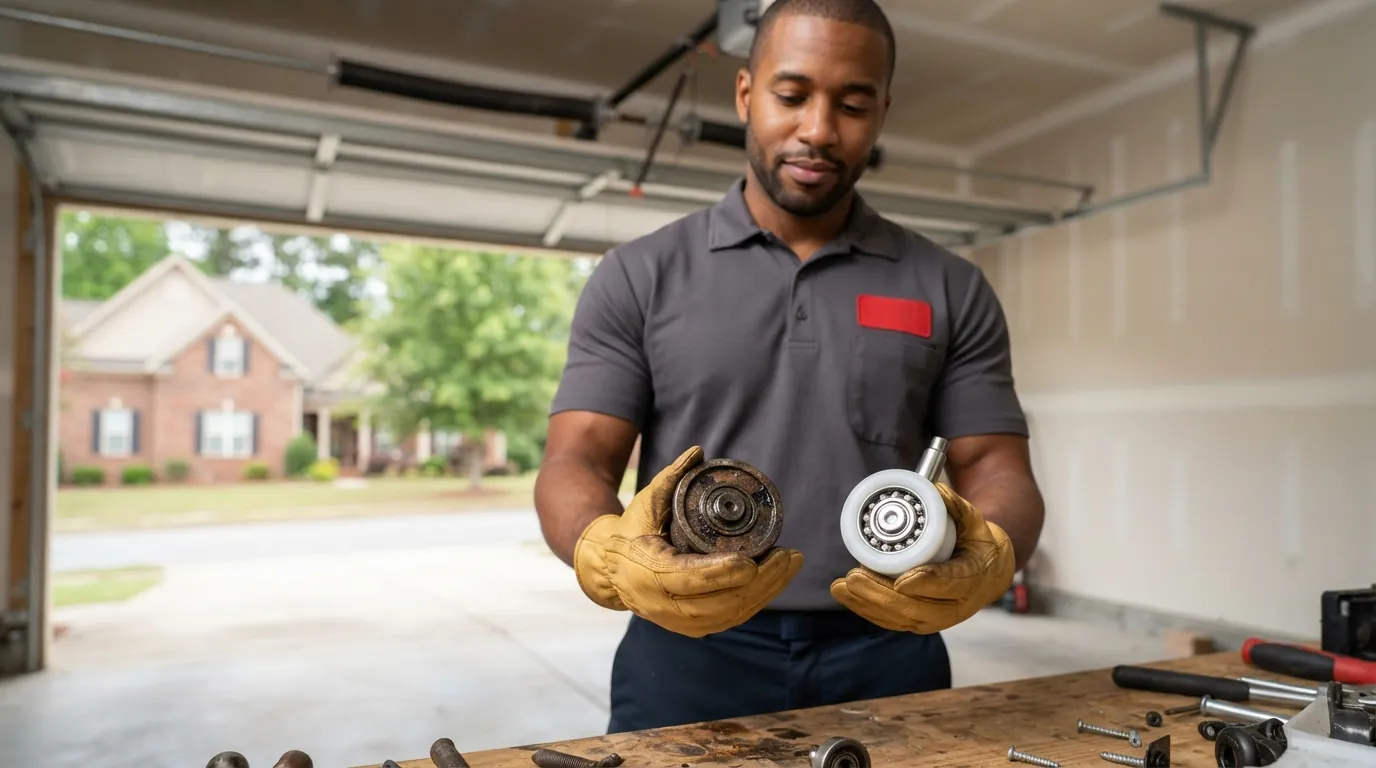
How do you know your garage door rollers are bad?
Garage door rollers are bad when the wheels wobble on their stems, crack or flatten, stop turning, or grind and squeak as the door moves. A door that shudders on the way up, or rollers riding up the lip of the track, confirms it.
Wobble on the stem
A worn bearing lets the wheel tilt. The tilted wheel rubs one side of the track and wears a groove into it.
Cracks or flat spots
A cracked or flattened wheel thumps once per turn, and the thump repeats at the same point on every trip.
Seized bearings
A wheel that no longer turns slides along the steel channel instead of rolling, so the opener drags it.
Grinding or squeaking
Dry, rusted or broken balls inside the bearing grind as the door travels. The noise follows the rollers, not the opener.
Shudder during travel
The door jerks or vibrates on the way up or down, most often where the track curves toward the ceiling.
Climbing the track lip
A roller riding up onto the edge of the channel is one bump away from leaving the track.
Watch the rollers while someone runs the door: a wheel that stops spinning, tilts or rides high is the one failing first. The others have run the same number of cycles.
Door grinding, shuddering or riding high in the track? Call (833) 752-1196. Calls booked by 12 pm, Monday to Saturday, get a same-day visit, with no trip fee anywhere in our North Carolina service area.
Nylon vs steel garage door rollers: which are better?
Nylon rollers with sealed ball bearings are better for most homes: they run quieter and do not rust. Steel rollers cost less, but they are louder and rust in humid or coastal air. Bearing count, from 7 to 13 balls, sets their durability.
| Roller type | Noise | Rust resistance | Bearing | Suits |
|---|---|---|---|---|
| Nylon, sealed bearing | Quietest: the nylon wheel rolls without metal-on-metal contact | The wheel does not rust, and the seal keeps moisture out of the bearing | Sealed, 7 to 13 balls | Attached garages under bedrooms, humid summers, coastal homes |
| Steel | Loud: steel wheel on a steel track | Rusts in humid or salt air, and rust stiffens the bearing | Usually open, needs regular lubrication | Detached garages where noise matters less |
| Plastic, no bearing | Quiet when new, then rattles as the bore wears | Does not rust | None: the wheel turns directly on the stem | Light doors only; the first type to wobble |
More balls spread the door’s weight across more contact points, so a 13-ball roller wears slower than a 7-ball one on the same door. Salt air near the coast and long humid summers inland are why steel rollers and their open bearings rust in North Carolina garages, while a sealed nylon roller keeps turning freely.
Stem length matters as much as the wheel. Rollers come with long or short stems, and each stem is matched to the hinge or fixture that holds it, so the wheel sits at the right depth in the track.
Where are the rollers on a garage door?
A garage door’s rollers sit in 3 places on each side: in every end hinge between sections, in the top fixture of the top section, and in the bottom bracket of the bottom section. A 4-section door runs 10 rollers in total.
- End hinges
- One hinge spans each joint between sections at both edges of the door, and each holds a roller. End hinges are graduated, numbered #1, #2 and #3 from the bottom up. Each higher number holds its roller a little further out, so the closing door leans into the jamb and seals against the stop.
- Top fixtures
- An adjustable fixture on each upper corner of the top section holds the top roller. Its slot sets how firmly the top of the door closes against the track and jamb.
- Bottom brackets
- The bracket on each lower corner holds the bottom roller and anchors the end of the lift cable. It carries the door’s full spring tension whenever the door is closed.
Count the joints between sections, add the top fixture and the bottom bracket, and double it for both sides. Each added section adds 2 rollers: a 5-section door runs 12.
How are garage door rollers replaced?
Garage door rollers are replaced one position at a time on a closed door, so the door never loses more than one guide point. Hinge and top rollers come out with their hinge or fixture; bottom rollers are changed only after the technician secures the cable tension.
Inspect
The technician checks every roller, the hinges, the bottom brackets and both tracks, and confirms the stem length the hinges need.
Price
You get the price for the full set before any work starts, and the work starts only when you say yes.
Close
The door is closed and the opener unplugged, so nothing moves while rollers are out.
Replace the hinge rollers
Each hinge roller is changed one at a time, with every other roller still in the track. A cracked hinge is replaced in the same step.
Replace the top-fixture rollers
The new top rollers go in, and each fixture is re-set so the top section closes snug against the track.
Secure the cable tension
The bottom rollers sit in the brackets that anchor the lift cables. The technician secures that tension before either bottom roller is changed. This step is technician-only.
Lubricate and test
The hinge pivots and any open bearings are lubricated to the manufacturer’s instructions. The door then runs a full cycle and is tested for smooth travel, balance and auto-reverse.
Changing one position at a time keeps the door square in its tracks during the whole swap. The rollers carry the manufacturer’s warranty.
Can you replace garage door rollers yourself?
Not the bottom rollers: they sit in the bottom brackets that anchor the lift cables under full spring tension, and DASMA reserves those brackets for trained technicians. Loosening a bottom bracket releases the cable and lets the door corner drop.
Bottom brackets hold the lift cables under full spring tension. They are technician work.
Hinge rollers carry less risk, but they still come out one at a time on a closed door with the opener unplugged. A door that already shudders, sits crooked or has a frayed cable is a sign the problem goes beyond the rollers, and the whole door needs a technician’s check.
What affects the cost of garage door roller replacement?
Roller replacement cost depends on how many rollers the door carries, nylon versus steel, the bearing count and stem length, and whether hinges, bottom brackets or track are also worn. The technician prices the full set before starting.
Roller count
10 on a 4-section door, 2 more for each added section.
Material
Nylon with a sealed bearing, or steel.
Grade
Bearing count and stem length.
Hinges and brackets
Cracked hinges or rusted bottom brackets found during the swap.
Track
Bent track sections that wore the old rollers down.
There is no trip fee anywhere in our North Carolina service area, so a technician gives you the price before any work starts. Call (833) 752-1196 or request a roller replacement quote.
Published ranges for rollers and other hardware are in the garage door repair cost guide.
Rollers wear alongside the track they ride in.
What happens when worn rollers are left in place?
Worn rollers left in place wobble out of the track, bend the hinges and make the opener work harder. A roller that rides out of the channel leaves the door crooked or jammed, which turns a planned roller swap into an off-track repair.
A door already hanging crooked with a roller out of its channel needs off-track garage door repair, not a roller swap alone, because the track and cables are checked and re-set first.
Rollers rarely fail without warning. A yearly garage door service spots wobbling wheels, dry hinges and worn track while the fix is still a roller set.