
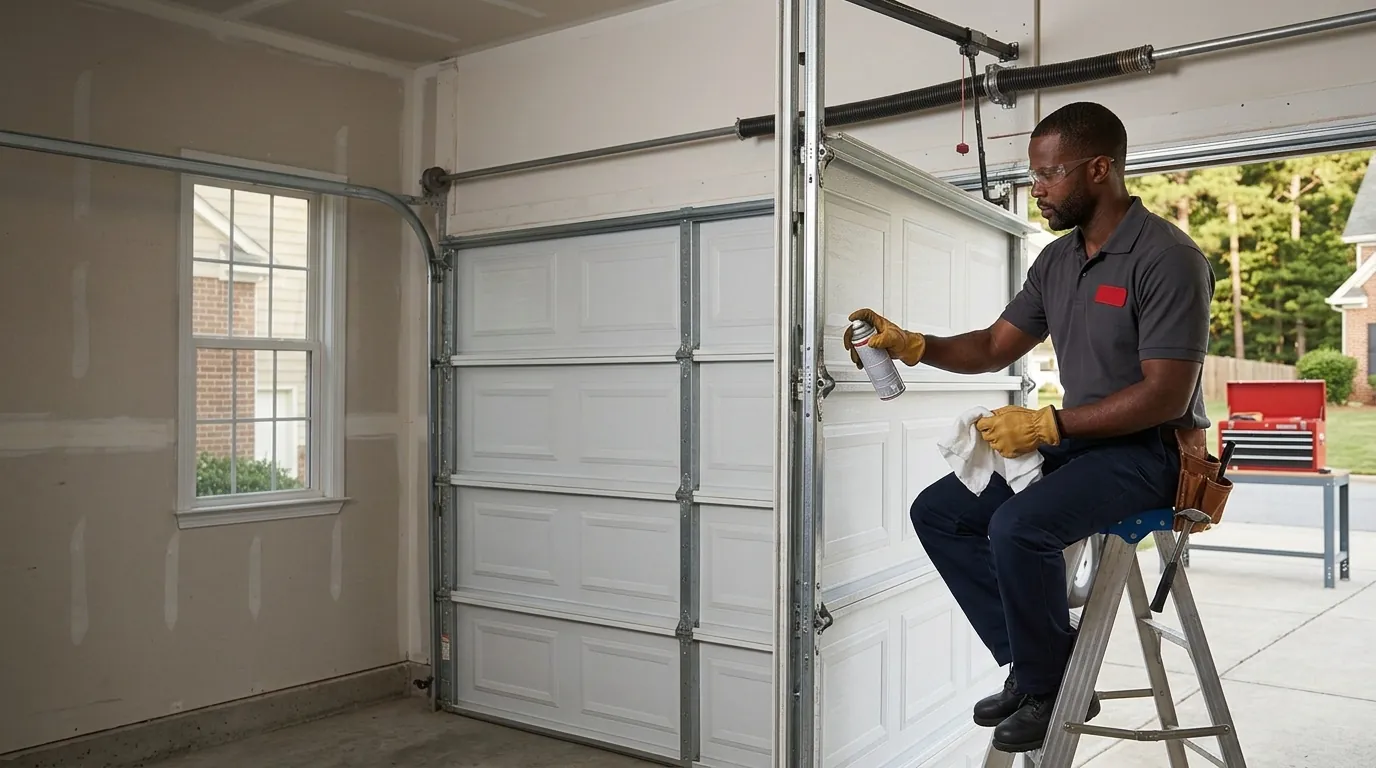
What does a garage door tune-up include?
A garage door tune-up includes a visual check of springs, cables, rollers, hinges and track, lubrication of the springs, hinges and bearings, tightening of non-tension hardware, a balance test, the auto-reverse and photo-eye tests, and a look at the bottom seal.
A tune-up is a scheduled technician visit for a door that still runs. It covers the door and the opener together, because a door that drags or sits out of balance strains the opener every cycle. The 8 checks run in this order:
Inspect the springs and cables
Springs, cables, drums and bottom brackets are checked for gaps in the coils, frayed strands and rust.
Inspect the rollers, hinges and track
Each roller is checked for wobble and cracks, each hinge for cracks, and each track section for bends and loose brackets.
Lubricate the moving parts
Springs, hinge pivots and bearings get the product the door or spring manufacturer specifies.
Tighten the non-tension hardware
Hinge, track and bracket fasteners that carry no spring tension are snugged down.
Test the balance
With the opener disconnected, the door is raised by hand and released halfway. A balanced door holds about 3 to 4 ft above the floor.
Test the auto-reverse
The door closes on a 1-1/2 in object at its center and has to reverse on contact.
Align and test the photo-eyes
The beam sits no higher than 6 in above the floor, and breaking it reverses a closing door.
Check the bottom seal and the opener settings
The seal is checked for cracks and flat spots, and the opener’s travel limits and force are set to the door.
Spring adjustment is the one step that touches spring tension. It happens only when the balance test shows the door drifting up or down, and it stays with the technician.
Door due for a tune-up? Call (833) 752-1196. Calls booked by 12 pm, Monday to Saturday, get a same-day visit, with no trip fee anywhere in our North Carolina service area.
Do garage doors need regular maintenance?
Yes. Springs, cables and rollers wear with every cycle, and DASMA ties spring cycle life partly to regular lubrication. Scheduled checks find a fraying cable, a seized roller or a door losing balance while the door still runs, before a part fails with the door open.
- Standard spring rating
- 10,000 cycles, where one cycle is one opening and one closing.
- Lubrication and spring life
- DASMA TDS 190 lists lubrication among the factors that decide how many cycles a spring reaches.
- Balance
- A balanced door, released halfway with the opener disconnected, holds about 3 to 4 ft above the floor (DASMA TDS 167).
A door run 4 times a day uses about 1,460 cycles a year, so a 10,000-cycle spring reaches its rating in about 7 years. Cables, rollers and the opener run the same cycles. A tune-up catches the early signs: a spring that stretched, a cable with a broken strand, a roller that stopped turning.
Which garage door parts need lubrication?
The torsion or extension springs, the hinge pivots and the bearings on the shaft and rollers need lubrication, using the product the manufacturer specifies. Spring lubrication is part of the technician tune-up; hinge pivots and open roller bearings are the owner-safe points.
| Part | Lubricate? | Who |
|---|---|---|
| Torsion or extension springs | Yes, with the product the spring manufacturer specifies | Technician, at the tune-up |
| Hinge pivots | Yes | Owner or technician |
| Shaft bearings | Yes | Technician |
| Open roller bearings | Yes | Owner or technician |
| Sealed-bearing nylon rollers | Sealed at the factory; follow the roller maker’s guidance | Technician |
| Opener chain or screw | As the opener manual states | Owner |
Springs sit on the torsion shaft above the door or along the horizontal tracks, and they hold the door’s full weight. Spring lubrication stays inside the technician visit, because the springs carry that weight under full tension. Hinge pivots and open roller bearings are reached from the floor with the door closed and the opener unplugged.
What garage door safety checks can you do each month?
Each month, run 3 owner-safe tests: close the door on a flat 2×4 to confirm it reverses, break the photo-eye beam to confirm it reopens, and look over the springs, cables and rollers. Leave any adjustment to springs or cables to a technician.
Close the door on a flat 2×4
Lay the board flat at the center of the opening and close the door with the opener. The door reverses on contact.
Break the photo-eye beam
Pass an object through the beam while the door closes. The door stops and reverses to fully open.
Look at the springs, cables and rollers
Look for a gap in a spring’s coils, frayed cable strands and rollers that tilt or stop turning.
Listen to a full cycle
Grinding, scraping or a bang during travel points to rollers, track or a spring.
Springs, cables, bottom brackets and spring anchors stay technician work. They hold the door’s full spring tension.
A door that fails either reversal test is a safety repair: keep people and cars clear of it and book a technician. Since June 1, 2026, North Carolina home inspectors report any opener that does not reverse, or that has no photo-eyes, under 11 NCAC 08 .1107, so a failed test also shows up at a home sale.
How do coastal and mountain conditions change garage door maintenance?
Coastal salt air pits spring wire and shortens its cycle life, so coastal doors get closer spring and cable checks, while wide mountain temperature swings affect screw-drive openers. Statewide, hurricane season runs June 1 to November 30.
- Coast
- Saline air pits spring wire with rust, and the pits start the cracks that end a spring’s life early (DASMA TDS 190). DASMA advises keeping coastal doors closed where possible.
- Hurricane season
- Before a storm, close and lock the door, disconnect the opener once the door is locked by hand, and skip homemade bracing (DASMA TDS 192, 152).
- Wind-driven rain
- Sectional doors are not watertight: rain driven by wind enters at the section joints, the sides and the bottom (DASMA TDS 1503). Bottom and perimeter seals are checked before the season.
- Mountains
- Screw-drive openers are sensitive to temperature where the seasons swing widely (Genie), so the opener’s travel and force are rechecked as the weather turns.
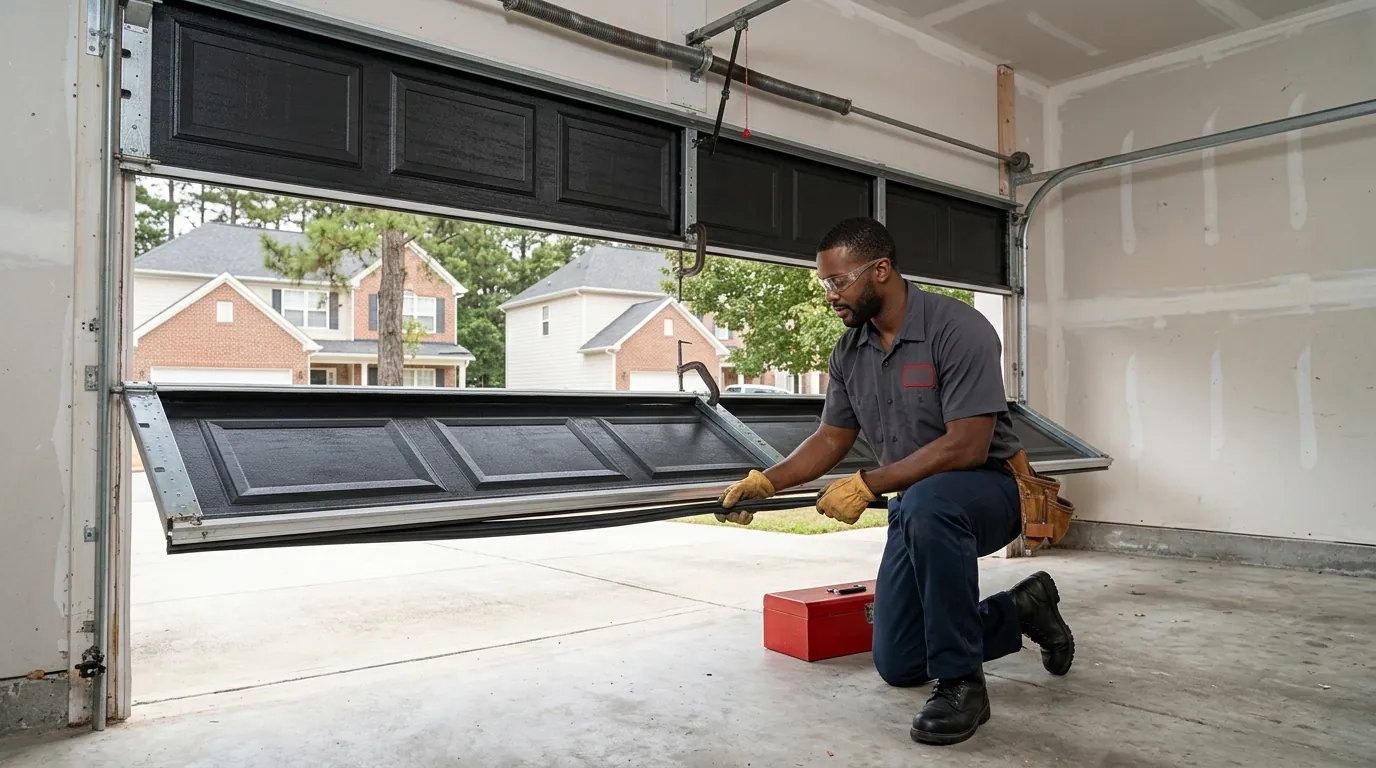
A worn bottom seal shows as daylight or drafts under the closed door, cracks in the rubber or a seal pressed flat. In Wilmington, New Bern and the rest of the coast, that seal is the first line against storm water.
What affects the cost of garage door maintenance?
Tune-up cost depends on how many doors and openers are serviced, whether the springs need re-balancing, and which worn parts, such as rollers, seals or cables, the visit uncovers. Any repair found is priced before any work starts.
Door count
One door or two, and a single or double width.
Opener service
Each opener’s travel limits, force setting and reversal test.
Spring re-balancing
An adjustment when the balance test shows the door drifting.
Worn parts
Rollers, seals, hinges or cables the inspection finds.
There is no trip fee anywhere in our North Carolina service area. The technician gives you the price before any work starts, and the work starts only when you say yes. Call (833) 752-1196 or book a garage door tune-up.
A tune-up ends in one of two ways: a door signed off, or a list of worn parts.
What happens when a tune-up finds a worn part?
A worn part found at a tune-up is shown to you, priced, and replaced on the same visit only when you say yes. Tired springs, frayed cables and cracked rollers are the usual finds; each has its own repair service.
The technician points to the part, explains what it does and states the price for the fix. Small parts such as a cracked hinge or a flattened seal are priced the same way, and the full process to repair broken garage door parts follows the same diagnose, price and test order.
A spring with a stretched coil or a door that no longer holds its balance moves to garage door spring repair, where both springs are matched to the door’s weight. Wobbling, cracked or seized wheels move to garage door roller replacement, which swaps the full set.