
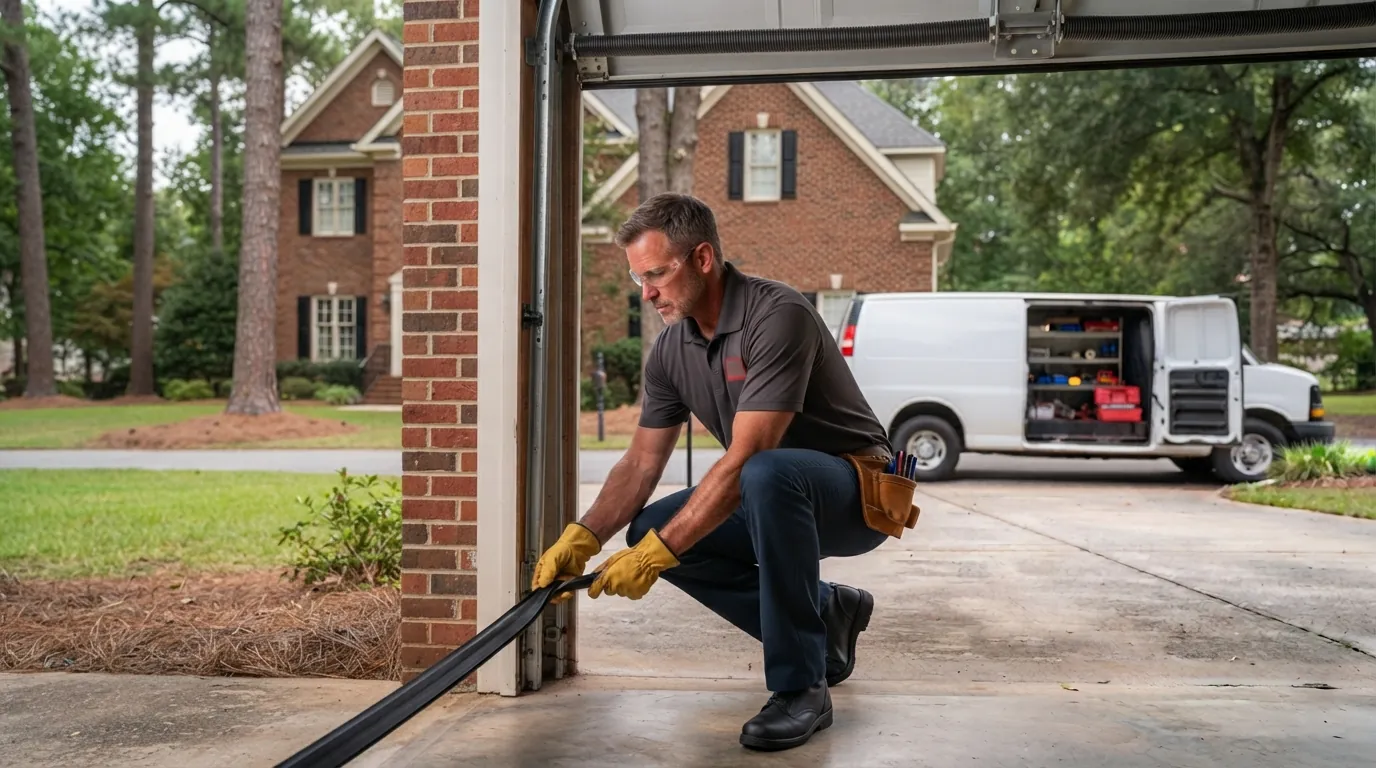
Which ways into your garage does garage door repair in Matthews close?
A closed garage door is as secure as 6 parts: the opener’s radio code, the emergency release, the closing controls, the windows, the manual lock and the tracks that seat the door at the floor. Each part is a way in, and each traces to a repair the technician prices before any work starts.
| Way in | What you notice | Repair |
|---|---|---|
| Opener radio code | Small switches inside the remote, or a remote gone missing | Rolling-code opener, cleared remote memory |
| Emergency release | A release cord hanging close to the top of the door | Trolley arm checked; the release stays |
| Door left open | The door found open in the morning | Timer-to-close or Wi-Fi retrofit |
| Windows | Clear glass showing cars, tools and the release cord | Frosted glass insert or solid section |
| Manual lock | A slide lock still fitted on a door with an opener | Lock disabled or removed |
| Closing and tracks | A door that stops short, reverses or sits crooked | Photo-eyes, close limit, track repair |
Door stuck open and it is getting dark? Keep people and cars clear of the opening and Call (833) 752-1196. Night or weekend, a person picks up.
Does your opener use rolling code or DIP switches?
Most openers sold before 1995 used a fixed code set with a row of 9 or 12 DIP switches; a rolling-code opener sends a new code on every press and discards the old one. Genie dates its own move to rolling code to 1995.
A DIP switch is a tiny on-off slider, set to one pattern in both the remote and the opener, so every press sends the same code. DASMA, the door manufacturers’ association, reported that rolling code arrived in the fall of 1994 to stop thieves who recorded a remote’s signal and played it back. Chamberlain’s rolling code picks from more than 100 billion codes and never repeats one; Genie calls its version Intellicode.
On Chamberlain and LiftMaster openers, the learn button on the motor unit dates the system: white, gray or yellow with a red light means DIP switches (1984 to 1993), green means Billion Code (1993 to 1997), a fixed code with no switches, and orange, red, purple or yellow with an amber light means Security+ rolling code. The rolling code lives in the opener’s receiver as well as the remote, so a fixed-code opener stays fixed-code whatever remote it pairs with. The route is an opener with rolling-code security. A remote lost from a car is a smaller job: remote and keypad reprogramming clears the opener’s memory and pairs only the devices you hold. A technician carries remotes and keypads, programs them on the visit, adds a HomeLink bridge or a second opener when a car needs one, and erases the old remote codes there and then.
Can someone open a garage door from outside with a coat hanger?
Yes, on some doors: a hooked wire pushed through the gap between the top section and the header catches the emergency release cord and disconnects the door from the opener. The fix keeps the release working, because the release is a safety device.
The emergency release is the red handle on a cord hanging from the trolley, the carriage that rides the opener’s rail. DASMA’s checklist (TDS 167) cites UL 325, the opener safety standard: a red handle no more than 6 ft above the floor. Chamberlain’s way to work the garage door emergency release from outside is a keyed exterior kit, which disconnects the opener but does not lift the door.
A 2003 article in DASMA’s Door & Access Systems magazine describes the hooked-wire method. Genie advised mounting the trolley arm at a 45-degree angle, which places the release farther from the door, and warned against altering the cord. So the cord is never tied up, cut short or zip-tied. A technician checks the trolley arm, the trolley and the release handle, and prices any change before any work starts.
Can a garage door close by itself when it is left open?
Yes, on openers with a timer-to-close feature, which closes a sectional door after a set time, and on app-connected openers that send an alert when the door opens. Unattended closing depends on photo-eyes that are installed and aligned.
Photo-eyes are the 2 sensors near the floor whose beam reverses a closing door when broken. LiftMaster’s 881LM control panel closes the door after 1, 5 or 10 minutes, works only with sectional doors, and stays off on battery power or with misaligned safety sensors; after 2 obstructions the timer switches off. Genie’s Aladdin Connect app alerts you when the door opens or closes, closes it after a set time or at a set time each night, and gives sound and light signals before the door moves.
A technician can retrofit Wi-Fi on an opener that lacks it, so the alert reaches your phone. No timer fixes a door that will not close at night; that is a repair, with emergency service 24/7.
Do the windows in your garage door show what is inside?
Clear glass in a garage door shows cars, tools and the release cord to anyone standing in the driveway. Window film or blinds cover it from the inside, and a technician can swap only the glass for a frosted insert, leaving the section in place.
Genie’s burglary tips list blinds or window film. When the glass is the only problem, the insert alone is swapped. When the whole panel should go, a technician fits a solid or frosted-glass section and leaves the rest of the door in place.
Should a garage door with an opener still have a slide lock?
No. On a door with an opener, the manual slide lock is disabled or removed, while a manual door with no opener keeps its lock in use. DASMA’s inspection checklist asks whether the manual lock on an automated door is disabled.
A slide lock is a steel bar on the inside of the door that slides into a slot in the track. DASMA (TDS 192) states that manual locks are typically disengaged, disabled or removed when an opener is installed, and that an opener run against a locked door can damage both.
The lock, hinges, rollers and the auto-reverse test are covered in a lock and hardware check on a tune-up. The door from the garage into the house is a house-door lock, outside garage door repair.
Why won’t your garage door close all the way?
A garage door that stops short, reverses at the floor or hangs crooked has misaligned photo-eyes, a wrong close limit, a sticking or binding door, or rollers out of their track. Each cause leaves the garage open, and the last one needs a technician.
Chamberlain names photo-eye misalignment as a common cause. The close limit, also called the down travel limit, sets where the door stops at the floor, and a wrong setting interferes with the safety reversal, so every adjustment ends with the reversal test against a 2×4 laid flat.
A door pried at the bottom or struck by a car bends a track or pops rollers out of it, while the springs and cables still hold its weight. Keep clear, unplug the opener, and leave a door forced or bent out of its track to a technician.
What does a home inspector report on a garage door opener?
Since June 1, 2026, a North Carolina home inspector must report an opener that does not reverse on resistance, a door that does not reverse when the photo-eye beam is blocked, and an opener with no photoelectric device. The rule is 11 NCAC 08 .1107, and it governs home inspectors.
Those findings echo the 1993 federal entrapment rule for openers (16 CFR 1211, UL 325), so an opener older than that is the likeliest to be flagged. Matthews’ median home dates from 1994, and a house from the 1980s can still hold its first opener. Remotes are outside the inspection. A technician runs the reversal and photo-eye tests, repairs or replaces what fails, and leaves a written service record for the closing file.
When were Matthews homes, and their garage door openers, built?
Matthews’ median home was built in 1994, and 45.4% of its housing units date from 1980 to 1999, against 18.1% built before 1980. An opener original to a house from those decades dates from before or around the industry’s move to rolling code in the mid-1990s.
- Median year built
- 1994 for Matthews’ housing units (ACS 2020-2024 5-year).
- Built 1980 to 1999
- 45.4% of 12,588 units: 23.1% from the 1980s and 22.2% from the 1990s (ACS 2020-2024 5-year).
- Built 2000 or later
- 36.6% of units, including 20.9% built in 2010 or later (ACS 2020-2024 5-year).
- Owner-occupied
- 64.4% of occupied homes; 61.9% of units are single-family detached (ACS 2020-2024 5-year).
Matthews is a town in southeastern Mecklenburg County and a suburb of Charlotte, incorporated in 1879 and named for Edward Matthews, a director of the Central Carolina Railroad.
What sets the price of a garage door security repair?
A Matthews garage door security repair is priced by the way in and the part behind it, from cleared remote memory to a rolling-code opener, a frosted section, a lock removal or a track repair. Each repair is priced by the way in before the work begins.
Opener coding
Reprogramming a rolling-code opener is a smaller job than replacing a fixed-code one.
Glass or section
A frosted insert swaps the glass alone; a solid section is matched only while the maker still builds the model.
Track damage
A bent track is a larger job than rollers reseated in a straight one.
The visit carries no trip fee. Third-party figures are in garage door repair costs in NC.
Can a technician see a Matthews door that will not close today?
Call before 12 pm, Monday to Saturday, to book a same-day inspection visit anywhere in Matthews, from downtown to the I-485 interchanges. The technician checks each way in, names the price and waits for your approval.
The line never closes, and emergency service runs 24/7 in every city we serve.
Downtown Matthews to Hemby Bridge: the southeast Mecklenburg and western Union County towns covered
Technicians who work in Matthews cover the town from downtown to I-485, and the towns around it:
- Downtown Matthews
- Mint Hill
- Stallings
- Indian Trail
- Hemby Bridge
- Lake Park
Service visits cover these Matthews zip codes:
- 28104
- 28105
Matthews meets Charlotte on its northwest and southwest sides, where homeowners call for Charlotte garage door service. Southeast along US 74, 14 mi on, see garage door repair in Monroe.