
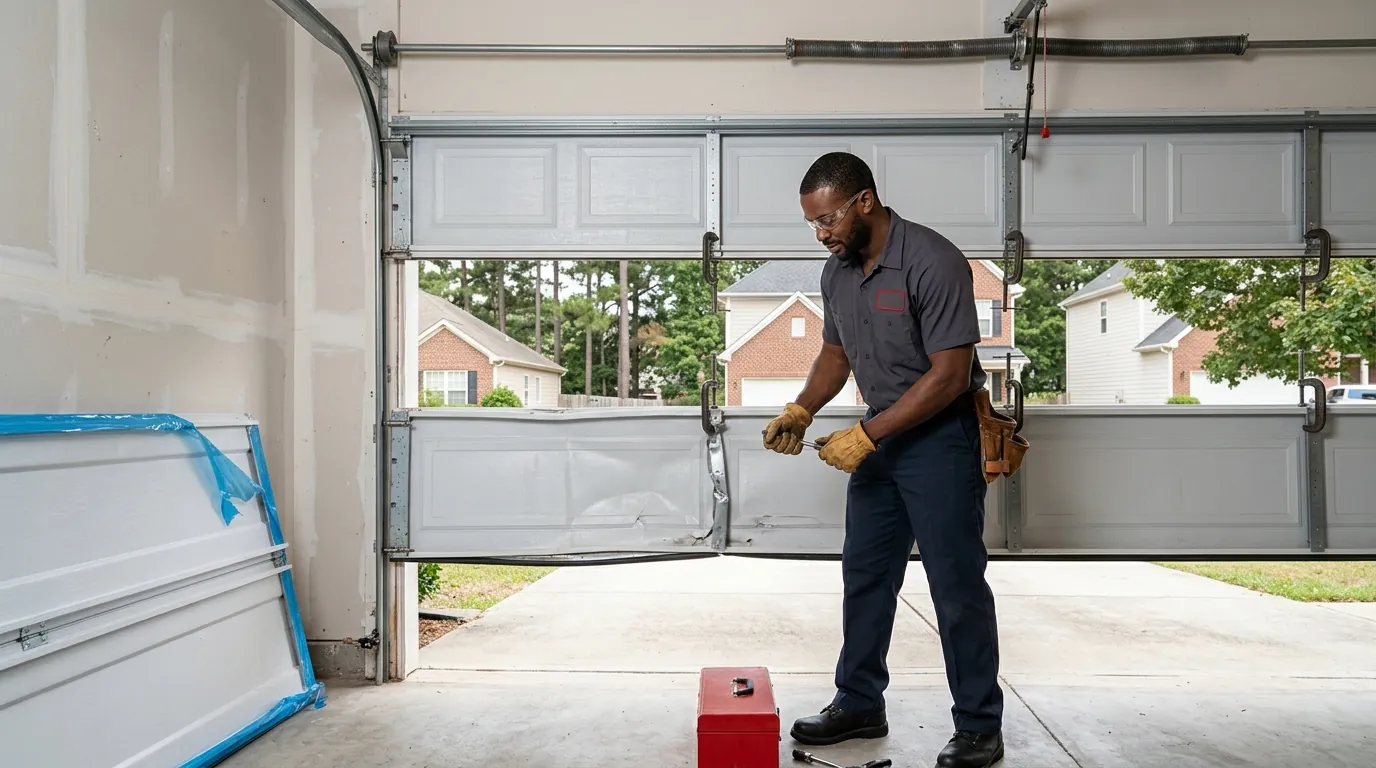
Can one garage door panel be replaced?
Yes, one garage door panel can be replaced when the manufacturer still makes a section in the same model, width, height and color. The new section takes over the old one’s hinges and strut, and the springs are re-balanced for the door’s new weight.
Sections are not interchangeable between brands or even between models of one brand: the hinge positions, joint profile and section height differ. The match starts with the label on the inside of the door, which names the manufacturer and model. A photo of that label can be sent before the visit, so the technician knows the model on a call for broken garage door panel repair in Cary or anywhere else.
Model
The manufacturer still builds the same door model, so the joint and hinge holes line up with the sections above and below.
Size
The new section matches the door’s width and the old section’s height, commonly 21 in on a 7 ft door.
Color
The factory color and panel design (raised panel, flush or carriage-house look) are still offered.
Rating
On a wind-rated door, the section comes from the same rated model listed on the door’s wind-load drawing.
Which kinds of panel damage need a new section?
A new section is needed for a crease or bend that stops the panel flexing at its hinges, a crack or split skin, rust that has eaten through the steel, or a top section bowing where the opener pulls on it. Shallow cosmetic dents stay.
| Damage | Common cause | Fix |
|---|---|---|
| Crease or bend | A car bumper or a trailer backing into the closed door | New section; a bent section binds at the hinges and strains the opener |
| Crack or split skin | A sharp impact, or a thin skin flexing over years | New section; water and cold get behind the skin |
| Rust-through | Standing water against the bottom section, or salt air near the coast | New section, usually the bottom one, with a check of the bottom brackets |
| Top-section bow | An opener arm pulling on a top section with no strut | A strut on a section that is still straight; a new section once it has kinked |
| Shallow dent | A ball, a bike or a bumped bin | Cosmetic; the door runs as before and the section stays |
Door creased, cracked or binding after a bump? Leave the opener off so it does not drag a bent section through the track. Call (833) 752-1196 and a technician checks whether a matching section still exists, with no trip fee.
Can a cracked window or a sagging top section be fixed without a new panel?
Yes. A cracked window is fixed by replacing only the glass pane or the window insert, and a top section that sags where the opener pulls is reinforced with a steel strut, provided the section has not kinked. Both repairs keep the original section on the door.
Glass pane or insert
The cracked pane, or the whole window insert, is replaced on its own while the section stays on the door.
Strut on the top section
A horizontal steel strut bolts across a bowing top section, so the opener arm pulls on the strut instead of the thin skin.
Paint to the HOA color
A new or repaired section, or the whole door, is painted to the color your HOA approved.
Parts for older doors
Hinges, rollers, struts and brackets are sourced for discontinued door models; the matching section is the part that runs out.
What is a garage door section made of?
A garage door section is a steel, wood, aluminum or composite panel with end stiles for the hinges, and on insulated doors a foam core between two skins. Most residential doors carry 3 to 8 sections, such as four 21 in sections on a 7 ft door.
Each door stacks four kinds of section: the top section (where the opener arm attaches), intermediate sections, a lock or window section, and the bottom section with its weatherseal and cable brackets. Hinges join each section to the next.
- Skins
- Steel in 24, 25 or 27 gauge, wood, aluminum or composite. A lower gauge number means thicker steel: 24-gauge resists dents better than 25 or 27.
- Core
- None on a single-layer door; polystyrene or polyurethane foam on 2- and 3-layer insulated doors, sealed between the outer and inner skins.
- Stiles
- The vertical steel ends and centers of each section, where the hinges and roller brackets bolt on.
- Strut
- A horizontal steel brace across a section that stops it sagging. The top section carries one wherever an opener is fitted, and wide doors carry more.
- Section height
- 18, 21 or 24 in, set by the maker; a 7 ft door commonly stacks four 21 in sections.
- Section count
- 3 to 8 per door, set by door height and the maker’s section size.
How is a garage door panel replaced?
A garage door panel is replaced by identifying the model from the door’s label, ordering the matching section, and swapping it with the door closed and secured. The bottom section is changed only after the technician releases the cable tension; the door is then re-balanced.
Identify
Read the manufacturer and model from the door’s label, and on a wind-rated door the wind-load drawing number.
Order
Order the matching section in the same width, height, design and color.
Secure
Close and secure the door, and unplug the opener.
Swap
Move the hinges, rollers and strut onto the new section. A bottom section waits until the technician has released the cable tension.
Re-balance
Set the springs for the new section’s weight, so a released door holds about 3 to 4 ft above the floor.
Test
Run the door through full travel, then check balance and the opener’s auto-reverse.
No trip fee. The visit to look at a damaged section carries no trip fee.
Price first. You approve the price for the section and the labor before the old section comes off.
Warranty. The new section carries the manufacturer’s warranty.
When is a new garage door better than a new panel?
A new garage door is the better route when the model is discontinued, 2 or more sections are damaged, the door is wind-rated and no rated section exists, or the old finish cannot be matched. A whole new door is measured and priced at the house, the same way a section is.
Discontinued model
No section from another model fits the joints and hinge holes of the old one.
Multiple damaged sections
Two or more new sections plus labor approach the cost of a whole door.
Rated door without a rated section
A non-rated section on a wind-rated door breaks the match with its wind-load drawing.
Unmatched finish
A stained wood or a discontinued color stands out on the street side of the house.
Half of Catawba County’s homes were built in 1985 or earlier, and many panel profiles from that era are no longer made, so a section search on those doors comes before any garage door replacement in Hickory and Conover.
When a whole door makes more sense, the quote covers measuring, the door options and the wind rating, and the swap follows the same process as any garage door installation.
What affects the cost of garage door panel replacement?
Panel replacement cost depends on which section is damaged, the door’s material, insulation and width, whether the manufacturer still stocks the model, and whether hinges, struts, rollers or a bottom bracket need replacing too. The quote comes before any work starts.
Position
Top, intermediate, window or bottom section.
Material and insulation
Single-layer steel through insulated or wood-look sections.
Width
A single-car or a double-car door.
Availability
Section in stock, special order or discontinued.
Hardware
Hinges, strut, rollers or a bottom bracket replaced alongside.
Third-party ranges for sections and other parts appear under typical garage door repair prices. For your own door, request a panel replacement quote or Call (833) 752-1196.
What else gets checked when a panel is damaged?
A damaged panel gets the track, rollers, hinges and lift cables checked too, because the impact that dented the section often bends a track or knocks rollers loose. Any damaged part goes on the same price, and the same checks run on every garage door repair service.