
How do technicians prepare a garage door for hurricane season?
Southport technicians prepare a garage door for hurricane season by replacing rust-pitted springs, hinges and cables, checking struts and brackets against the wind-load label and servicing the opener. The season runs June 1 to November 30 and peaks around September 10.
The work follows the calendar. One card covers the weeks before the season, one covers the hours before a storm and one covers the day after it passes.
Before June 1
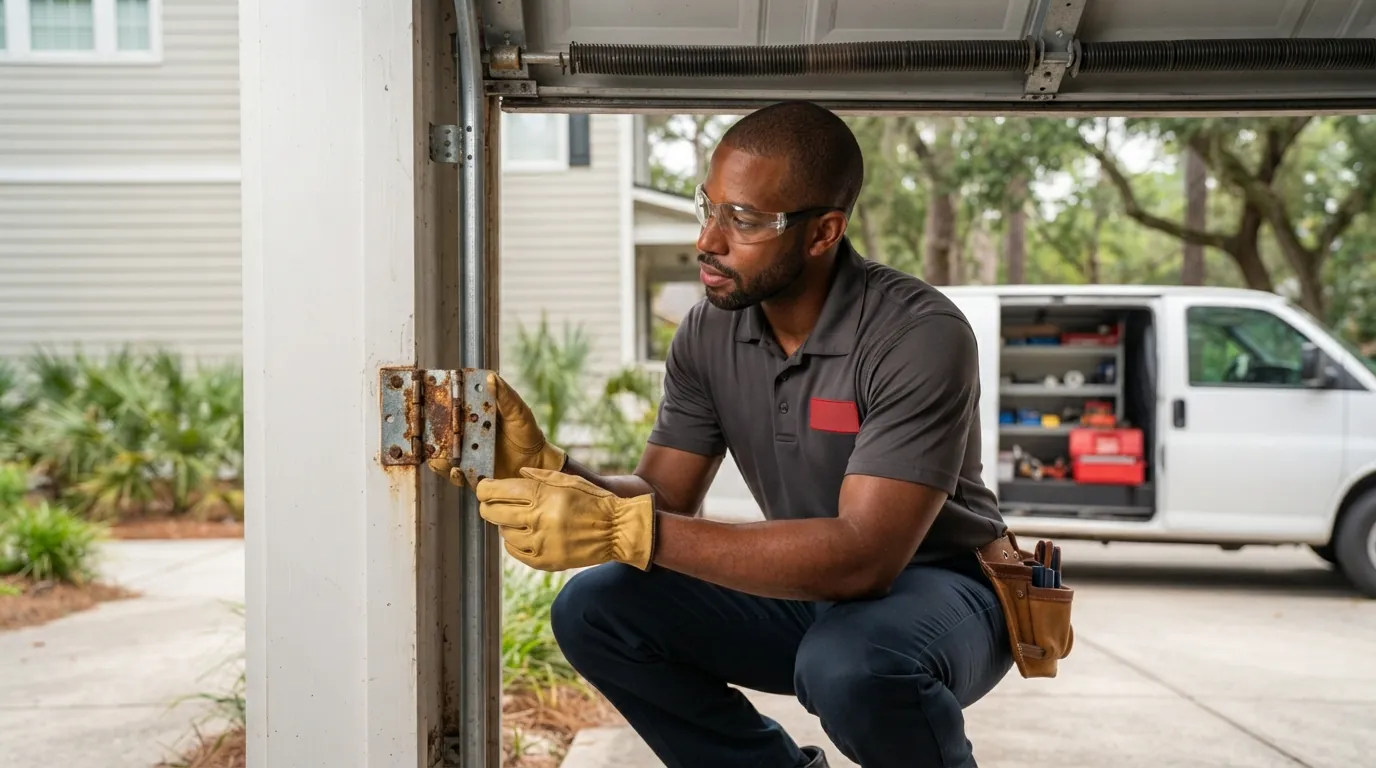
A technician replaces rust-pitted springs as a matched pair, swaps corroded hinges and rollers and checks both lift cables for rust at the bottom brackets. Struts and jamb brackets are compared with the door’s wind-load label. Weak battery backups, stripped drive gears and water-damaged boards get opener motor and gear repair before the season starts. A battery-backup opener can be fitted, so the door still moves when a storm takes the power, along with a surge protector for the returning current.
When a storm is forecast
Close and lock the door, then disconnect the opener while the door is locked. Keep cars from parking against it. Homemade bracing adds weight that overloads springs and track, so nothing is added to the door.
After the storm passes
Look for dents, bowed panels and bent track before running the door. Do not force a door that binds. A door jammed open by wind or held up by a failed cable is a garage door stuck open that needs a technician visit, and a deformed panel or track is replaced, not forced.
Door stuck, loud or leaning after weather in Southport? Keep it closed, keep the opener off and Call (833) 752-1196. Night or weekend, a person picks up.
What does salt air do to garage door springs and hinges?
Salt air corrodes garage door springs and hinges in Southport, and rust pits in spring wire speed up the fatigue cracks that end its cycle life. Galvanized coatings slow the rust but do not stop it; DASMA advises keeping coastal doors closed where possible.
A torsion spring is a coil of steel wire that twists a little on every lift. A pit on the surface of that wire is a place where a crack can start, and each cycle widens it. A spring that would reach its rated cycles inland can fail sooner in a house a few blocks from the river, the harbor or the Atlantic.
The same moisture works on the smaller parts. Hinge pins seize, rollers stiffen, and the galvanized lift cables fray first where they wind onto the drums and where they meet the bottom brackets. A door that groans, jerks or sits slightly crooked on a salt-exposed street is often telling you about rust in one of those places.
Rinsing is not repair. Pitted springs are replaced as a matched pair, and corroded hinges and rollers are swapped rather than oiled back into service. Technicians fit new threshold and side weatherstrip as well, because a cracked seal lets salt-laden air sit against the bottom section and its brackets.
Which garage door materials hold up to salt air near the river and the ocean?
Aluminum garage doors resist salt air most reliably because aluminum does not rust, and fiberglass doors resist salt corrosion but resist impact less well. Galvanized steel doors corrode over time near the coast; wood needs regular refinishing. Springs, hinges and cables are steel on every door, so they still need salt-air checks.
| Material | Salt-air behavior | Trade-off |
|---|---|---|
| Aluminum | Does not rust | Lighter, and dents more easily |
| Fiberglass | Resists salt corrosion | Less impact-resistant |
| Galvanized steel | The zinc coating slows rust | Corrodes over time near the coast |
| Wood | Does not rust | Needs regular refinishing |
What wind rating does a garage door need in Southport?
A Southport garage door is built for pressure, not just speed: Chapter 45 of the 2018 NC Residential Code lists 25 to 39 psf in its Table R4502(b), and the state fire marshal’s office allows DASMA TDS 155h to supply engineered alternates. At 150 mph, a 16 × 7 ft door on a single-story home in Exposure B is rated +16.7 and −18.6 psf; open waterfront sites need more.
- Prescriptive pressures
- Chapter 45 lists 30, 35 and 39 psf at 150 mph for roof heights of 15, 25 and 35 ft.
- Design pressure, 16 × 7 ft
- +16.7 psf pushing in and −18.6 psf pulling out, for a 16 × 7 ft door on a single-story home in Exposure B; a 9 × 7 ft door is +17.4 and −19.7 psf (DASMA TDS 155h).
- Exposure category
- Open ground raises the pressure: multiply by 1.49 for Exposure C and 1.81 for Exposure D at a 15 ft roof height (DASMA TDS 155h).
- Design wind speed
- 150 mph for Brunswick County east of US 17 and on Bald Head Island; 140 mph west of US 17 (2018 NC Residential Code, Table R301.2(4)).
A top section that has begun to sag gets a strut fitted across it. An inspector checks the door against its wind-load drawing, not the label alone: struts, hinges, rollers, track brackets and jamb fasteners all have to match (DASMA TDS 181). The local building department confirms the rating for an address, and a replacement door is chosen to meet it.
What do Brunswick County housing numbers say about door age?
Half of Brunswick County homes were built in 2002 or later, and 84.6% are owner-occupied (ACS 2020-2024 5-year). A door original to a median home is 24 years old, and the owner who lives there decides between a part and a new door.
- Median year homes were built, Brunswick County
- 2002, so the original door on half the county’s homes is 24 years old or newer, with salt air on it for most of that time.
- Owner-occupied homes, Brunswick County
- 84.6%: most doors here belong to the household that approves the repair.
Photos of the rusted part, sent before the visit, give the technician a first look. A homeowner who lives elsewhere can book a visit to an empty house and approve the price by phone before anything is touched.
What gets checked on a garage door after a storm?
After a storm, a Southport garage door gets a visual check for dented panels, bent track and loose brackets, then an operational check by hand and by opener. Any deformation stops the check; a technician repairs it before the door runs again.
Look first
Check for dents, bowed panels, bent track and loose brackets with the door closed.
Run it by hand, then by opener
Lift the door by hand with the opener disconnected, then reconnect the opener and cycle it once.
Stop at any deformation
A bend, a bind or a noise stops the check. Call a technician; do not force the door.
Sectional doors are not watertight, so wind-driven rain can still reach the garage floor through the section joints (DASMA TDS 1503). That is a property of the door design, not a sign of damage.
What decides the price of garage door repair in Southport, wind-rated replacements included?
The price of a Southport garage door repair depends on the corroded or failed parts, the hardware grade and the door’s size; a replacement adds material, design pressure and reinforcement. You approve the number before a tool comes out.
Corroded parts
Springs, hinges, rollers and cables priced by what the salt air has taken.
Hardware grade
Galvanized or heavier-duty parts for a coastal door.
Door size
A 16 × 7 ft door needs more than a 9 × 7 ft door.
Design pressure
A 150 mph rating asks more of a replacement door than a 115 mph one.
Reinforcement
Struts and bracket sets listed on the wind-load drawing.
The garage door installation cost guide lists third-party price ranges for new doors, and single-part repairs are covered under garage door repair costs across North Carolina. New doors are measured at your home before the price is given.
Oak Island, Bald Head Island and the lower Cape Fear towns we serve
Southport’s technicians cover the lower Cape Fear, from the barrier islands to the towns along NC 211 and NC 133:
- Southport Historic District
- Oak Island
- Caswell Beach
- Bald Head Island
- Boiling Spring Lakes
- St. James
- Bolivia
Up the river, see Wilmington garage door repair. Farther up the coast, the Jacksonville garage door technicians cover Onslow County.