
Which part of a garage door has failed: spring, cable, roller, track, opener or seal?
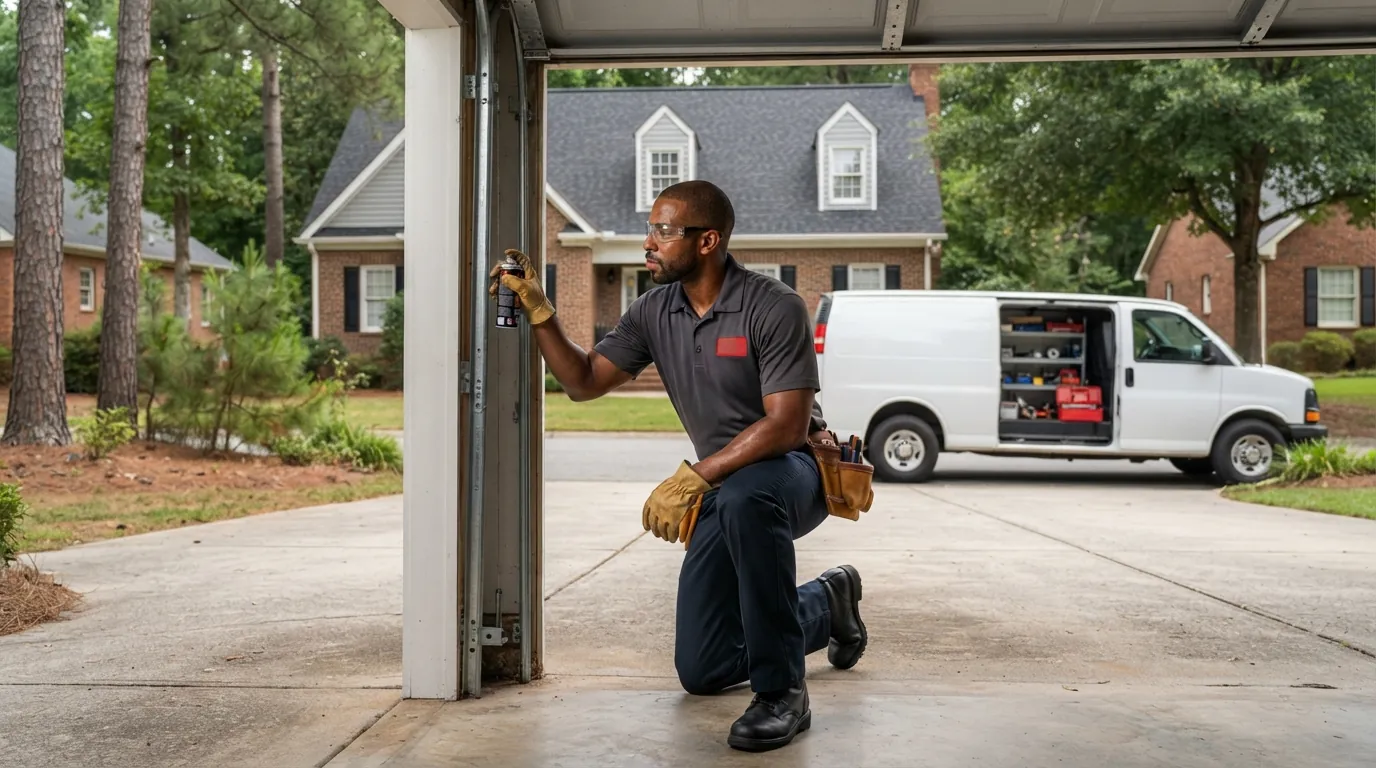
The failed part of a Burlington garage door is one of six: springs, lift cables and drums, rollers and hinges, tracks, the opener and its photo-eyes, or seals. A technician identifies it on site and prices that part before any work starts.
Springs
A torsion spring twists on a shaft above the door; extension springs stretch beside the horizontal tracks. A broken spring leaves the door too heavy to lift, and the technician replaces springs as a matched set, from stocked high-cycle springs when the door runs many trips a day.
Lift cables and drums
Galvanized 1/8 in cables run from the bottom brackets to the drums. Frayed or snapped cables are replaced in pairs; the technician can replace a snapped garage door cable and rewind both drums so the door sits level.
Rollers and hinges
Rollers ride in the track on bearings, and hinges join the sections and set each roller’s offset. Steel rollers wear flat and grind; sealed-bearing nylon rollers replace them and run quieter.
Tracks
Vertical tracks lean slightly back from the opening. A bent track, loose jamb brackets or a roller out of line stops the door; the track is straightened or replaced and re-fastened.
Opener and photo-eyes
Chain, belt and wall-mount jackshaft openers are repaired on site: drive gears, capacitors, logic boards, travel and force settings. Photo-eye lenses sit 6 in above the floor at most.
Seals
The bottom seal closes the gap at the floor, and T-style and bulb profiles fit different retainers and floors. Perimeter seals along the jambs block drafts and light.
Parts fail in chains. A broken spring drops the tension on the cables, and a slack cable lets the door leave its track. The technician names each failed part, gives a price for each, and you decide what goes ahead.
A bang, then a crooked door? Stay clear of it, unplug the opener and park the cars outside. Call (833) 752-1196. Calls are answered around the clock.
What is different about a single-bay garage door in Burlington?
A single-bay garage door is usually 8 or 9 ft wide and 7 ft tall, lighter than a 16 ft double, and lifted by one or two torsion springs or a pair of extension springs. Its parts are the same as a double door’s, in a smaller and lighter set.
- Standard single door size
- 8 × 7 ft, also 9 × 7 ft, against 16 × 7 ft for a double door.
- Torsion springs on a single door
- 1 or 2 on a shaft above the door. Enclosed torsion systems such as the Wayne Dalton TorqueMaster use one spring on a single door and two on a double, and the technician services them like any other spring.
- Extension springs on a single door
- 1 pair, one beside each horizontal track, color-coded for a door weight from 50 to 300 lb in 10 lb steps.
- Median year built, Alamance County
- 1988 (ACS 2020-2024 5-year), so half the county’s homes are 38 years old or older. 65.0% are owner-occupied.
A lighter door does not mean a lighter spring problem. The spring is matched to the door’s weight, and a spring from a heavier door will not balance it. The technician reads the wire size or the color code and fits the matching spring. Before a single-bay door is replaced, the opening is checked against the single garage door dimensions that standard doors come in.
Are extension springs on an older door safe?
Yes, extension springs are safe when a containment cable runs through each spring and is anchored at both ends. Without that cable, a breaking spring can fly loose across the garage. DASMA calls for the cable, and missing cables are fitted when springs are replaced.
Extension springs stretch along each horizontal track, and an older single-bay door often has them. They store force while the door is closed, which is why the technician handles the spring, the cable and the pulley as one set. Springs on the same door wear at the same rate, so a technician replaces the pair, not one.
The cable also protects the car and the shelves beside the door. When you hear a spring snap, leave the door alone and call a technician, who checks the safety cable before the new springs go on.
Can an old one-piece tilt-up door be repaired?
Yes, a one-piece tilt-up door is repaired by replacing its springs, arms or hinges and checking it against DASMA’s tilt-up inspection list. A warped panel or a frame without sound fastening points means replacing it with a sectional door.
A tilt-up door is one rigid panel that swings up and out on pivot arms, balanced by springs on each side. It turns up on older Burlington homes, and the technician works through DASMA’s inspection list (TDS 198) before touching a part, so the arms, springs, hinges and panel are all looked at, not only the one that failed.
Springs, arms and hinges are replaced on the door. When the panel has warped, or the jamb will not hold a fastener, a repair does not last, and the technician prices a sectional door for the same opening instead.
Does a sagging top section or a discontinued model mean a new door?
No: a sagging top section is braced with a strut, and parts or a section for a discontinued model are sourced before anyone suggests a new door. A new door becomes the answer only when the model is gone and its sections cannot be matched.
On a single-bay door the opener arm pulls on one spot of the top section, and years of that pull bow the steel. A strut, a reinforcing bar fastened across the section, stops the sag and protects the opener. Alamance County’s median home was built in 1988, so many Burlington doors are older models, and technicians source rollers, hinges, opener circuit boards and single sections for them while the maker still lists the part.
What shows that a roller, hinge or bottom seal has worn out?
A worn roller grinds or wobbles in the track, a worn hinge shows cracks or elongated holes, and a worn bottom seal lets daylight or water in at the floor. Rollers attached to the bottom brackets stay technician work because those brackets are under cable tension.
Grinding rollers
A steel roller worn flat grinds and shudders as the door travels. Sealed nylon rollers run quieter.
Cracked hinges
Cracks near the screws or holes stretched into slots let a section sag and the roller drift out of line.
Daylight under the seal
A bottom seal that has hardened, torn or flattened leaves a gap at the floor. T-style and bulb seals fit different retainers.
A door that stops at one spot
A door that halts at the same point on every trip has a bent track, a loose bracket or a roller out of line.
Look from the floor and do not touch the springs, the cables or the brackets at the bottom corners. Call a technician when you see any of the four signs.
Who measures, supplies and installs a new garage door?
Burlington homeowners get a new garage door measured, supplied and installed by a technician after an on-site measure and price. The door is sized to the opening, matched with new springs, track and seals and rated for Alamance County’s 115 mph design wind speed.
Measure the opening
The technician records width, height, headroom and sideroom, so the door and its hardware fit the opening and the ceiling.
Choose material and insulation
Steel, insulated steel and other materials differ in weight and in R-value, and the weight decides the springs.
Schedule the install
The old door comes out, and the new door goes in with matched springs, track, rollers and seals, then is balanced and tested.
Alamance County sits in the 115 mph inland zone of the 2018 NC Residential Code, a lower design wind speed than the 150 mph reached on parts of the coast, so Burlington is not a high-wind zone.
What makes the cost of Burlington garage door repair go up or down?
The cost of a Burlington garage door repair goes up or down with the part replaced, the spring type (torsion or extension), the door’s weight, the roller grade and whether an older part is still made. The technician names the price before work.
Part replaced
A bottom seal is a smaller job than a matched pair of springs or an opener logic board.
Spring type
Torsion and extension springs differ in parts, in the safety cable and in the labor to fit them.
Door weight
A heavier door needs heavier springs and cables.
Roller grade
Sealed nylon rollers with more bearings cost more than basic steel rollers and run quieter.
Parts availability
Technicians source parts for older and discontinued models, and a hard-to-find part adds to the job.
The visit carries no trip fee. Published third-party ranges show what garage door repairs cost part by part.
Burlington, Graham, Elon and the rest of Alamance County
Burlington’s technicians cover the whole of Alamance County and the Triad cities to the west. Technicians who work in Burlington cover the city and these neighboring areas:
- West Davis Street–Fountain Place Historic District
- Glen Raven
- Graham
- Elon
- Gibsonville
- Haw River
- Green Level
- Swepsonville
- Mebane
- Whitsett
Service visits cover these Burlington zip codes and nearby towns:
- 27215
- 27217
- 27201 (Alamance)
- 27202 (Altamahaw)
- 27258 (Haw River)
West of Alamance County, homeowners find Greensboro garage door technicians and Winston-Salem garage door repair, and High Point homes have their own page for garage door service in High Point.
East along I-40 and I-85, homeowners find Mebane garage door repair, and next door in the Alamance County seat there is Graham garage door repair. In the university town of Elon, homeowners find Elon garage door repair.