
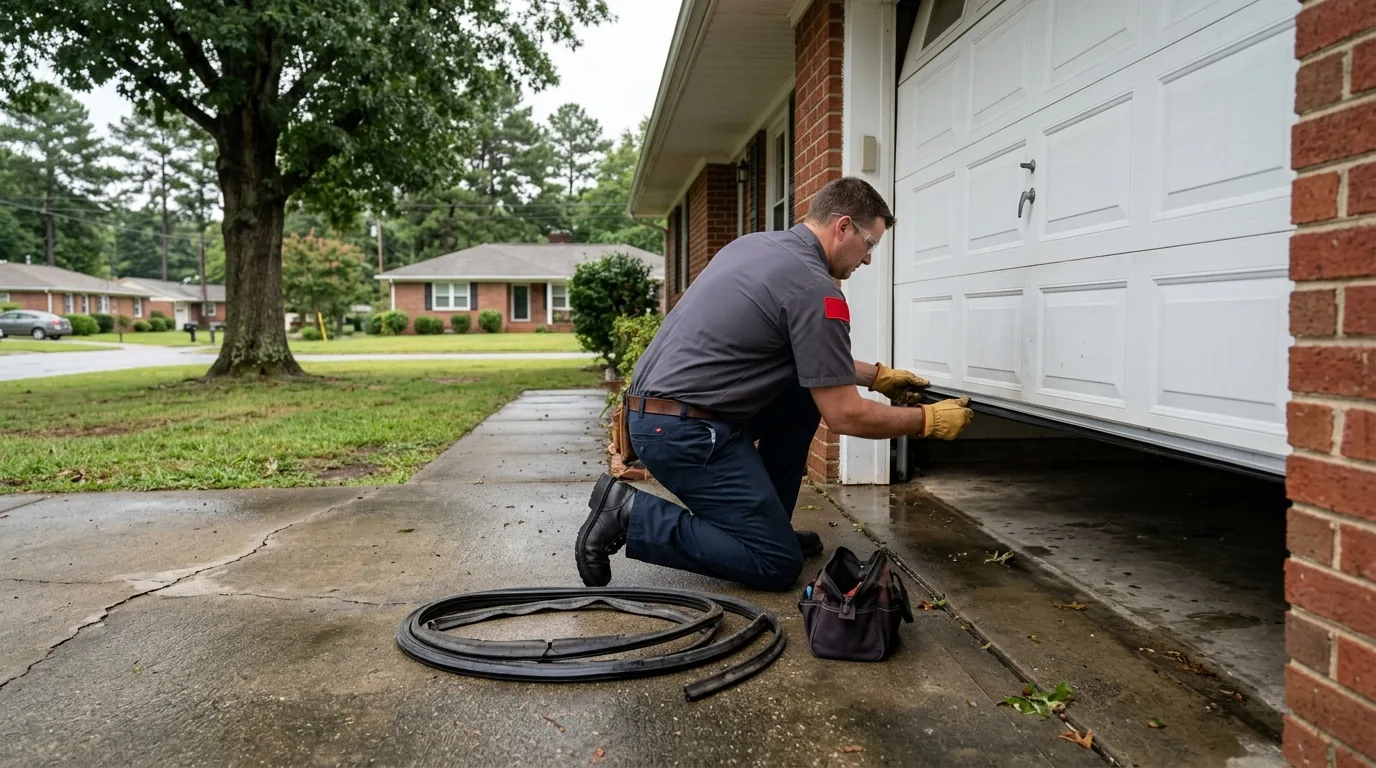
What is getting into your garage, and where does it get in?
Water, drafts, leaves, dust, mice and daylight reach a closed garage through 4 places: under the bottom edge, along the sides and top, between the sections, and through the door itself. Each entry point traces to one part, and the technician prices that part before any work starts.
Look from inside with the door closed and the lights off: daylight marks the gap.
| What you find | Where it gets in | Part that lets it in |
|---|---|---|
| Water pooled inside the door after rain | Under the bottom edge | Split bottom seal, settled slab, no threshold seal |
| Daylight or a cold draft along the floor | Under the bottom edge | Worn seal, door stopping short or hanging lower on one side |
| Leaves, dust or mouse droppings in a corner | Bottom corners | Torn seal ends, a dip in the slab |
| Light along the jambs or across the header | Sides and top | Hardened perimeter weatherstrip, door shifted off it |
| Wet streaks on the inside face of the sections | Between sections | Rain held in the joints |
| Rust or soft, dark wood along the bottom | The door itself | Bottom section that stood in water |
| A garage as hot or cold as outdoors | The door itself | Single-layer door, no insulation core |
Door hanging lower on one side, or a cable loose at a bottom corner? Keep the door closed, unplug the opener, and Call (833) 752-1196. Calls are answered around the clock, Sundays too.
Why is there a gap under your Graham garage door?
A gap under a closed garage door comes from a bottom seal that has flattened, cracked or torn, a slab that has settled or cracked below it, a door that stops short of the floor, or a door hanging lower on one side. Each cause has a different fix.
The bottom seal, also called an astragal, is the rubber or vinyl strip held in a metal retainer along the door’s lower edge. A threshold seal is a separate strip fixed to the floor under the door that dams water. An older slab that has settled or cracked leaves a dip the original seal no longer reaches; a taller profile or a threshold seal fitted to the floor fills it, while sunken or broken concrete is slab work, outside garage door repair. Profiles are compared in garage door weather seal replacement. A bent or rusted retainer is technician work, because its ends sit next to the bottom brackets that hold the lift cables under full spring tension.
A door that stops short of the floor has its down travel limit set too high. That limit also governs the safety reversal, so the technician resets it and retests the reversal. A door that sits crooked in its tracks points to a lift cable or spring, and no seal closes that gap.
Why does light show around the sides and top of a closed garage door?
Light along the jambs or header of a closed garage door means the perimeter weatherstrip has hardened, split or pulled away, or the door no longer presses against it. The perimeter weatherstrip is stop molding with a flexible flap, fixed along both jambs and the header around the opening.
Years of sun and temperature swings stiffen the flap until it stops flexing, and wind carries leaves and dust through the strip of daylight. Light along one jamb only means the door has shifted in its tracks or a track bracket has worked loose, and the door needs adjusting before any weatherstrip seals. Both seals are covered in a seal and hardware check on a tune-up, with lubrication, the balance test and the auto-reverse test. Technicians fit new side and top weatherstrip along both jambs and the header, and a threshold seal on the floor where the slab dips below the door, each priced before the work. Where the stop molding has rotted or the jamb or header sits out of square, the technician builds it out so the new strip meets the door evenly.
How does rain get between the sections of a garage door?
Rain gets between the sections when water collects in the joints of the closed door and runs to the ends, past the perimeter seal, or when strong wind drives it straight through. DASMA, the door manufacturers’ association, states that sectional garage doors are not watertight.
DASMA names 3 paths: water that drips in as the sections separate on opening, which is normal; water held in the joints that wicks to the ends of the door; and rain that strong wind forces through the sides, bottom and joints. Graham has a humid subtropical climate with rain through the whole year, so the joints see water in every season. Wet streaks on the inside face of the sections show it.
The joint profile is built into the sections, so a door that lets a steady stream through its joints is a replacement question. The technician prices the seals and adjustment against a tighter-sealing replacement door, and you choose.
Is the door itself letting water and cold into the garage?
Yes, when the bottom section has rotted or rusted from standing water, or when the door is single-layer steel with no insulation core. A rotted or rusted bottom section is replaced as one section, and an uninsulated door is replaced with an insulated model.
Water that sits at the threshold soaks the door’s lower edge first: a wood bottom section turns dark and soft, a steel one blisters and rusts along the retainer, and a new seal then has nothing sound to hold. When the maker still builds that model and color, a technician can replace a rotted or rusted bottom section and leave the rest of the door in place.
A single-layer door is one steel skin. An insulated door has a foam core of polystyrene or polyurethane between 2 skins, built in at the factory, so a new door is the usual route to an insulated garage; compare insulated replacement door prices. Seals still matter: gaps at the sides and bottom let air past any core.
Which opener faults make a door stop short of the floor or reverse on the way down?
An opener leaves a gap when its down travel limit is set too high, and it reverses a closing door when the photo-eyes lose alignment or the force setting is too low for a door that drags. Both read as a gap or a stuck door, and both are opener repairs rather than seal repairs.
A photo-eye is a sensor on each side of the door, about 6 in above the floor, that stops the door when something crosses the beam. A lens smeared with dust, or a bracket knocked a few degrees off line, sends the door back up before it reaches the floor; the technician cleans and re-aims both before touching the force setting. An opener made before 1993 has no photo-eyes at all, so on a Graham home from the 1960s or 1970s the technician tests the reversal against a 1-1/2 in object and prices a replacement unit if the old one cannot pass. A remote or wall keypad that stops responding is programmed or replaced on the same visit, and remote codes left from earlier owners are erased from the opener’s memory.
Which decades were Graham’s homes built in?
Graham’s median home was built in 1987, and 44.6% of its housing units were built before 1980, against a 1988 median across Alamance County. A garage slab and its seals from before 1980 have had more than 40 years to settle, crack and harden.
- Median year built
- 1987 in Graham and 1988 across Alamance County; 19.0% of Graham’s units were built in 2010 or later (ACS 2020-2024 5-year).
- Built before 1980
- 44.6% of Graham’s housing units, including 11.4% built before 1950 (ACS 2020-2024 5-year).
- 1950s, 1960s and 1970s
- 13.0% of units date from the 1950s, 10.1% from the 1960s and 10.1% from the 1970s (ACS 2020-2024 5-year).
- Owner-occupied
- 53.2% of occupied homes in Graham, against 65.0% across Alamance County (ACS 2020-2024 5-year).
- Single-family detached
- 65.8% of Graham’s housing units, and 25.6% of occupied homes have a householder who moved in during 2020 or later (ACS 2020-2024 5-year).
Graham was laid out in 1849 as the seat of the new Alamance County. The Graham Historic District covers 72 contributing buildings around Court Square, with the Alamance County Courthouse at its center. The North Main Street Historic District holds 101 contributing buildings dating from the 1850s to 1949 in a mostly residential part of the city.
Which parts change the price of a Graham garage door repair?
A Graham garage door repair is priced by the entry point and the part behind it, from a bottom seal insert or a retainer to perimeter weatherstrip, a travel-limit reset, a lift cable, a replacement section or a new door. Each part is priced on the spot, and you approve the number before a tool comes out.
Entry point
A bottom seal insert is a smaller job than a cable, a section or a new door.
Retainer condition
A bent or rusted retainer is replaced along with the insert it holds.
Weatherstrip run
New perimeter strip is cut for both jambs and the header, so a wider opening takes more of it.
Door width
A double door takes twice the length of seal of a single door.
Section availability
A bottom section is matched only while the maker still builds the model and color.
The visit carries no trip fee. Third-party figures show what garage door repairs cost statewide.
Can a technician look at a leaking Graham garage door today?
Yes. Calls booked by 12 pm, Monday to Saturday, get a same-day inspection visit anywhere in Graham, from Court Square south to Alamance Creek. The phone line never closes, and a door stuck open after dark gets emergency service, which runs 24/7 wherever we work. On the visit the technician inspects the gap, names the part and waits for your answer on the price.
Court Square to Saxapahaw: the Alamance County areas technicians cover
Technicians who work in Graham cover the city from its historic districts to Alamance Creek, and the Alamance County towns around it:
- Downtown Graham (Court Square)
- North Main Street
- Haw River
- Swepsonville
- Green Level
- Saxapahaw
- Mebane
Graham meets Burlington on its north and west sides, where homeowners call for garage door repair in Burlington. West along I-85, see Greensboro garage door service.