
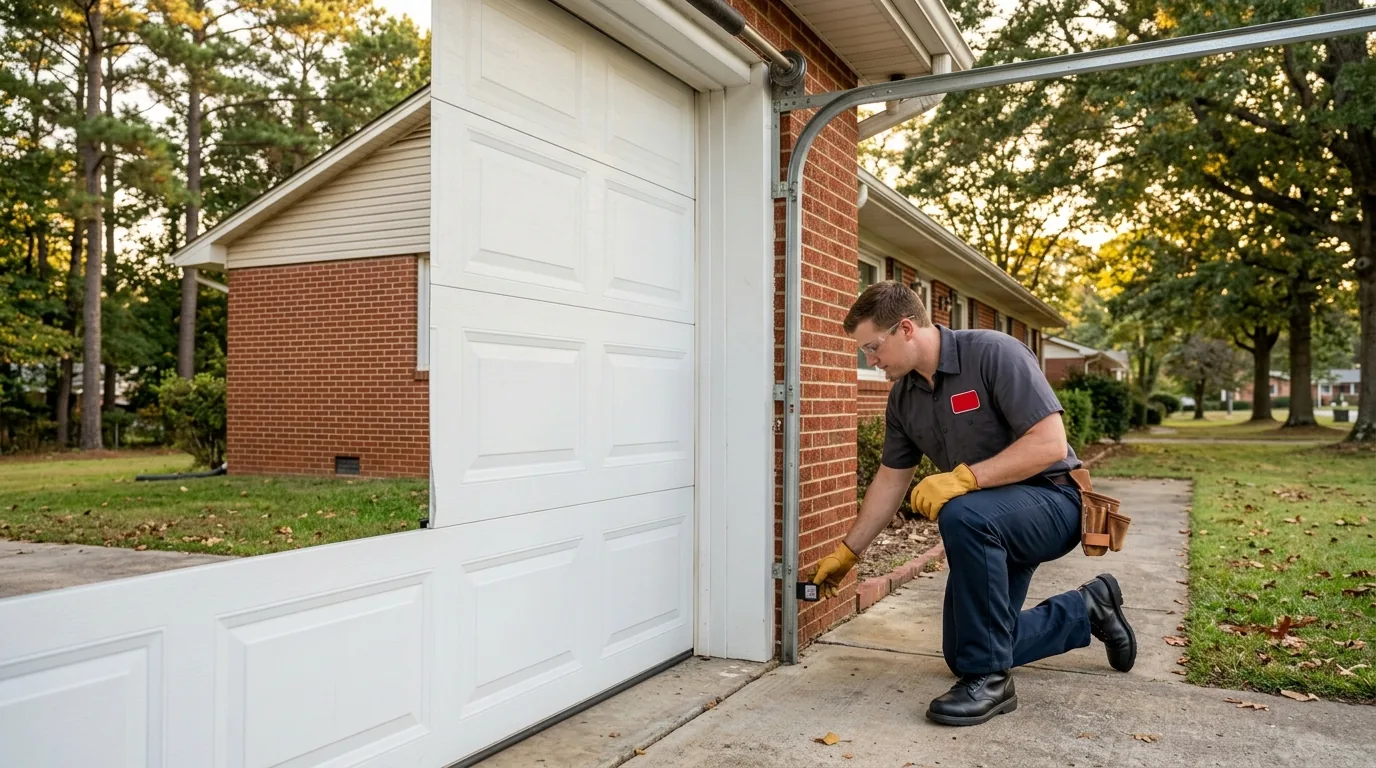
Which garage door checks are safe to do yourself?
Four checks are safe for a homeowner: the photo-eyes, the auto-reverse test, the balance test with intact springs, and the wall button and power cord. Springs, lift cables, bottom brackets, bent track and a door stuck partway are technician work, because they hold the door’s weight under tension.
Read the left column as a homeowner’s checklist and the right column as the part of the job that waits for a technician. The photo-eyes are the matched pair of sensors bolted low on either side of the opening; the invisible beam between them is what turns a closing door around. Stay out from under the door while you test.
| Safe for you to check | Technician-only work |
|---|---|
| Photo-eyes: clean lenses, steady indicator lights, and both sensors mounted no more than 6 in off the floor. The photo-eye alignment guide shows what a misaligned pair looks like. | Torsion or extension springs: winding, unwinding, adjusting or replacing them. |
| Auto-reverse: lay a 1-1/2 in board flat in the doorway; a closing door that meets it should turn back up. | Lift cables and bottom brackets, which stay under spring tension even with the door closed. |
| Balance, if the door is down and neither spring has failed: disconnect it from the opener, lift to 3 to 4 ft and watch whether it stays there. | Bent track, a door off its rollers or a door hanging crooked. |
| The wall button’s lock setting and the opener’s power cord. | The opener’s drive gear, circuit board or rail. |
| Visible wear on rollers and hinges, and gaps along the weatherstripping. | Any door stuck partway, open or crooked. |
Heard a bang, or is a cable hanging loose? Stop using the door, pull the opener’s plug and Call (833) 752-1196. Someone picks up at any hour, every day of the week.
When is it safe to pull the emergency release?
Use the red emergency release only on a fully shut door whose springs are both intact. Once a spring has broken, the opener alone carries a raised door, so disconnecting it sends the door to the floor. A door caught open stays open until the technician gets there.
In a Gastonia garage the red handle dangles from the trolley, the carriage sliding on the opener’s rail. One pull frees the door from the opener so it can be moved by hand, which is only harmless when three conditions hold:
Door fully closed
A shut door is already on the floor, so freeing the trolley moves nothing.
Both springs intact
A gap in a torsion coil, or an extension spring dangling slack, means nothing but the opener is supporting the door.
Door stuck open stays open
Do not lower a raised door yourself; keep family and vehicles clear and wait for the technician.
The guide on when the emergency release is safe to pull also covers what to do in a power outage and how the trolley is reconnected afterward.
Why are springs, cables and bottom brackets technician work?
Springs, lift cables and bottom brackets carry the whole door under tension, so one slipped tool or loosened bolt lets that stored energy go in an instant. A technician brings winding bars, clamps and parts sized to the door’s weight, and swaps springs as a matched pair.
The two spring designs matter more in a city with older housing. A torsion spring is a coil on a steel shaft over the door that winds tighter as the door comes down. An extension spring stretches alongside each horizontal track, and each one should have a safety cable running through its center, anchored at both ends, so a snapped spring stays put instead of whipping across the garage. Where an older door has an extension spring with no cable through it, the technician fits one. Lift cables tie the steel brackets at the bottom corners of the door to drums on the shaft.
Every one of these parts stays loaded while the springs hold tension, so this page points to why spring replacement is not a DIY job and gives no steps. The technician takes on broken spring replacement and snapped lift cable repair, then balances the door and runs the reversal test before packing up.
How old are Gastonia’s homes, and what does that mean for the door?
The median Gastonia home was built in 1978, and 52.4% of the city’s homes predate 1980. In a house that old, the garage may still have extension springs, which call for a safety cable through each one, or an opener from before 1993 that never needed photo-eyes.
- Median year built
- 1978 inside the city limits, 1982 for Gaston County as a whole (American Community Survey, 2020-2024 data).
- Built before 1980
- 52.4% of Gastonia’s housing units, with 14.8% dating from before 1950 (American Community Survey, 2020-2024 data).
- Owner-occupied
- 54.2% of occupied homes in the city, against 66.8% countywide (American Community Survey, 2020-2024 data).
- Federal opener rule
- Federal rule 16 CFR 1211 applies to openers made from January 1, 1993 onward: they must turn around within 2 seconds of hitting an obstruction and add a second safeguard such as photo-eyes.
Gastonia is the Gaston County seat and grew up around textile manufacturing, so a large share of its houses were framed before the 1993 opener rule existed. Age alone does not mean a door has failed; it tells the technician which older parts to look for first.
What does garage door repair in Gastonia involve on a 1970s-built home?
It often means a strut across a sagging top section, a safety cable fitted to an extension spring, and parts traced for a door or opener model the maker no longer builds. Gaston County’s median home dates from 1982, so a first door from that era is still common.
A strut is a steel stiffener along the inside of a section. The top section carries the opener’s pull, so it bows first, and the bow shows as a gap between sections or a door that binds in the track. A matching replacement section is ordered only while the maker still builds the model; when it does not, the technician measures the opening and gives a garage door replacement quote for a new door. Hinges, rollers and opener gears for discontinued models are traced by part number from the label on the door or the motor unit.
Which factors set the price of an older-home door repair?
Four things set the price of a Gastonia repair: which part failed, what the spring system and door weight demand, how much nearby hardware is worn, and whether matching parts can still be bought. The price is stated up front, ahead of any work, and no trip fee is added.
Failed part
One hinge or roller is a quick swap next to a spring pair, a cable pair or an opener gear.
Springs and door weight
A heavy door calls for stronger springs, and the extension springs common in older Gastonia garages bring safety cables with them.
Related wear
A spring that gave out after thousands of cycles can leave frayed cables or flat-spotted rollers behind it.
Part availability
Technicians source parts for discontinued section and opener models, and the extra sourcing changes the scope of the work.
Published third-party figures for each part sit on the page about garage door repair prices across NC.
What happens when you book the inspection visit?
A Gastonia home gets a same-day inspection visit when the call is booked by 12 pm, Monday to Saturday. That visit is for looking the door over and naming the price; repairs begin on your yes. The phone line never closes, and emergencies are covered 24/7.
Gastonia neighborhoods and Gaston County towns we cover
From the York-Chester and Brookwood historic districts to the Gaston County towns strung along I-85, US 29, US 74 and US 321, the same technicians cover:
- York-Chester
- Loray Mill
- Downtown Gastonia
- Belmont
- Mount Holly
- Cramerton
- Lowell
- McAdenville
- Ranlo
- Dallas
- Stanley
- Bessemer City
- Cherryville
- Crowders Mountain
Service visits cover these Gastonia zip codes and nearby towns:
- 28052
- 28054
- 28056
- 28164 (Stanley)
- 28032 (Cramerton)
- 28034 (Dallas)
- 28098 (Lowell)
- 28101 (McAdenville)
East along I-85, homeowners call for garage door repair in Charlotte. North in Lincoln County, see Denver garage door service.