
Can You Change Out Garage Door Springs Yourself?
No. DASMA says only trained technicians change out garage door springs. The job releases and re-applies the stored torque that holds a door in balance, using winding bars in a cone locked by set screws, with cables and brackets under tension. This guide explains what the job involves, why the injury risk is documented, and which safe checks a North Carolina homeowner can run from the floor.
Is replacing garage door springs a safe DIY job?
No, garage door springs are not a safe do-it-yourself job. DASMA, the door manufacturers’ association, tells homeowners not to remove, repair or adjust springs, cables or brackets, and directs that a trained door systems technician with proper tools and instructions do all spring work.
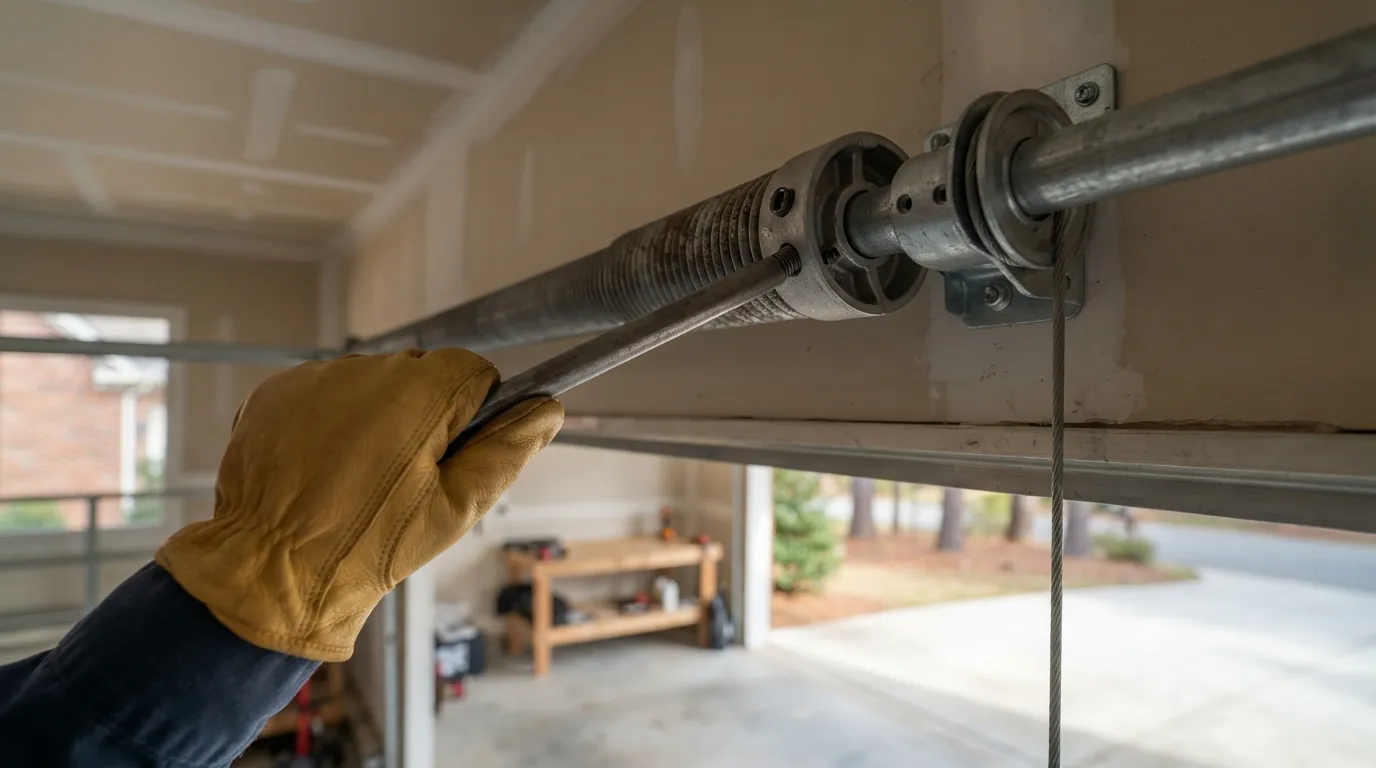
The rule is the same for torsion and extension springs and for every brand of door. North Carolina issues no garage-door-specific license, so the standard that applies is the industry’s own, set by the association whose members build the doors. Its guidance does not change because a video makes the job look short.
A torsion spring replacement by a technician covers both springs, the cone set screws and a balance test before the opener is reconnected. Hanging a whole new door carries the same stored energy, so garage door installation technicians release the old springs before the sections come down and wind new ones sized to the new door.
What does it take to change out garage door springs?
Changing out garage door springs involves taking the stored torque off the old springs, removing them from the shaft, fitting a matched pair and putting the torque back on with winding bars. Every stage happens with the springs, cables and bottom brackets under tension.
This page names the parts and what each one does. It gives no steps, because a list of steps is what turns a safety page into a how-to for the one job DASMA reserves for trained technicians.
- Stored torque
- The twisting force a torsion spring holds to balance the door. It is released from the old springs and put back on the new ones.
- Winding cone
- A cast fitting on the spring’s free end, with holes for winding bars and set screws that lock it to the shaft.
- Set screws
- Lock the winding cone to the shaft once tension is set.
- Winding bars
- Solid steel rods that fit the cone holes. They are the only means of holding the spring’s torque while it is changed.
- Lift cables and bottom brackets
- Carry the door’s weight to the springs. They stay under full spring tension, and DASMA’s checklist names them among the parts homeowners never loosen.
- Matched pair
- Springs matched on wire size, inside diameter, length and wind direction, with the door maker’s chart giving the winding for the door’s height and track radius.
The stationary cone and the center bearing plate hold the fixed end of the spring in place. The plate carries a warning label for the same reason this page exists.
Why are garage door springs dangerous?
Garage door springs are dangerous because they store enough energy to lift the whole door, and that energy releases at once when a spring, cone, cable or bracket slips. DASMA’s checklist warns that serious injury or death can result.
DASMA TDS 167: “Springs and spring hardware are under high tension. If a spring is broken, do not operate the door until the spring is replaced.”
DASMA’s damage-check sheet, TDS 174, adds that doors move with springs under extreme tension and can cause serious injury or death. The risk does not fall only on beginners. DASMA’s Technical Data Sheet 190 lists what goes wrong even for installers: a wrong turns count, a spring wound backwards and a cracked cast fitting from a dropped spring. Each is a safety issue, and each is why the work belongs to people who do it every week.
Extension springs carry the same hazard in another form. They stay stretched under load whenever the door is closed. How the two systems differ is covered under garage door extension springs vs torsion springs.
Call (833) 752-1196 if a spring has already broken. Leave the door closed and the opener off until a technician arrives.
What are garage door spring winding bars and tools?
Winding bars are solid steel rods, usually 1/2 in thick and 18 in long, that fit the holes in a torsion spring’s winding cone and hold its torque while tension is set. Door and spring makers’ installation instructions call for them by size.
A bar is not a screwdriver or a length of pipe. It fits the cone hole closely and is solid steel, so it does not bend under the spring’s torque. That is why DDM Garage Doors and the installation instructions of door makers specify bars by diameter and length instead of leaving the choice open.
Owning the bars does not supply the other half: the matched springs, the maker’s chart for the door and the trained hands. A homeowner who buys the tools has bought the equipment for the job, not the training DASMA names.
Garage door spring replacement: DIY or pro?
Garage door spring replacement is a job for a trained technician, not a homeowner. Homeowners handle the visual check, the balance test with the opener released, the monthly reversal and photo-eye tests, and lubrication; every task touching spring tension belongs to the technician.
DASMA’s guidance splits garage door spring tasks by one question: does the task touch stored spring energy? The table sorts nine common tasks by that question.
| Task | Homeowner | Technician only | Why |
|---|---|---|---|
| Looking at springs from the floor, door closed | Yes | — | Nothing is touched |
| Balance test with the opener released, springs intact | Yes | — | A DASMA consumer checklist item |
| Lubricating springs as the door maker instructs | Yes | — | A maintenance factor in DASMA TDS 190 |
| Monthly reversal and photo-eye tests | Yes | — | In DASMA TDS 167 and TDS 364 |
| Replacing torsion springs | — | Yes | Stored torque, winding bars, set screws |
| Replacing extension springs | — | Yes | Springs stretched under load |
| Adjusting spring tension | — | Yes | The same stored energy |
| Replacing lift cables or bottom brackets | — | Yes | Held under full spring tension |
| Replacing enclosed or drill-wound springs | — | Yes | A different tool, the same energy |
What can a homeowner safely check on garage door springs?
A homeowner safely checks garage door springs by looking at them from the floor with the door closed and by running DASMA’s balance test with the opener released. A door that stays 3 to 4 ft off the floor has working springs.
Visual check from the floor, door closed
Look for a gap in a torsion coil, rust or pitting, and frayed cable strands. Do not touch the springs, cables or brackets. The guide on how to tell if your garage door spring is broken describes each sign.
Balance test with the opener released
Pull the opener’s release, lift the door by hand to 3 to 4 ft and let go. A door that holds is balanced; one that drops or rises is not.
Monthly reversal test
With the door closing, a 1-1/2 in object laid on the floor in its path makes the opener reverse the door.
Monthly photo-eye test
Wave an object across the beam as the door closes. The door reverses when the beam breaks.
North Carolina rule 11 NCAC 08 .1107, effective June 1, 2026, requires North Carolina home inspectors to inspect garage door operators, including the reversal and photo-eye checks, so these are the same tests an inspector runs.
The other homeowner task is lubrication, the part of garage door spring maintenance done by spraying the coils without touching them.
When to call a technician for a spring replacement
The checks tell you what is wrong; the replacement itself goes to a technician. Call a technician when a coil has a gap, the door will not hold at 3 to 4 ft, or the springs have rusted or frayed. A technician brings the matched pair, the right bars and the maker’s chart for the door, and services enclosed TorqueMaster-style springs too.
The technician prices the spring job on the spot, then waits for your yes. A same-day inspection visit is available Monday to Saturday when you book by 12 pm. The bill carries no trip fee for a spring visit.
Call (833) 752-1196 or request a garage door quote online to book the spring visit. Calls are answered around the clock.
The torsion spring price depends on wire size, length, cycle rating and whether one or two springs are fitted; the torsion spring price page lists what moves it.
Next: how garage door spring tension is read with the balance test, and why only a technician adjusts it.