
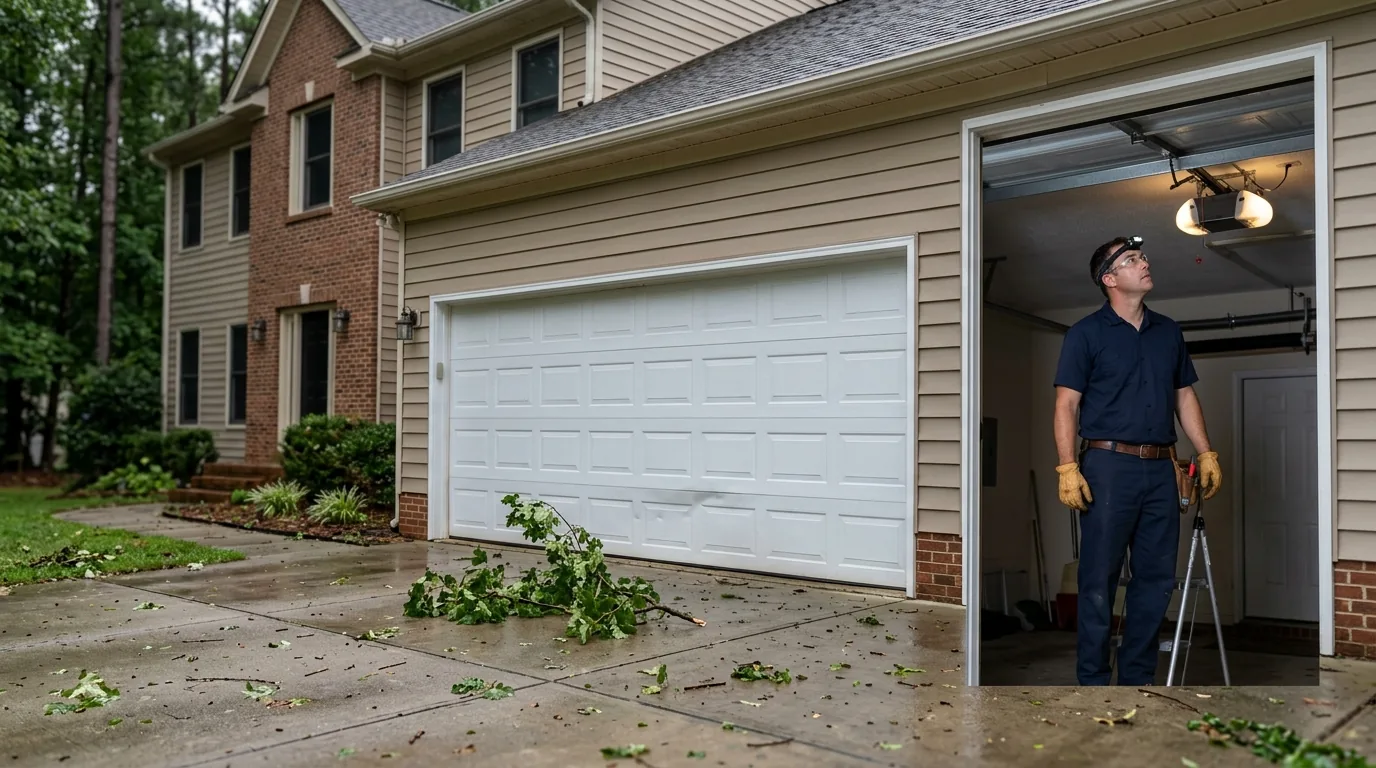
Can a garage door open by hand when the power is out?
Yes: a closed garage door with intact springs lifts by hand once the red emergency release cord disconnects it from the opener, because the springs, not the opener, carry the door’s weight. A door with a broken spring stays shut, and the cord is left alone.
The red cord that hangs from the trolley, the carriage that rides along the opener rail and pulls the door, is the emergency release for a garage door. Chamberlain’s instructions are to pull it only with the door fully closed, and never to use it to raise or lower the door: a released door with weak or broken springs falls rapidly and without warning.
A balanced door rises with steady hand pressure and stays where you stop it partway. A door too heavy to raise more than a few inches points to a broken spring or cable, and DASMA, the door manufacturers’ association, says to stop there. A technician replaces the springs that make a door easy to lift by hand, because springs under extreme tension are technician work only.
Door too heavy to lift, or a gap in a spring coil? Leave the door closed and Call (833) 752-1196. The line is staffed through the night, and emergency service runs 24/7.
Why is the garage door opener dead after a power outage?
An opener that runs after an outage but leaves the door still is usually disconnected from the trolley, and an opener that stays dark with power at the outlet has a failed part, most often the logic board. A released trolley re-engages on the next full open-and-close cycle.
The logic board is the opener’s main circuit board: it reads the remote, wall control and safety sensors and runs the motor. Chamberlain’s first check for a dark opener is the outlet: test it with a working 120 V device, check the breaker, and never run an opener from a switched outlet.
DASMA says to wait until power is restored before reconnecting the opener, then test the reversing feature. A technician checks the trolley latching on the rail, the door’s balance with the opener off, and the safety reversal before the door goes back into daily use.
What does a battery backup garage door opener do in an outage?
A battery backup opener switches to a charged battery when the power fails, so the door still opens from the remote, keypad or wall control without the release cord. Genie rates its add-on unit for up to 50 operations of the door in the 24 hours after a power loss.
The backup is built into the opener or added as a separate unit, and Genie’s add-on fits only certain models. A technician fits an add-on battery-backup unit to an opener that accepts one. On battery, the light stays off and the door moves more slowly. Both types recharge while the opener is plugged in; Genie says to test the backup every 6 months.
With 46.6% of Summerfield households keeping 3 or more vehicles, an outage morning often means more than one car behind a closed door. An opener with no add-on option is replaced with an opener with battery backup built in. A Wi-Fi retrofit then lets you confirm from your phone that the door closed behind you when the storm hit. The guide to what still works when the power drops sorts the opener, the remotes and the release cord.
Why did a thunderstorm knock out your garage door opener?
A power surge during a storm, or a nearby lightning strike, damages the opener’s circuit board, leaving a unit that stays dead with power at the outlet, works erratically, or ignores its remote and wall control. Genie lists an opener that opens on its own or stops halfway as a sign of surge damage.
Openers carry some built-in surge protection, and Chamberlain and Genie both sell plug-in protectors that add more. Chamberlain’s protector, made for its openers built after 1994, covers 3 paths into the opener: the AC power line, the door control panel on the wall and the safety reversing sensors, the photo-eyes at the foot of each track.
Repairing an opener knocked out by a power surge starts at the outlet and breaker, then the logic board, wall control and sensor wiring. A technician also fits a plug-in surge protector at the outlet, and can source parts for an opener or door model that is no longer made, so a repair stays possible on an older unit.
What should you check after a limb or high wind hits a Summerfield garage door?
Check the closed door from inside, by eye, for dented sections, bent track, loose brackets and slack cables, and lift it by hand only when nothing is bent. DASMA’s post-storm guidance says any deformed panel, track or hardware means stopping and calling a technician, because the springs still hold the door’s weight.
| What you see | What it means | Next step |
|---|---|---|
| A dent or crease across one section | A limb or debris bent the section | Keep the door closed; one section is replaced while the model is still made |
| Rollers out of the track, door crooked | Wind or a limb pushed the door off its track | Unplug the opener and keep clear |
| Track bent, or a bracket pulled from the jamb | The track system is out of line | Technician work: the track carries the door, and a split jamb is built out so the bracket has wood to hold |
| A loose or slack lift cable | The spring system has shifted | Do not touch it; cables hold spring tension |
| Door will not move, car inside | Damage, a jam or a broken spring | Call for 24/7 emergency service |
DASMA’s check runs in 2 parts. The visual part comes first, from inside with the door closed and a flashlight: alignment and broken glass, the jambs and header, the track, rollers, hinges and brackets, the springs by eye only, and the sections from both sides.
The operational part follows only when nothing looks wrong: disconnect the opener, lift the door a few inches, and stop if it is too heavy, binds or moves on its own. Do not run the opener while a limb rests against the door. Send photos of the damage before the visit. A technician can replace a section dented by a fallen branch, fit a strut across a top section the impact left sagging, re-hang a door pushed off its track by wind or a limb, or open a door stuck shut after a storm at any hour.
How do you get a garage door ready for high wind?
Close the door before high wind arrives and leave it closed, engage a manual lock only where the door came with one for wind resistance, and disconnect the opener while the door is locked. Guilford County’s design wind speed under the 2018 North Carolina Residential Code is 115 mph.
DASMA adds 3 rules. Do not park a vehicle against the door: it adds no reinforcement and can damage both. Do not add homemade bracing, because the extra weight can overload the track and the parts that carry the door. Do not run the door during high wind. Unlock the door before the opener runs it again, since an opener pulling against a lock damages both.
How does Summerfield’s housing differ from the rest of Guilford County?
Summerfield is almost all owner-occupied single-family houses: 96.6% of its housing units are detached homes, and 93.8% of occupied homes are owner-occupied, against 59.9% across Guilford County. Its median home was built in 2000, against 1987 across the county.
- Single-family detached
- 96.6% of Summerfield’s housing units, with none in buildings of 2 or more units (ACS 2020-2024 5-year).
- Owner-occupied
- 93.8% of occupied homes in Summerfield, against 59.9% across Guilford County (ACS 2020-2024 5-year).
- Median year built
- 2000 in Summerfield and 1987 across Guilford County; 49.4% of Summerfield’s units were built in 2000 or later (ACS 2020-2024 5-year).
- 3 or more vehicles
- 46.6% of Summerfield households, against 25.2% across North Carolina (ACS 2020-2024 5-year).
- Rural share
- 81.5% of Summerfield residents lived in rural areas at the 2020 census, across a town of 27.3 square miles.
The area was settled about 1769 as Bruce’s Crossroads and incorporated as a town in 1996. Its population grew from 2,051 in 1990 to 7,018 in 2000 as Summerfield turned from a rural farming area into a bedroom community.
What sets the price of garage door repair in Summerfield after a storm?
A storm or outage repair in Summerfield is priced by the failed part, from a trolley reconnection or a logic board to a spring, a lift cable, a length of track, one door section or a new opener. Each price is spoken aloud on site, ahead of any tool coming out.
Failed part
A trolley that will not latch is a smaller job than a surge-damaged board or a broken spring.
Parts availability
A board or a door section for a discontinued model takes longer to source, and the price of that part is stated before it is ordered.
Track and hardware
A door pushed off its track sometimes needs new track, rollers or brackets as well.
The storm call carries no trip fee. Third-party figures give repair price ranges across North Carolina.
When can a technician inspect the door after a storm?
A call booked by 12 pm, Monday to Saturday, gets a same-day inspection visit anywhere in Summerfield, from the Oak Ridge Road crossroads to the US 158 corridor in the north of town. Someone picks up at 2 am as readily as at 2 pm, and emergency service runs 24/7 in every city we serve.
Summerfield, Oak Ridge, Stokesdale and Browns Summit: where technicians work
Technicians who work in Summerfield cover the town from its historic crossroads to its northern edge, and the Guilford County communities around it:
- Summerfield crossroads (Summerfield Historic District)
- Oak Ridge
- Stokesdale
- Browns Summit
Service visits cover this Summerfield zip code:
- 27358
Summerfield is largely regarded as a suburb of Greensboro, where homeowners call for Greensboro garage door service. Farther south in Guilford County, see High Point garage door technicians.