
Are Insulated Garage Doors Worth It? R-Values Explained
An insulated garage door suits garages beside living space. Its foam core, polystyrene board or injected polyurethane, sits between steel skins and rates R-6.3 to R-20.4 on Clopay doors. North Carolina's energy code exempts garages on the same lot, so insulation is a choice made for comfort, noise and panel strength. This guide compares cores, R-value against U-factor, and retrofit kits.
What is garage door insulation?
Garage door insulation is a foam core, either rigid polystyrene board or injected polyurethane, built into each door section between the outer steel skin and an inner skin. It slows heat moving through the door, stiffens the panels and dampens operating noise.
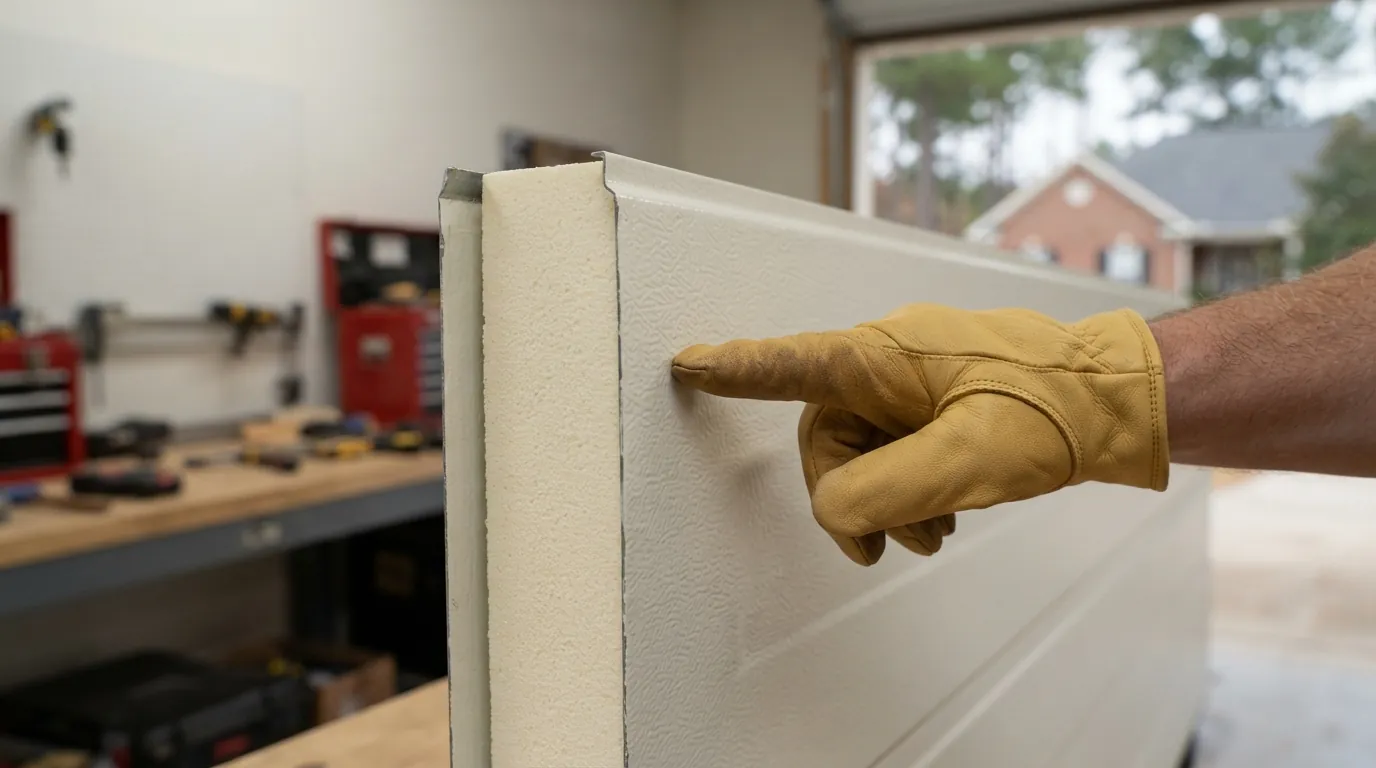
A three-layer door has an outer steel skin, the insulation core and an inner skin. A two-layer door has a skin and a foam backing, and a one-layer door is steel alone. Polystyrene arrives as a rigid board inserted into the section. Polyurethane is foam injected between the skins, where it bonds to them and adds structural strength, as Clopay describes it.
Insulation is built into the sections at the factory, so the usual route to an insulated door is to replace an old garage door with an insulated model.
What does R-value mean on a garage door?
R-value is the calculated thermal resistance of a single garage door section, based on the insulation’s type and thickness; the higher the number, the better it insulates. It ignores joints, seals and hardware, which the whole-door U-factor test captures.
- R-value
- Rates one section, by calculation from the insulation’s type and thickness. Higher is better.
- U-factor
- Rates the whole installed door, tested to ANSI/DASMA 105. Lower is better; it is the whole-door number.
- Not reciprocals
- DASMA’s TDS 163 states the two numbers cannot be compared by flipping one into the other.
- NC energy code
- Garages on the same lot are exempt (G.S. 143-138(b19)), so a door’s insulation is optional.
- Worked example
- In DASMA’s own calculation, a 22 in polyurethane section works out to R-16.47.
The calculation adds the thermal resistance of the air films on both faces to the insulation’s thickness divided by its conductivity. The steel skins add almost nothing, so the foam sets the number. That is why a door with a thicker core, or a denser one, rates higher.
A section’s R-value is a good number for comparing two doors. It is not a promise about the finished garage, because gaps at the sides and bottom let air through whatever the core is.
Which garage door insulation is right: polystyrene or polyurethane?
Polyurethane is the better insulator: at the same 1-3/8 to 2 inch thickness, Amarr’s polyurethane doors rate R-13.35 to R-19.40 against R-6.48 to R-9.05 for its polystyrene doors. Polyurethane also bonds to the skins and adds strength.
Clopay’s steel lines show the same spread: its polystyrene Canyon Ridge Elements door rates R-6.5, and its polyurethane Canyon Ridge Carriage House doors rate R-18.4 and R-20.4 in four and five layers. Each figure is that manufacturer’s own, so another maker’s door rates differently.
| Attribute | Polystyrene | Polyurethane |
|---|---|---|
| Form | Rigid board inserted in the section | Foam injected between the skins, bonded to them |
| R-value at 1-3/8 to 2 in (Amarr) | 6.48 to 9.05 | 13.35 to 19.40 |
| Strength | Adds little | Adds structural strength (Clopay) |
| Noise | Dampens | Dampens more, because it is denser |
| Price direction | Lower | Higher (Clopay); the cost page has the figures |
Insulated vs non-insulated garage door: what changes?
An insulated garage door adds a foam core and usually an inner skin, which slows heat transfer, stiffens each section, and runs quieter than a single-layer steel door. A non-insulated door is lighter and suits detached garages used only for parking.
Temperature control
The foam core slows heat moving through the door, in summer and in winter.
Panel stiffness
The core and inner skin make each section stiffer than a single sheet of steel.
Quieter operation
Both foam types dampen noise, and polyurethane, the denser, dampens more.
Door weight
The core and inner skin add weight over a single-layer door, and the springs are sized to the door’s weight.
Price direction
An insulated door costs more than a single-layer door, and polyurethane adds more than polystyrene.
Can you insulate a garage door after installation?
Yes, retrofit kits fasten foam or reflective panels to the inside of an uninsulated door, but the result has no tested whole-door rating. The added weight changes the door’s spring balance, so the springs need a check after the kit goes on.
An insulation kit adds weight the springs were not sized for. DASMA TDS 190 notes that adding components to a door can push it past the springs’ rating; a technician rebalances the door.
A kit adds some insulation to bare steel, which is better than none on a door that is otherwise sound. It is still a different product from a factory core: the panels sit on the inside of the sections instead of bonding between skins, and no test rates the door and kit as one assembly.
Balance is the part to watch. A door that feels heavier or drifts down from half-open after a kit goes on is out of balance, and spring adjustment is technician work.
Does North Carolina’s energy code require garage door insulation?
No. North Carolina’s residential energy code exempts attached and detached garages on the same lot (G.S. 143-138(b19)), so a garage door has no insulation requirement. Insulation is a choice made for comfort, noise and panel strength.
Is insulation worth it on a North Carolina garage?
Insulation is worth it in North Carolina when the garage is attached, sits under living space, or is used as a workroom, because summers here are very warm and humid. A detached parking-only garage gains little.
NOAA’s state climate summary describes North Carolina’s climate as humid with very warm summers. An attached garage shares at least one wall with the house, according to C.H.I. Overhead Doors, so heat that enters the garage reaches the living space. A garage under a bedroom, or one used as a gym or workshop, makes the difference easiest to notice.
This page puts no number on energy savings, because no verified source gives one for North Carolina. The mechanism is what holds: the core slows heat flow, and R-value works in both directions.
Gaps under and around the door are closed by bottom seals and weatherstripping, not by the panel core.
When to call a technician about garage door insulation
Insulation is ordered with the door, so the choice lands with the installer. Call a technician when a door feels heavier or drifts after an insulation kit goes on, or when an old door is being replaced with an insulated model. Spring balance and new-door sizing are technician work.
Nothing is fitted until you approve the price of the insulated door. For a same-day inspection visit, book by 12 pm, Monday to Saturday; the visit carries no trip fee.
Call (833) 752-1196 or ask for a quote on an insulated door online.
Core type and layer count are among the price factors on the garage door replacement cost page.